Author: Administrator

  • Zoomlion Intensifies Disinfection and Disinfestation Exercise in Oti Region

    Zoomlion Intensifies Disinfection and Disinfestation Exercise in Oti Region

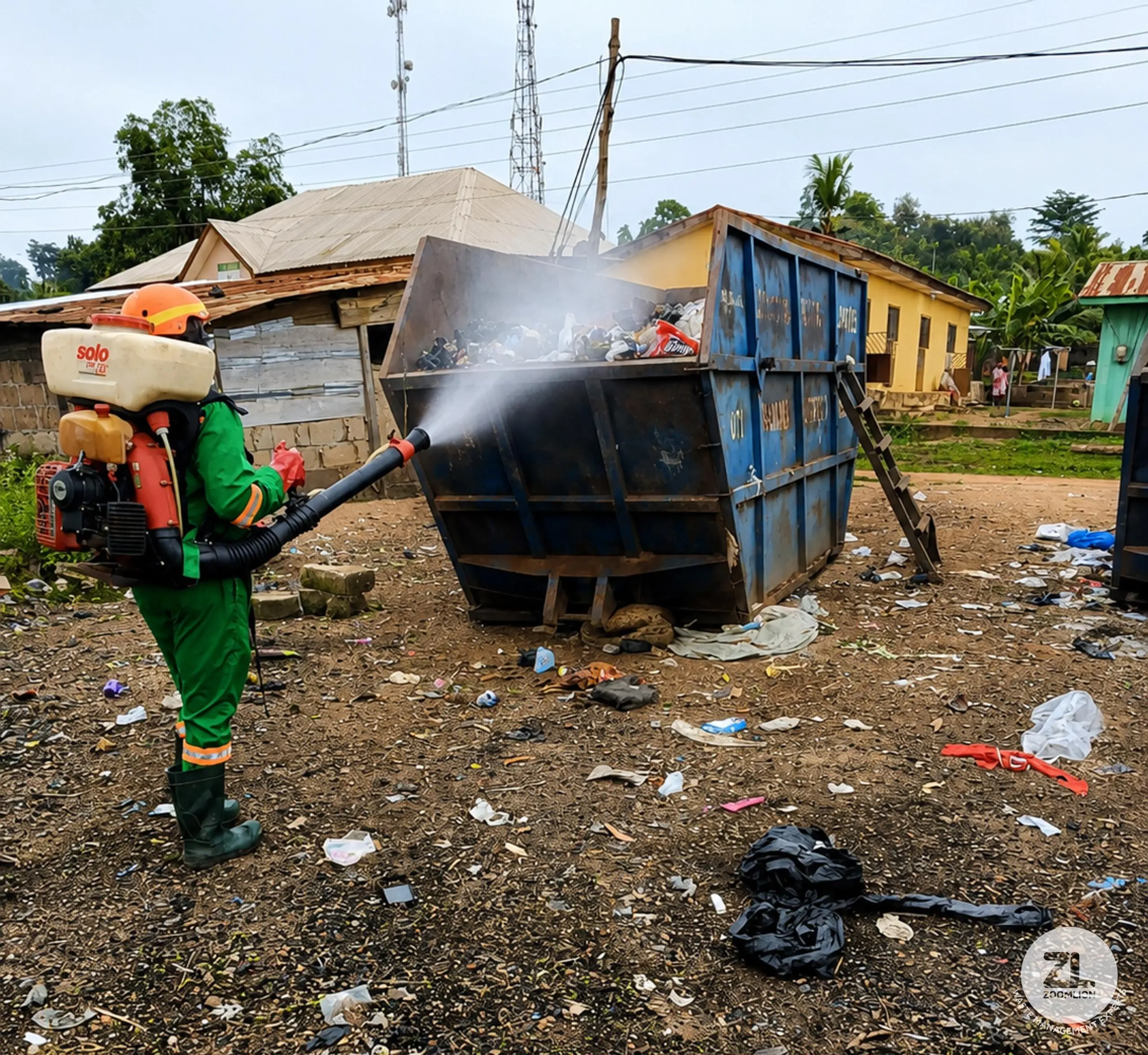
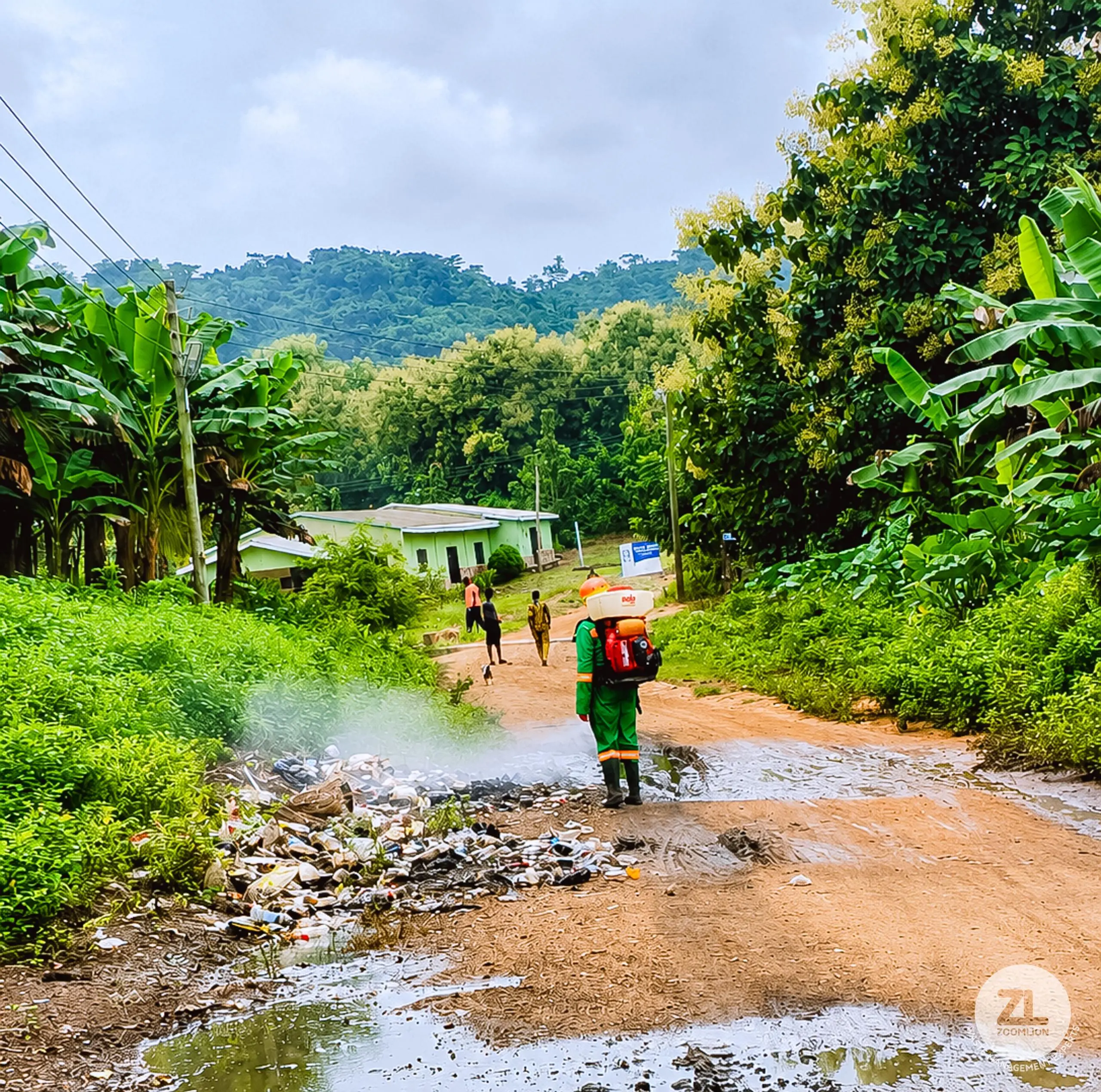
    Zoomlion Ghana Limited has intensified its seven-day disinfection and disinfestation exercise across the Oti Region as part of efforts to prevent disease outbreaks and improve environmental sanitation following recent flooding in parts of the country.

    The exercise, which commenced simultaneously in the Krachi East and West Municipalities, is expected to cover all nine Municipal and District Assemblies (MDAs) in the region. It is being undertaken in collaboration with the respective Assemblies, which have identified priority areas requiring the intervention.

    The exercise targets markets, shops and sheds, public toilets, drains and gutters, refuse container sites, waste-dumping areas, flood-prone communities and other public spaces considered potential breeding grounds for disease vectors and harmful pathogens.

    Speaking to the media during the exercise, the Oti Regional Manager of Zoomlion Ghana Limited, Mr. Joseph Buabeng, said the intervention formed part of the company’s Corporate Social Responsibility (CSR) and its broader commitment to protecting public health and supporting local authorities in addressing sanitation challenges.

    He explained that the intervention went beyond conventional fumigation to include comprehensive disinfection and disinfestation aimed at controlling disease vectors, reducing harmful pathogens and mitigating the risk of waterborne and other communicable diseases associated with flooding and poor sanitation.

    “Our objective is to protect residents from diseases that commonly emerge after flooding. We do not want to wait until there is an outbreak before taking action. This is a proactive measure aimed at safeguarding public health and protecting lives,” Mr. Buabeng stated.

    According to him, floodwaters could carry sewage, waste and other contaminants into drains, waterways and public spaces, thereby increasing the risk of diseases such as cholera, particularly in communities already facing sanitation challenges.

    Mr. Buabeng said particular attention was being given to waste-dumping sites and areas close to water bodies, where decomposing waste, leachate and increased fly populations could create significant environmental and public health risks.

    He added that the exercise was in line with a directive from the Executive Chairman of the Jospong Group of Companies, Dr. Joseph Siaw Agyepong, to support communities across the country in controlling vector-borne diseases and reducing the threat posed by harmful pathogens.

    Beyond the immediate intervention, Mr. Buabeng called for sustainable and long-term solutions to Ghana’s sanitation challenges. These, he said, should include the development and maintenance of properly engineered landfill sites, stronger regulation of waste transportation and the establishment of strategically located waste transfer stations in rapidly growing municipalities.

    The Environmental Health Officer at the Krachi East Municipal Assembly, Mr. Adem Atiase, commended Zoomlion for the intervention and expressed appreciation to the company for undertaking the exercise as part of its Corporate Social Responsibility.

    He noted that the exercise would complement the Assembly’s environmental health efforts and contribute to making public spaces safer, cleaner and healthier for residents.

    The intervention forms part of Zoomlion’s nationwide disinfection and disinfestation programme, which seeks to strengthen collaboration with local authorities, improve environmental sanitation, control disease vectors, prevent potential disease outbreaks and promote cleaner, safer and healthier communities across the country.
  • Beyond the Midnight Market: A Rebuttal to Nana Prof Okatakyi Amanfi VII

    Beyond the Midnight Market: A Rebuttal to Nana Prof Okatakyi Amanfi VII

    By Samuel Akpokavi

    When the Paramount Chief of the Asebu Traditional Area, Nana Prof Okatakyi Amanfi VII, posed the question, “Who buys koobi at midnight?” he delivered a culturally grounded metaphor that resonated widely. It was sharp, memorable, and rooted in the familiar cadence of rural life; yet interpreting the 24‑hour economy as midnight retail activity reduces a complex industrial policy to a village‑market anecdote, and obscures the true mechanics of modern production cycles.

    A 24‑hour economy does not envision market women sitting under lamps at 2:00 AM waiting for households to buy koobi; it envisions agrarian districts like Asebu evolving from daylight‑dependent producers into continuous processing and logistics hubs.

    1:Reimagining the Agrarian Supply Chain, Night Is for Processing

    The traditional farming rhythm, harvest at dawn, sell at noon, spoil by dusk, is precisely the bottleneck that traps rural communities in low‑value cycles.
    In a modernized agricultural system:

    • Night‑shift processing, Koobi and similar produce require cleaning, salting, drying, packaging, and cold storage; facilities operating three shifts allow afternoon harvests to be processed overnight, preventing post‑harvest losses that claim up to 40 percent of Ghana’s produce.
    • Aggregated bulk logistics, Haulage trucks move most efficiently between 10:00 PM and 5:00 AM, avoiding congestion, fuel waste, and heat damage; the midnight buyer is not a household preparing stew, it is an industrial aggregator moving tons of processed goods toward regional distribution.

    2:Infrastructure as the Equalizer

    Operationalizing a 24‑hour economy in agrarian districts requires targeted infrastructure, not merely urban lighting.

    • Time‑of‑use energy tariffs, Reducing industrial electricity tariffs during off‑peak hours makes cold storage, cassava mills, and fish‑curing units significantly cheaper to run at night.
    • Rural security architecture, Night‑patrol units and solar‑grid lighting create safe commercial corridors for shift workers and transport operators.
    • Digital financial inclusion, Mobile money and digital trade platforms operate continuously, enabling contracts, payments, and inventory management across rural‑urban boundaries.

    3:Transforming Rural Youth Employment

    A single‑shift economy limits job creation; if an agro‑processing plant operates only from 8:00 AM to 5:00 PM, it employs one crew.
    Restructuring that same plant to run around the clock yields:

    • Tripled job creation, Additional shifts expand operational, supervisory, security, and logistics roles without requiring new buildings or land.
    • Flexible income models, Youth can work evening or night shifts while using daytime hours for schooling or farming.

    The Verdict

    Nana Prof Okatakyi Amanfi VII’s question offers a valuable cultural reminder, policies must respect local realities; yet true economic leadership requires expanding those realities rather than being confined by them.

    Who buys koobi at midnight? Industrial buyers, export logistics hubs, hotel networks, processing plants, and digital supply chains.
    The 24‑hour economy does not ask Asebu to abandon its sleep patterns; it provides an industrial roadmap ensuring that Asebu’s produce, labor, and economic output retain value every hour of the day.

  • FROM FILTH TO FORTUNE: HOW GHANA’S COMMUNITY SERVICE BILL CAN FINALLY CLEAN ACCRA. 

    FROM FILTH TO FORTUNE: HOW GHANA’S COMMUNITY SERVICE BILL CAN FINALLY CLEAN ACCRA. 

    By; Harry Hammond

    gozaro007@gmail.com

    0244658466 / 0207698171

    For years, I have watched with growing concern as the sanitation crisis in our capital, Accra, deepens. The gutters choked with plastic, the heaps of refuse at Agbogbloshie, Kaneshie, Kwame Nkrumah Circle and our beaches, they tell a story of a beautiful city slowly being buried under its own waste.

    We have tried many things. The monthly National Sanitation Day. The evacuation levies. The engagement of private waste collectors. The ‘Operation Clean Your Frontage’ campaign. The results have been mixed at best, disappointing at worst. Yet we keep doing the same things, deploying the same strategies, and somehow expecting a different result. As the old saying goes, that is the definition of insanity.

    We cannot continue on this path. I believe we have just been handed a golden opportunity, perhaps the closest we have ever come to a sustainable solution, and we are not paying attention. I refer to the Community Service Bill recently signed by the President. For many, this bill is seen narrowly as a penal reform,an alternative to custodial sentences for minor offenders. That is true, but it is much more than that. If we choose to see it differently, it is a national human resource waiting to be harnessed for development. It is free, organized labour that can be deployed for public good, emerging from the misfortune of others who have fallen foul of the law.

    We have quietly told ourselves that we have lost the fight against filth. We whisper it to ourselves when we hold our noses to walk past a drain. We have normalized it. Once in a while, when cholera breaks out or the rains flood the city because the drains are blocked, we pretend to be concerned. We organize press conferences, we issue threats, we clean for a week, and then we return to business as usual. It has become, frankly, hogwash.

    But what if we did it differently this time?

    A small voice, perhaps a voice of conscience and common sense, keeps telling me: If this community service scheme is well managed, well structured, and provided with the right logistics and tools, we will be on the verge of eradicating the sanitation problem in Accra permanently. This problem can be consigned to the history books.

    Imagine this model: Under the supervision of the Department of Social Welfare, the Judicial Service, and the Metropolitan, Municipal and District Assemblies (MMDAs), persons sentenced to community service are formed into well-kitted, trained, and supervised Sanitation Brigades. They are not left to wander. They are provided with gloves, boots, wheelbarrows, shovels, tricycles, and compactors. They are assigned to specific electoral areas, working from 6am to 2pm, to desilt gutters, clear refuse heaps, clean markets, scrub pavements, and maintain public spaces. They are identifiable, accountable, and their service is tracked.

    This is not forced labour; it is lawful, corrective service sanctioned by the courts and recognized worldwide as best practice. It restores dignity to the offender by allowing them to pay back society, and it restores cleanliness to society.

    Yes, initially, this will be capital intensive. You cannot send people to clean without tools. You need personal protective equipment, you need trucks, you need coordination centres, you need supervisors, you need health screening. The state alone cannot bear this cost, especially given our current fiscal constraints.

    This is where stakeholder commitment must come in. This must be seen as a Corporate Social Responsibility (CSR) project of national importance.

    The banks, who benefit from a clean and healthy economy; the oil companies and mining companies, whose operations impact the environment; the telcos, who have branded every corner of this city; the multimedia houses, who shape public perception; and the multinational corporations who call Accra home, all must come together to fund and support this. They can adopt a district. A bank can provide 50 sets of PPE and two trucks for Ablekuma Central. A telco can fund the logistics for AyawasoWest. A mining company can sponsor the recycling and composting component. The media can provide the publicity and the social re-engineering needed to make citizens appreciate the work being done. It is a game changer because it solves three problems at once.

    First, it solves the sanitation problem with a constant, reliable workforce.

    Second, it solves the prison overcrowding problem. Our prisons were not built to hold people who failed to pay a traffic fine or who committed a minor nuisance offence.

    Third, it solves the problem of citizen attitude. When people see offenders cleaning gutters as punishment, it becomes a powerful deterrent against indiscriminate littering. It carries a moral lesson that no amount of preaching has achieved.

    Accra wants to be a modern capital. It cannot be modern with filth. We host the African Continental Free Trade Area Secretariat. We welcome investors and tourists daily. What impression does filth give?

    The Community Service Bill should not be allowed to become just another law on paper. The Ministry of Local Government, Decentralisation and Rural Development, the Ministry of Interior, the Attorney-General’s Department, and the Office of the Head of Local Government Service must sit together now and develop a comprehensive implementation framework with sanitation at its core.

    This is the time to make use of free labour for public good. This is the time to turn our misfortune into a fortune for the city.

    We have lost too many battles against filth quietly. Let us win this war openly, together.

  • Paramount Chief Questions Relevance of 24 Hour Market Proposal

    Paramount Chief Questions Relevance of 24 Hour Market Proposal

    By Fuvi Kloku

    A pointed and culturally grounded critique has emerged from the Asebu Traditional Area, where the Paramount Chief, Nana Prof Okatakyi Amanfi VII, has openly questioned the practicality of the National Democratic Congress’ proposed twenty four hour market initiative. His remarks, now circulating widely across community platforms, have sparked a national conversation about whether the policy reflects the lived realities of Ghana’s rural and agrarian districts.

    The chief’s concern was expressed through a striking rhetorical question, who buys koobi at midnight. In that single line, he distilled a broader argument about economic rhythm and cultural context. Asebu, like many traditional communities, is built around farming, fishing, and daytime trading. Commerce follows the sun, not the clock. The chief’s position is that a nationwide twenty four hour market system may not align with the daily patterns of communities whose livelihoods depend on early morning harvests and evening rest.

    His intervention arrives at a time when political parties are intensifying campaign messages and presenting ambitious development proposals. The NDC’s twenty four hour economy concept has been promoted as a strategy to expand productivity, create jobs, and modernize Ghana’s commercial landscape. Yet the Paramount Chief’s remarks highlight a critical nuance, modernization must be contextual, and policies must be shaped by the communities they intend to serve.

    The reaction to his comments has been swift and varied. Some supporters argue that development must be rooted in cultural understanding and local needs, insisting that traditional leaders offer essential insight into how policies will function on the ground. Others contend that the twenty four hour market initiative is intended primarily for urban centers, not rural districts, and that the chief’s critique reflects a misunderstanding of the proposal’s intended scope.

    Regardless of political interpretation, his remarks have achieved one undeniable outcome, they have compelled a deeper national conversation about how policies are communicated, interpreted, and adapted. His voice, carrying both traditional authority and academic stature, has reminded the nation that development is not uniform. It must reflect the diverse realities of Ghana’s communities, from metropolitan hubs to agricultural districts.

    As Ghana moves further into another election season in 2027, the Paramount Chief’s commentary stands as a call for thoughtful engagement between policymakers and traditional authorities. It underscores the importance of aligning national ambitions with local realities, ensuring that progress is not only modern but meaningful.

  • Ghanaian Businesses Expanding Into the U.S. Market Through Cultural Festivals

    Ghanaian Businesses Expanding Into the U.S. Market Through Cultural Festivals

    Ghanaian cultural festivals in the United States have matured into strategic commercial gateways, transforming community gatherings into platforms for market expansion. Ghanafest in Chicago and Ga Homowo celebrations across major American cities now function as annual entry points for Ghana domiciled companies seeking to engage the diaspora, build brand visibility, and introduce products tailored to the needs of Ghanaians abroad. These festivals attract thousands, creating a concentrated audience of consumers who maintain strong emotional and financial ties to Ghana.

    The Enterprise Insurance Stand At The Recent Homowo Celebrations In Bolingbrook

    In recent years, banks, insurance firms, media houses, and service providers from Ghana have increasingly recognized the value of these gatherings. They now travel to the United States to meet the diaspora where they are, presenting products that address real challenges faced by Ghanaians living abroad. Enterprise Life’s introduction of its AkwantuPa policy at the Homowo celebrations in Bolingbrook this year is a clear example of how Ghanaian companies are using cultural festivals to expand into the U.S. market.

    Enterprise Life’s AkwantuPa, A Case Study in Cross Border Market Strategy

    Enterprise Life’s presence at Bolingbrook demonstrates a deliberate and well informed approach to diaspora engagement. The company identified a persistent burden carried by Ghanaians abroad; the emotional and financial strain of funeral planning for loved ones in Ghana.

    AkwantuPa, branded as Insurance Beyond Borders, allows Ghanaians living abroad to insure family members in Ghana. The policy provides immediate financial support during bereavement, discounted funeral services through Enterprise Transitions, and a full refund of risk premiums after a minimum of fifteen years.

    By introducing this product at Ghanafest, Enterprise Life positioned itself as a Ghanaian company ready to serve the diaspora directly within the U.S. market. The strategy reflects an understanding that cultural festivals are not only celebrations but also commercial corridors.

    Better Terms, Bigger Benefits, Stronger Market Presence

    AkwantuPa’s strength lies in its combination of cultural relevance and financial innovation. Its benefits include:

    • Immediate support for families during bereavement
    • Discounted funeral services through Enterprise Transitions
    • Risk premium refund after fifteen years
    • Coverage up to GHS70000 for loved ones in Ghana
    • Diaspora friendly policy management designed for customers abroad

    These features make AkwantuPa one of the most diaspora responsive insurance products offered by a Ghanaian company.

    Festivals as Commercial Gateways for Ghanaian Companies

    Enterprise Life’s participation at Homowo celebrations reflects a broader trend in Ghana’s corporate landscape. Cultural festivals in the United States now provide:

    • Direct access to thousands of potential customers
    • Opportunities to build brand recognition within diaspora communities
    • Platforms for product demonstrations and customer education
    • A culturally aligned environment that encourages trust and engagement

    Ghanafest and Ga Homowo have become commercial launchpads where Ghana domiciled companies can test products, gather feedback, and establish a presence in the U.S. market without the high cost of traditional expansion. Enterprise Life’s AkwantuPa stands as a model of how Ghanaian businesses can successfully leverage these festivals to connect with customers and introduce services that meet diaspora needs.

    Their website: https://mobilife.enterprisegroup.net.gh/