Category: Business News

  • GhanaMedia.net Gains Global Recognition Through Project Oasis Listing

    GhanaMedia.net Gains Global Recognition Through Project Oasis Listing

    Ghanaian digital news platform GhanaMedia.net has reached another milestone after being featured in the Project Oasis Global Media Directory, bringing the organisation greater visibility within an international network of independent digital media.

    The listing highlights GhanaMedia.net‘s identity as an independent digital news organisation producing original content for the public interest, while underscoring the values of independence and transparency associated with its editorial work.

    The development comes as digital journalism continues to play an increasingly important role in how audiences access news, analysis and information in Ghana and across Africa.

    International Platform for Independent Publishers

    Project Oasis maps independent digital media organisations across different countries and provides a directory through which publishers can be discovered and understood within their local media environments. GhanaMedia.net‘s inclusion gives the organisation an opportunity to be seen alongside other independent digital publishers operating in different markets.

    The profile is particularly meaningful because it places emphasis on original content, public interest, editorial independence and transparency — principles that are central to responsible digital journalism.

    Strengthening GhanaMedia.net‘s Growth

    The recognition adds to GhanaMedia.net‘s development as it continues to expand its coverage and digital presence. The platform reports on major national developments while also covering areas such as politics, education, technology, sports, business and the economy.

    Greater international visibility can also help Ghanaian stories travel further, giving audiences outside Ghana easier access to reporting produced from a Ghanaian perspective.

    Commitment to Credible Journalism

    GhanaMedia.net says its continued growth will be anchored in original reporting, public-interest journalism and transparent editorial practices. The Project Oasis listing provides a notable platform for communicating those values to a wider audience.

    As the organisation develops, the recognition serves as an encouragement to deepen its journalism, strengthen audience trust and contribute meaningfully to Ghana’s evolving digital media ecosystem.

    Looking Ahead

    The Project Oasis feature is being positioned as a positive step in GhanaMedia.net‘s journey from a growing local digital publisher towards greater international visibility. The organisation intends to build on the milestone by continuing to tell Ghanaian stories with relevance, clarity and impact.

    View the official Project Oasis profile: GhanaMedia.net profile in the Project Oasis Global Media Directory

  • GPHA RECORDS GH¢2.82 BILLION NET PROFIT AS REVENUE RISES TO GH¢7.62 BILLION

    GPHA RECORDS GH¢2.82 BILLION NET PROFIT AS REVENUE RISES TO GH¢7.62 BILLION

    The Ghana Ports and Harbours Authority (GPHA) recorded a net profit of GH¢2.82 billion in 2025, representing a 17.18 per cent increase over the approximately GH¢2.41 billion recorded in 2024.

    The Authority’s total revenue also increased from GH¢6.998 billion in 2024 to GH¢7.620 billion in 2025, according to the 2025 State Ownership Report by the State Interests and Governance Authority (SIGA).

    The results reinforce GPHA’s position as one of Ghana’s consistently profitable State-Owned Enterprises and a major contributor to the performance of the country’s transport and logistics subsector. 

    This was contained in the 2025 State Ownership Report released the State Interest and Governance Authority (SIGA). The report noted that operating revenue increased by 5.95 per cent, from GH¢5.252 billion in 2024 to GH¢5.564 billion in 2025. The growth was principally supported by increased income from cargo services and facilities, reflecting the continuing importance of Ghana’s ports to international trade and the national logistics system. 

    GPHA’s interest in Meridian Port Services Limited also contributed significantly to the Authority’s performance. Its share of profit from the company increased from GH¢1.276 billion in 2024 to GH¢1.531 billion in 2025. This represented approximately 20.09 per cent of GPHA’s total revenue for the year. 

    Profitability and returns improve

    The report placed GPHA’s net profit margin at 50.69 per cent in 2025, compared with 45.83 per cent in the preceding year. It also identified the Authority as the dominant contributor to the profitability of the transport and logistics subsector. 

    The subsector remained profitable throughout the five-year period from 2021 to 2025, with its aggregate net profit increasing by 9.16 per cent to GH¢3.211 billion in 2025.

    GPHA itself recorded an average annual net profit of approximately GH¢1.410 billion over the five-year period, the second-highest average among State-Owned Enterprises that remained profitable throughout the period. 

    The Authority’s net profit increased from GH¢485.70 million in 2021 to GH¢655 million in 2022 and GH¢690.10 million in 2023. It rose substantially to GH¢2.401 billion in 2024 before reaching GH¢2.821 billion in 2025. 

    Returns generated from the Authority’s capital base also strengthened during the year. Return on assets increased from 16.47 per cent in 2024 to 19.07 per cent in 2025, while return on equity rose from 45.98 per cent to approximately 49.55 per cent. 

    Financial base and cash position strengthen

    GPHA’s total assets stood at GH¢19.544 billion at the end of 2025, while total equity increased by 16.01 per cent, from GH¢13.069 billion in 2024 to GH¢15.162 billion.

    The report further indicated that the Authority’s debt-to-asset ratio declined during the year. Its equity multiplier also reduced from 1.48 times in 2024 to 1.29 times in 2025, reflecting greater reliance on equity and reduced financial leverage. 

    GPHA maintained a strong debt-servicing position, with short-term debt coverage increasing from 1.63 times in 2024 to 2.15 times in 2025.

    Net cash flow from operating activities was approximately GH¢3.189 billion, while cash and cash equivalents increased to approximately GH¢1.648 billion. The Authority also recorded an operating cash-flow-to-revenue ratio of 0.57. 

    These indicators demonstrate the Authority’s capacity to support its operations and investments through internally generated resources while maintaining a solid long-term financial position.

    Investments support port modernisation

    Beyond the financial results, GPHA continued to undertake investments intended to enhance port capacity, operational efficiency and resilience.

    The Authority commenced dredging at the Port of Tema to deepen the main harbour basin to a chart datum of minus 14 metres. It also deployed cargo and container haulage trucks to improve movement across terminals and completed a phase of breakwater restoration intended to reduce direct wave action within the harbour basin. 

    GPHA also commenced 24-hour operations across all operational areas, supporting continuous port activity and creating the potential for improved cargo processing and reduced delays.

    Its environmental interventions included the installation of real-time air-quality monitoring systems financed from internally generated funds and the climate-resilient reinforcement of port breakwater infrastructure. 

    The Authority, which was established in 1986, is responsible for planning, developing, managing, maintaining and controlling Ghana’s seaports. Its mandate covers vessel handling, stevedoring, cargo transfer and storage, container and general-cargo services, security, safety and port conservancy.

    With a workforce of approximately 8,020 employees, GPHA was reported as the second-largest employer among the individual State-Owned Enterprises covered by the report. 

    The 2025 results highlight GPHA’s contribution to public-sector profitability while pointing to continued investments in port infrastructure, operational modernisation, environmental monitoring and round-the-clock service delivery.

    They also affirm the Authority’s central role in Ghana’s drive to strengthen its ports and position the country as a leading trade and logistics hub in West Africa.

  • Skills for Progress Africa & ELAF Industrial Automation launch 10 Fellows

    Skills for Progress Africa & ELAF Industrial Automation launch 10 Fellows

    …targeting 10,000 to power Ghana’s TVET-to-industry pipeline

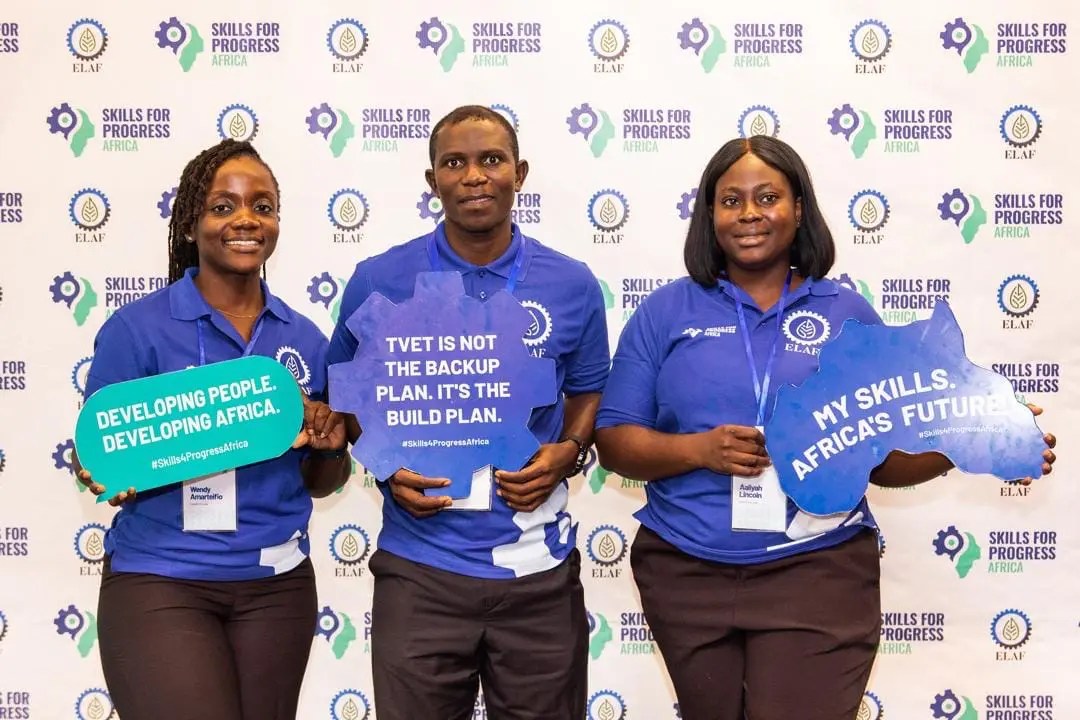
    Accra, Ghana — September 1, 2026 — Skills for Progress Africa (SFPA) has officially launched in Accra, inaugurating its first cohort of 10 Fellows under the theme ‘Building the Workforce That Will Build Africa’. The launch, held at the Accra AI Community Centre (AICC), Google Ghana, saw relevant stakeholders including industry leaders, technical and vocational education and training (TVET) practitioners, policymakers and development-sector representatives converge to examine how Africa can better prepare its technical talent for the demands of industry.

    The fellowship is being established with ELAF Industrial Automation Limited as its founding technical partner, combining technical training and practical industry exposure with personal, professional and leadership development.

    Speaking at the launch, Kwame Nyatuame, Executive Director of Skills for Progress Africa explained that the initiative is designed to bridge the persistent gap between technical education and industry readiness by developing professionals who are technically competent, adaptable and equipped to contribute meaningfully to Africa’s industrial transformation.

    He added that the fellowship was founded on a simple premise that technical education must translate into workplace competence and opportunity. “Education without experience is incomplete, and talent without opportunity is a tragedy,” he said, noting that Skills for Progress Africa (SFPA) would identify promising technical talent, develop them to high industry standards, expose them to experienced professionals and connect them to the companies and networks that can shape their careers.

    According to Mr. Nyatuame, the inaugural cohort is the first step towards a much larger ambition. Skills for Progress Africa plans to grow from 10 to 10,000 fellows, creating a scalable talent pipeline rather than a one-off training programme. He therefore called on industry, educational institutions and development partners to support the expansion of the model and help create more pathways from technical education into meaningful employment and enterprise.

    Solomon Bekoe, Managing Director of ELAF Industrial Automation Limited, said the need for such a bridge was underscored by the growing number of young people entering technical education alongside persistent challenges in transitioning from training to productive employment.

    He noted that enrolment in pre-tertiary TVET programmes in Ghana had increased by almost 130 percent over seven years, while youth unemployment among people aged 15–24 in Greater Accra reached 49.3 percent in the third quarter of 2025.“We don’t have an unemployment problem. We have a connection problem,” Mr Bekoe said as he described the disconnect between education and competence, competence and industry, and industry productivity and youth opportunity.

    He argued that employability and productivity are two sides of the same challenge. When an organisation cannot find a young professional capable of diagnosing and resolving a technical fault, he explained, the company faces a productivity problem; when a graduate cannot demonstrate that capability, the individual faces an employability problem.

    As SFPA’s founding technical partner, ELAF will provide the Fellows with structured technical training combining digital learning, AI-supported simulation and hands-on practical experience through the Festo LX platform.

    Mr. Bekoe also challenged companies hosting Fellows to make workplace attachments genuinely experiential by giving participants real problems to solve rather than limiting them to observation. Feedback from industry, he said, should also be used to continuously strengthen the fellowship’s training model.

    Lloyd Ashley, Managing Director of Niche Cocoa, brought an industry perspective to the discussion, focusing on engineering culture, resilience and productivity. Drawing on his own early experience, Mr. Ashley said engineering culture is ultimately reflected in everyday behaviour, whether people report problems, ask questions, share knowledge and support younger professionals. He described resilience as the ability to absorb pressure, adapt to changing circumstances and continue moving forward, noting that the quality is important not only for individual engineers but also for the organisations and systems they help build.

    On productivity, Mr Ashley challenged the notion that hard work should be measured simply by effort or hours spent. Instead, he urged the Fellows to focus on working smarter by simplifying processes, reducing downtime and using data and automation to improve efficiency. “I encourage you to build on the foundations established by those before you but you must also strive to improve upon them,” he said. 

    Industry, academia and policy confront the skills gap

    The launch also featured a panel discussion examining what African industry needs from the continent’s technical talent. The discussion brought together perspectives from manufacturing, TVET policy and implementation, and international labourorganisations. Panelists examined the persistent mismatch between industry’s demand for work-ready graduates and the current alignment of training programmes and curricula.

    They also considered international approaches to scaling TVET, the role of workplace learning in developing practical competence, and the uneven availability of industry partners for technical students outside Ghana’s major urban centres. The discussion reinforced the need for stronger collaboration among industry, training institutions, government and development partners to ensure that technical education responds more directly to the skills required by productive sectors.

    From 10 Fellows to a continental talent pipeline

    For the inaugural Fellows, the programme is already providing a bridge between classroom knowledge and the realities of industry. Participants highlighted the opportunity to gain practical technical skills, learn from experienced professionals, work with industry-standard tools and technologies, and develop the confidence to apply their knowledge to real-world problems. 

    As they progress through the fellowship, the Fellows expect the combination of technical training, mentorship, workplace exposure and professional development to strengthen their employability and open pathways into careers where they can make a meaningful contribution to industry.

    With the inauguration of Cohort 1, the 10 Fellows now begin a structured fellowship combining ELAF’s technical training with SFPA’s personal, professional and leadership development programme. The inaugural cohort will also provide an opportunity to test, measure and refine the fellowship model. Organisers intend to use evidence from the cohort’s performance and outcomes to guide expansion to 100 Fellows and, ultimately, 1,000 and beyond.

    For Skills for Progress Africa (SFPA), the objective extends beyond training individual professionals. It is to help build a deeper pool of technically capable Africans who can enter industry ready to solve problems, improve productivity and contribute to the continent’s industrial development. 

    About Skills for Progress Africa

    Skills for Progress Africa, a not-for-profit organisation focused on identifying, developing and connecting high-potential TVET talent to the skills, industry exposure and leadership opportunities they need to build successful careers and contribute meaningfully to Africa’s industrial development.

    About ELAF Industrial Automation Limited

    ELAF Industrial Automation Limited is the founding technical partner of Skills for Progress Africa. The company provides practical, industry-relevant technical and vocational education and training in partnership with Festo Didactic, including through the Festo LX industrial automation learning platform.

    Media Contact

    Skills for Progress Africa

    Teshie Nungua SSNIT GREDA Estates

    Accra, Ghana

    team@skillsforprogressafrica.org

  • MTN Pan-African Media Innovation Programme welcomes its first cohort

    MTN Pan-African Media Innovation Programme welcomes its first cohort

    MTN Group, the University of Johannesburg (UJ) and The African Editors’ Forum (TAEF) yesterday welcomed the first cohort of media practitioners to the MTN Pan-African Media Innovation Programme. This marks the start of a continental effort to strengthen journalism and build media institutions in a digital world.

    The inaugural cohort to start the six-week course is made up of 42 journalists, editors and media practitioners from 10 African countries. They come from print, broadcast, digital and independent newsrooms in South Africa, Nigeria, Rwanda, Eswatini, Ghana, Côte d’Ivoire, Cameroon, South Sudan, Zambia and Benin. Between them, they carry a working picture of how African media is changing.

    Newsrooms are absorbing rapid technological shifts, audiences that behave nothing like they did five years ago, revenue models under strain, and the growing pull of artificial intelligence and global platforms. How journalism gets made, paid for and delivered is being rewritten – and newsrooms are expected to hold on to public trust and editorial integrity while it happens.

    Strong and independent media institutions are essential to informed societies as well as to Africa’s progress,” said Nompilo Morafo, MTN Group Chief Sustainability and Corporate Affairs Officer. “This first group is made up of people who already understand what African newsrooms are up against and can do something about it. MTN is providingthe platform and the partnerships. Responsibility for thecurriculum as well as the selection of participants sits with our academic partners.

    UJ selected fellows independently by using professional and academic criteria based on track record, commitment to ethical journalism, the ability to influence their own organisations, and a genuine appetite for media innovation. The selection also aimed to reflect the geographic and professional spread of journalism across MTN’s markets.

    “The programme puts academic rigour alongside the daily realities media professionals actually face,” said Professor Sifiso Mnisi, Director of the Centre for Data and Digital Communications at UJ. “Fellows will interrogate how technology, audience expectations and commercial pressure are reshaping journalism – and then take that thinking back into their own newsrooms.

    The Pan-African programme builds on the MTN Nigeria Media Innovation Programme, established in 2022, which combines academic study with practical exposure to the institutions and issues shaping Africa’s media environment. This week, its fifth cohort is undertaking a week-long study visit to South Africa, engaging with leaders from academia, business, government and the media.

    “The shrinking of democratic systems, the rise in attacks on press freedom, and the revolution in technology, all conspire against journalism in many ways than could be imagined, but they also present opportunities – opportunities that journalists who are aware and conscious of their responsibilities can take advantage of and turn positive, said Emmanuel K. Dogbevi, the Vice President of TAEF during the virtual induction of the cohort. “We’re genuinely glad you’re here. The work ahead matters, its arduous, but must be done. Africa needs us. Africa needs impactful journalism now more than ever  you have the chance to learn to do it more effectively. Hold yourselves accountable to the facts, and as you do, serve the people, and uphold the standards.” 

    Six weeks, six areas of focus

    The certified programme includes a six-week curriculum of online academic study, where fellows will work through:

    • Pan-African media futures and storytelling

    • Media innovation and entrepreneurship

    • Digital transformation and platform economies

    • Digital journalism, content strategy and analytics

    • Media business strategy and sustainability

    • Media ethics, law and governance in the digital age

    Every fellow will also build a practical innovation project aimed at a real problem or opening in their newsroom or the wider sector. Beyond the curriculum, the intention is a standing Pan-African community of practice – fellows trading knowledge across markets, building relationships that outlast the six weeks, and shaping a broader conversation about where African journalism goes next.

    The full list of fellows and further information about the programme are available at [insert programme URL].

  • Telecel Ghana Launches SME Month 2026 to Unlock Growth for Entrepreneurs 

    Telecel Ghana Launches SME Month 2026 to Unlock Growth for Entrepreneurs 

    Telecel Ghana has launched this year’s edition of its annual Small and Medium-scale Enterprises (SME) Month, setting a clear ambition to help emerging businesses scale up and achieve sustainable growth.

    Led by Telecel Business, the month-long campaign themed “Connect to Growth: Unlock More,” will take practical business support, digital solutions and growth opportunities to SMEs across Ghana, with activities focused on skills, technology, market access and networks.

    Speaking at the launch, the Acting Director of Enterprise Business at Telecel Ghana, Nii Lartey said the focus this year is deliberately shifting to helping businesses grow and remain sustainable.

    “Starting a business is one thing, but growing, sustaining and turning it into a thriving business is where the struggle lies for many SMEs. Telecel Business has built practical tools, knowledge, systems, connections and opportunities to help emerging businesses level up,” Mr. Lartey said.

    According to the Ghana Statistical Service, the country had more than 2.6 million business establishments as of March 2026, with about 92% operating as informal micro businesses. Telecel Ghana believes the data highlights the need to help more businesses move from small and informal operations to sustainable and scalable enterprises.

    Partnering with the Ghana Enterprises Agency (GEA) on a Train-to-Scale initiative, the free regional training programme covers business skills, mentorship, content creation and Telecel Cash Merchant training, to give selected SME owners practical skills to grow their businesses.

    Speaking at the launch, Madam Habiba Sumani, Head of MSME Development Directorate of GEA said, “We believe that digital inclusion is central to inclusive economic growth. When entrepreneurs can access reliable connectivity and understand how to use digital tools effectively, they are better able to reach customers, lower transaction costs, access information, build professional networks and participate more meaningfully in local and global markets. We commend Telecel’s leadership in recognising the important role of SMEs in Ghana’s development.”

    A key highlight of the month will be The CEOs Unscripted with Delay, an insightful conversation with founders of thriving businesses on the realities of building and scaling, including their mistakes, setbacks, technology choices and growth strategies.

    This year’s SME Month will go beyond Accra, with the Telecel Business Runway, a game-changing experience for existing SMEs, start-ups, financial advisors and investors heading to the Western Region. 

    According to the Head of SME at Telecel Ghana, Alfred Neizer, this year’s SME Month is championed by its flagship product, The Boss Plan, a product built to accelerate digital transformation for SMEswith a high-volume, non-expiry data and voice bundles as well as a built-in customer outreach and SMS marketing tool.

    As businesses grow, they need more data, better communication and simple ways to stay connected to their customers. The Boss Plan gives SMEs all three in one solution, helping them run their businesses more efficiently and focus on growth,” Mr. Neizer said. We want entrepreneurs to adopt a digital solution, make a valuable connection, access an opportunity or improve the way they operate.”

    The 2026 Telecel SME Month builds on Telecel’s previous SME Month programmes, which have evolved from capacity building and women-focused entrepreneurship to youth entrepreneurship, AI training, business showcases, networking and digital business solutions.

    SMEs across Ghana are encouraged to sign up to the Boss Plan through the Telecel Play App or by dialing *5959 #.

    Telecel Senior Management Team with Executives from GEA and invited SMEs at the launch

    C2 General