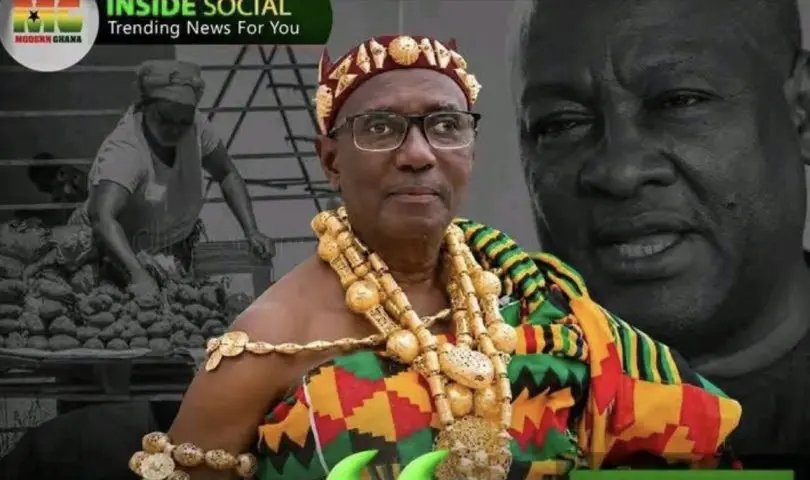

By Fuvi Kloku
A pointed and culturally grounded critique has emerged from the Asebu Traditional Area, where the Paramount Chief, Nana Prof Okatakyi Amanfi VII, has openly questioned the practicality of the National Democratic Congress’ proposed twenty four hour market initiative. His remarks, now circulating widely across community platforms, have sparked a national conversation about whether the policy reflects the lived realities of Ghana’s rural and agrarian districts.
The chief’s concern was expressed through a striking rhetorical question, who buys koobi at midnight. In that single line, he distilled a broader argument about economic rhythm and cultural context. Asebu, like many traditional communities, is built around farming, fishing, and daytime trading. Commerce follows the sun, not the clock. The chief’s position is that a nationwide twenty four hour market system may not align with the daily patterns of communities whose livelihoods depend on early morning harvests and evening rest.
His intervention arrives at a time when political parties are intensifying campaign messages and presenting ambitious development proposals. The NDC’s twenty four hour economy concept has been promoted as a strategy to expand productivity, create jobs, and modernize Ghana’s commercial landscape. Yet the Paramount Chief’s remarks highlight a critical nuance, modernization must be contextual, and policies must be shaped by the communities they intend to serve.
The reaction to his comments has been swift and varied. Some supporters argue that development must be rooted in cultural understanding and local needs, insisting that traditional leaders offer essential insight into how policies will function on the ground. Others contend that the twenty four hour market initiative is intended primarily for urban centers, not rural districts, and that the chief’s critique reflects a misunderstanding of the proposal’s intended scope.
Regardless of political interpretation, his remarks have achieved one undeniable outcome, they have compelled a deeper national conversation about how policies are communicated, interpreted, and adapted. His voice, carrying both traditional authority and academic stature, has reminded the nation that development is not uniform. It must reflect the diverse realities of Ghana’s communities, from metropolitan hubs to agricultural districts.
As Ghana moves further into another election season in 2027, the Paramount Chief’s commentary stands as a call for thoughtful engagement between policymakers and traditional authorities. It underscores the importance of aligning national ambitions with local realities, ensuring that progress is not only modern but meaningful.