By Sankofaonline News Desk : July 31, 2026.
Over three decades under the 1992 Constitution, the Fourth Republic has matured into a resilient electoral democracy. Yet persistent structural challenges , executive overreach, political patronage, institutional fatigue, and public financial inefficiencies have underscored the need for constitutional recalibration.
On January 19, 2025, President John Dramani Mahama inaugurated an eight‑member Constitution Review Committee (CRC) chaired by Professor Henry Kwasi Prempeh to synthesize past reform proposals, including the 2010 CRC‑1 and the 2023–24 CRCC reports, and to articulate a new constitutional vision grounded in “Developmental Democracy.”
Following extensive national consultations, the CRC submitted a 518‑page Final Report containing 147 recommendations and 59 proposed new provisions. On July 28, 2026, the Office of the Attorney‑General and Ministry of Justice released the Government’s official Position Paper.
Rather than issuing a conventional White Paper, the Government adopted a Position Paper guided by four constitutional principles:
Caution and Constitutional Economy — Amend only matters of high normative value.
Statutory Preference — Resolve governance issues through legislation or administrative reform where possible.
The Comprehensive Human Rights Act — Expand rights through Article 33(5) legislation rather than enlarging Chapter 5.
Preserving Executive Balance — Avoid reforms that dilute essential executive authority or create administrative fragmentation.
Core Highlights of the Government’s Decisions
Executive Reform and Political Terms
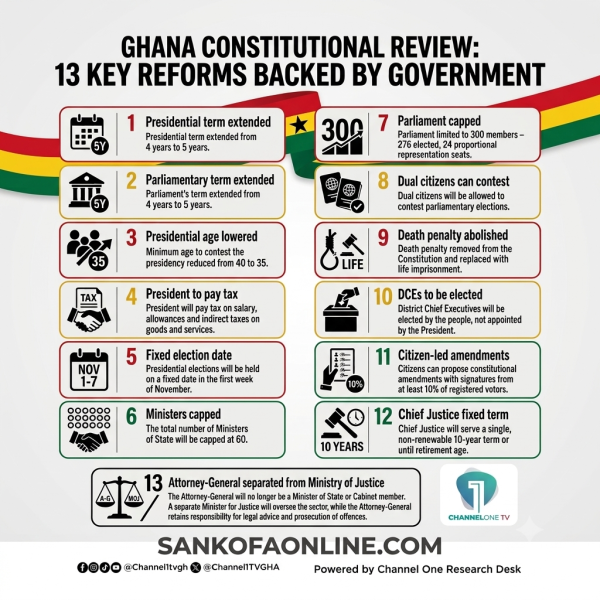
Extended Terms (Accepted): Presidential and Parliamentary terms move from four to five years to reduce perpetual election cycles and strengthen policy continuity.
Age Qualification (Accepted in Principle): Minimum presidential age lowered from 40 to 35, rejecting the CRC’s proposal of 30.
Capping Ministerial Size (Accepted in Principle): A firm ceiling of 60 Ministers of State replaces the CRC’s 57‑minister formula.
Decoupling MPs from Ministerial Roles: The Government rejects a full prohibition. Instead, it removes the requirement that most Ministers must be MPs, granting the President full discretion.
Censure of Ministers (Accepted): A parliamentary censure under Article 82 triggers mandatory revocation and bars reappointment for the remainder of the term.
Taxation of the President (Accepted in Principle): The President will pay direct and indirect taxes on salary and allowances; pensions and gratuities remain exempt.
Parliament, Citizenship, and Elections
Dual Citizenship (Accepted): Dual citizens by birth may contest parliamentary elections and hold public office.
Parliamentary Size and Mixed Electoral System (Accepted in Principle): Parliament capped at 300 seats, with 276 directly elected and 24 allocated through Proportional Representation for women, youth, and persons with disabilities.
Voting and Oversight (Accepted): Secret voting limited to elections and removals of officers. All legislative and constitutional votes become open and publicly recorded.
Private Members’ Bills affirmed.
By‑Elections (Accepted in Principle): No by‑election within six months of a general election.
Judiciary Architecture
Fixed Term for Chief Justice (Accepted): A single, non‑renewable 10‑year term or until retirement age.
Supreme Court Size (Accepted in Principle): Court capped at 19 Justices, rejecting the CRC’s proposal of 15.
Rejected Structural Splitting: No division of the Supreme Court into Appellate and Original divisions; the Chief Justice retains authority to sit on lower superior courts.
Anti‑Corruption and Ethical Governance
Decoupling Attorney‑General from Cabinet: Article 88(1) amended so the Attorney‑General is no longer a Minister of State. A separate Minister of Justice manages the ministry, while the Attorney‑General receives security of tenure equivalent to a Supreme Court Justice.
Refocusing CHRAJ (Accepted): Anti‑corruption functions removed; CHRAJ focuses exclusively on human rights and administrative justice.
Public Ethics Commission: Anti‑corruption enforcement consolidated under a statutory Public Ethics Commission through the Conduct of Public Officers Bill.
Public Financial Management and Natural Resources
Independent Public Emoluments Commission (Accepted): Article 71 reformed to establish an independent commission to determine public sector compensation.
Statutory PFM over Constitutional Amendments: Proposals on tax expenditures, earmarked funds, central bank credit limits, and debt rules rejected for constitutional entrenchment. These will be addressed through amendments to the PFM Act (Act 921) and Bank of Ghana Act (Act 612).
Land and Natural Resources: Proposals to re‑vest public lands away from the President or abolish the Office of the Administrator of Stool Lands rejected. The Land Act, 2020 (Act 1036) deemed sufficient.
Key Acceptance Matrix
Presidential Term — Extend from 4 to 5 years, Accepted, Constitutional Amendment (Non‑Entrenched)
Ministers from Parliament — Complete prohibition, Rejected in Principle (optional appointment flexibility), Constitutional Amendment
Ministerial Ceiling — Max 57 Ministers, Accepted in Principle (cap at 60), Constitutional Amendment
Censure Consequences — Revocation and bar on reappointment, Accepted, Constitutional Amendment
Parliamentary Size — Cap at 276 seats, Accepted in Principle (cap at 300, 24 via Proportional Representation), Constitutional Amendment and Feasibility Study
Dual Citizenship — Allow for MPs and public office, Accepted, Constitutional Amendment
Electoral Date — Fixed first week of November, Accepted, Constitutional Instrument and Amendment
Chief Justice Tenure — Fixed 10‑year non‑renewable term, Accepted, Constitutional Amendment
Supreme Court Cap — Cap at 15 Justices, Accepted in Principle (cap at 19), Constitutional Amendment
A‑G Role — Strip corruption prosecution power, Rejected (AG removed from Cabinet, Minister of Justice separated), Constitutional Amendment
Council of State — Make appointment advice binding, Rejected (advisory role maintained).
Human Rights Scope — Add extensive new rights chapters, Accepted in Principle (via Statutory Human Rights Act), Comprehensive Human Rights Act (Article 33(5))
Implementation and Next Steps
Constitutional Amendment Bills: To be processed through the Constitution Review Implementation Committee (CRIC) under Articles 290 (entrenched) and 291 (non‑entrenched).
Statutory Legislation Package: Priority passage of the Conduct of Public Officers Bill, Public Ethics Commission Bill, Political Parties Regulatory Commission Bill, and amendments to the PFM Act (Act 921), Presidential Transition Act (Act 845), and Land Act (Act 1036).
Comprehensive Human Rights Act: Drafting legislation under Article 33(5) to codify expanded social, digital, and economic rights.