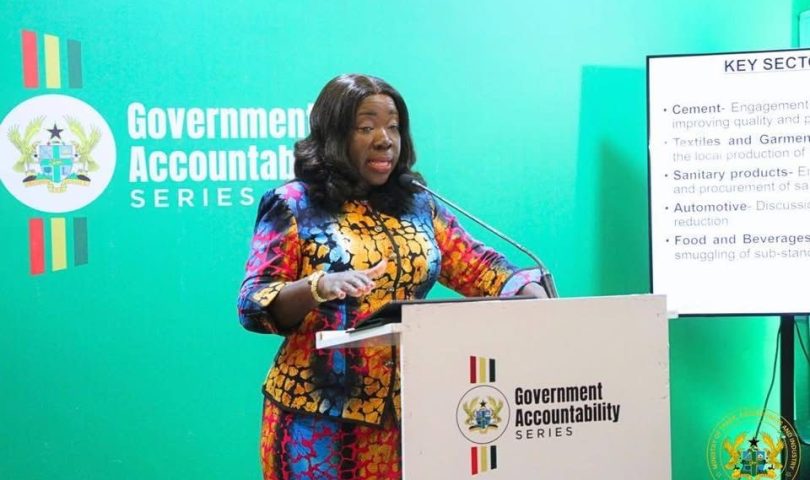

The Minister for Trade, Agribusiness, and Industry, Mrs. Elizabeth Ofosu-Adjare, has reported significant advancements in Ghana’s industrial and trade sectors since the current administration took office.
Speaking at the Government Accountability Series in Accra on Wednesday, January 21, 2026, the Minister detailed a scorecard defined by robust growth in exports, industrial revitalization, and expanded support for youth-led businesses. She noted that these achievements align with President John Dramani Mahama’s strategic vision to transform agribusiness into an economic driver and accelerate manufacturing across the country.
A key highlight of the report was the surge in Non-Traditional Export earnings, which reached US$2.54 billion in the first half of 2025. This reflects a 41.21 percent increase compared to the previous year, a growth the Minister attributed to value addition and the Accelerated Export Development Programme. Recent milestones include Ghana’s first-ever road shipment of mangoes to Morocco and successful participation in international trade fairs that secured millions of dollars in orders.
Mrs. Ofosu-Adjare also noted critical market access gains, such as the three-year extension of the African Growth and Opportunity Act (AGOA) and ongoing duty-free negotiations with China.
On the industrial front, the Minister announced the completion of strategic policies covering textiles, pharmaceuticals, and automotive components, alongside efforts to revive defunct state-owned enterprises. Financial support played a major role in these gains, with the Ghana EXIM Bank disbursing GHS304 million in 2025 to bolster trade and industrial financing.
Additionally, the Apprenticeship to Entrepreneurship initiative successfully trained over 155,000 young people, providing many with start-up kits and capital to launch their own ventures.
The Ministry’s future outlook remains focused on expanding agro-processing, improving export competitiveness, and operationalizing a 24-hour business environment.
Mrs. Ofosu-Adjare emphasized that the government will continue to support local firms in leveraging opportunities under the African Continental Free Trade Area (AfCFTA) while reforming regulations to enhance the nation’s investment climate.
Ruth Abla ADJORLOLO