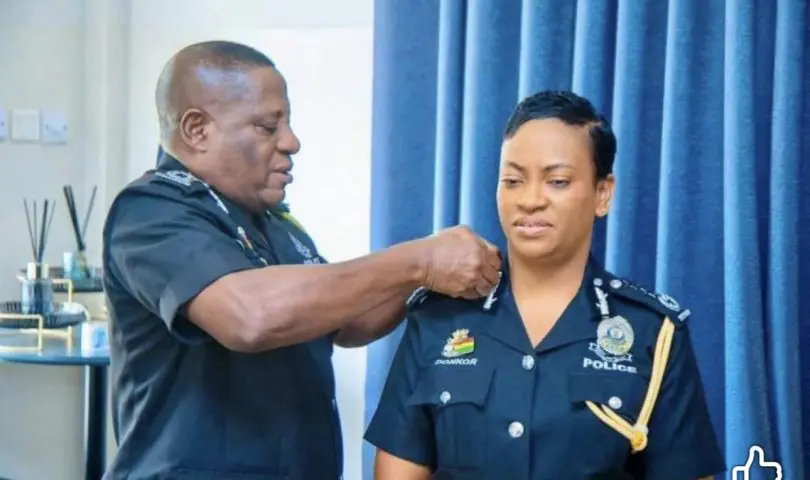

Source: The GaDangme Kingdom
There are leaders who occupy office, and there are leaders who redefine the office itself. Commissioner of Police Lydia Yaako Donkor, Director-General of the Criminal Investigations Department of the Ghana Police Service, belongs firmly in the second category. Her story is not merely one of rank and responsibility. It is a study in the quiet, relentless architecture of character under pressure—the kind of leadership that does not announce itself with noise but reshapes institutions through consistency, intellect, and moral clarity.
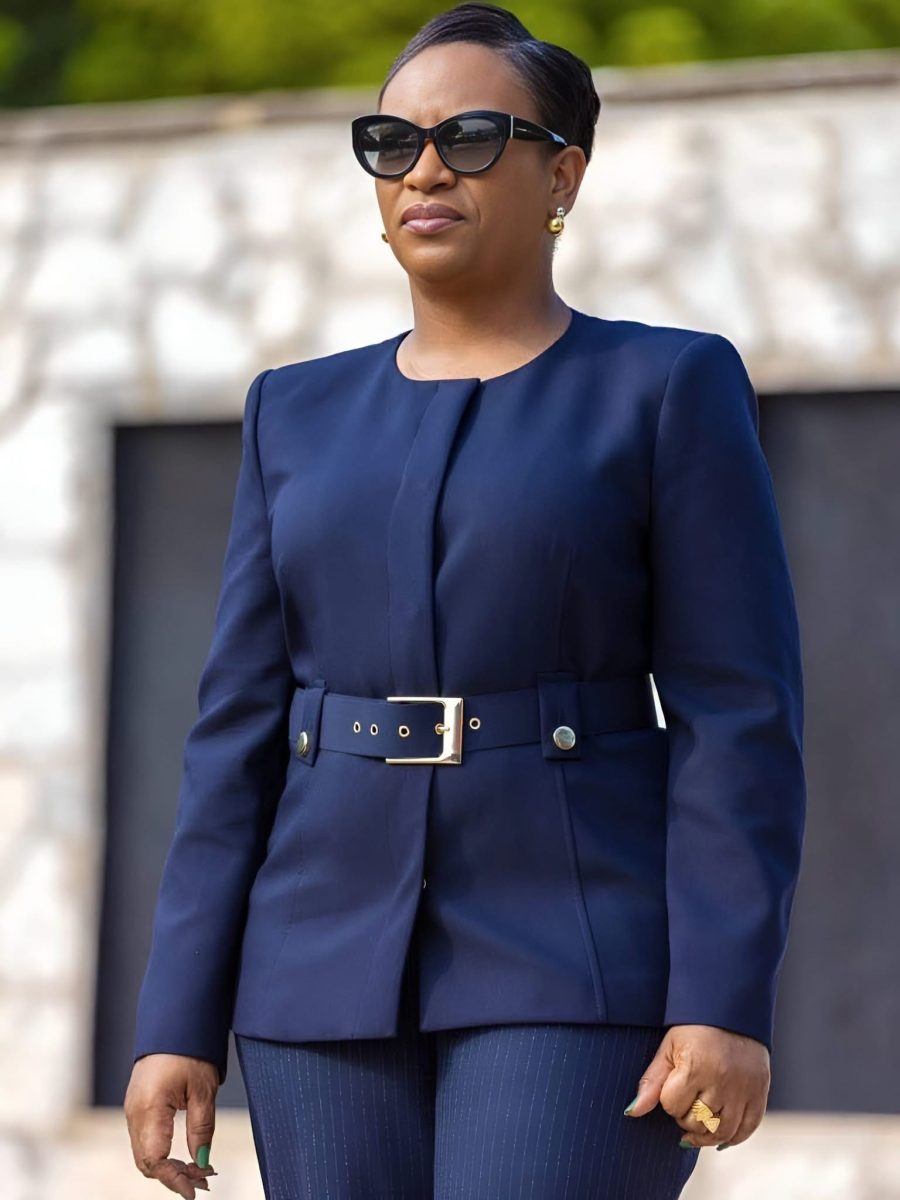
To understand her contribution requires looking beyond the official timeline. Born in 1974 and shaped by the rigorous discipline of Wesley Girls’ High School, she emerged into a Ghana still negotiating the boundaries of what women could claim in public life. She chose the law not as a profession of status, but as an instrument of protection. Her LLM in International and Human Rights Law from the University of Leeds was not an ornamental credential; it became the intellectual scaffolding for everything that followed. When she later designed human rights training for the Ghana Police Service—introducing a curriculum that had previously been absent—she was doing more than adding content to a syllabus. She was altering the moral operating system of an institution.
Her entry into the Police Service in 2003 as a legal officer placed her in a dual identity that few occupy successfully: the lawyer who must also enforce, the enforcer who must also interpret justice with precision. That tension—between the letter of the law and the lived reality of power—has defined her career. Serving as a United Nations Police officer in Liberia, heading legal and prosecutions units, commanding districts, and later leading the Police Professional Standards Bureau, she developed a rare capacity to hold institutions accountable from within. Integrity, for her, has never been a slogan. It has been operational.
When she assumed leadership of the CID in March 2025 and was elevated to Commissioner of Police months later, she inherited an institution facing the full force of twenty-first-century crime: cyber-enabled fraud, cross-border networks, digital exploitation of children, and sophisticated financial schemes that mock traditional jurisdictional lines. Under her watch, Ghana’s participation in INTERPOL operations has moved from participation to measurable disruption—arrests, asset recovery, the dismantling of digital infrastructure, and the rescue of children whose safety cannot be reduced to statistics. When she asks, “What price do we place on restoring a child’s safety, dignity and future?” she is not offering rhetorical flourish. She is naming the moral centre of policing that too often gets lost in metrics and press briefings.
There is a deeper lineage at work. Her mother, retired COP Jane Christie Donkor, was Ghana’s first female Commissioner of Police—a woman who broke through ceilings that had previously terminated careers at the rank of Deputy Commissioner. Lydia did not simply inherit a name or a rank. She inherited a demonstrated possibility. In speaking of her mother, she has noted that hard work and the refusal to accept artificial limits opened pathways for other women. That intergenerational transmission of courage is rare and powerful. It turns personal achievement into institutional memory and institutional memory into cultural permission.
Yet the deeper truth of her leadership lies in what she refuses to romanticise. Policing, especially at the CID level, is grinding work. It involves long nights, incomplete information, political pressure, public impatience, and the constant knowledge that failure can cost lives or liberty. To lead such work while remaining a visible advocate for gender equity, while chairing the GFA’s Safety and Security Committee, while guiding Police Ladies FC, and while representing Ghana on the INTERPOL Africa Committee as its first Ghanaian and only female member, requires a form of stamina that is rarely celebrated because it is not theatrical. It is cumulative. It is the daily decision to remain rigorous when exhaustion would be understandable.
There is also a philosophical dimension to her approach. She has described policing as a calling rather than a career. That distinction matters. Careers optimise for advancement; callings orient around responsibility. In an age when trust in institutions is fragile, leaders who treat their roles as moral obligations rather than personal platforms become stabilising forces. Her consistent emphasis—protect the vulnerable, strengthen investigations, build trust through professionalism and fairness—functions as both strategy and ethic. It resists the temptation to reduce policing to force or to public relations. It insists that legitimacy is earned through competence and restraint in equal measure.
The challenges she faces are not uniquely Ghanaian, but they are acutely felt here: the speed of technological crime versus the slower pace of institutional adaptation; the need for international cooperation without surrendering national sovereignty; the imperative to empower women within a historically male-dominated service without tokenism; the demand for results without compromising the rule of law. Her leadership suggests that these tensions are not resolved by charisma alone, but by the patient accumulation of standards, training, partnerships, and personal example.
In honouring COP Lydia Yaako Donkor, we are not simply celebrating a successful officer. We are recognising a particular kind of public servant: one who understands that the deepest form of power is the power to protect without spectacle, to reform without self-congratulation, and to lead without diminishing those who follow. Her hard work is not the performative kind that seeks validation. It is the structural kind that quietly raises the floor for everyone else.
Ghana’s Criminal Investigations Department is stronger because she leads it. The wider service is more accountable because she has insisted on standards. Young officers—especially women—can see a path that was once narrower. And the public, often frustrated by the opacity of power, is offered a rare example of leadership that prioritises substance over image.
In the long arc of institutional life, such figures are not common. When they appear, the responsible response is not mere applause, but careful attention. Because the real tribute to a leader like Lydia Yaako Donkor is not the praise we offer today, but the higher expectations we place on the institutions she has helped shape—and the quieter, more exacting standards we now know are possible.