

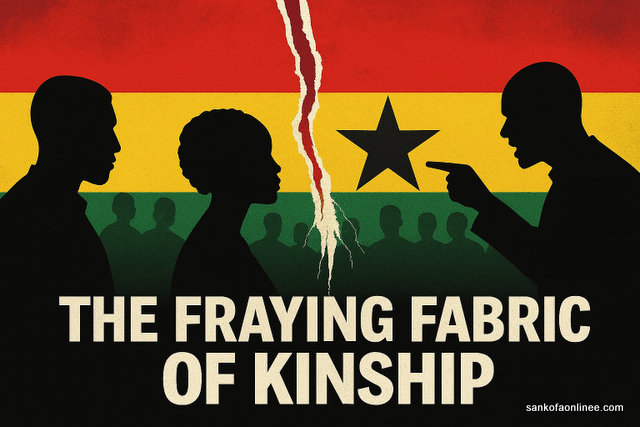

Sankofaonline News Desk : November 5, 2025.
For decades, the Ghanaian diaspora has stood as a luminous thread in the global tapestry of immigrant communities woven together by shared ancestry, cultural pride, and a solemn vow to remain “faithful and loyal to Ghana my Motherland.” This pledge, recited with reverence across generations, has transcended borders and time zones, anchoring communities in cities like Chicago with a sense of purpose, unity, and belonging. It has been the quiet force behind neighborhood initiatives, cultural festivals, youth mentorship, and the tireless volunteerism that has kept the spirit of Ghana alive far from its shores.
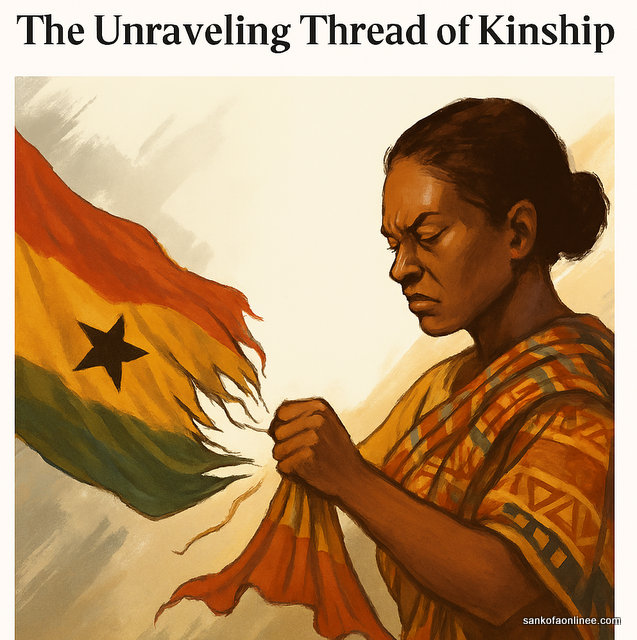
But today, that thread is unraveling.
A troubling shift has emerged, one that threatens to tear apart the very fabric of a proud and resilient community. At the heart of this rupture lies a toxic brand of identity politics, where authenticity is weaponized and belonging is questioned.
In a recent presidential contest in Chicago, a candidate whose life has been an epitome of service, offering free medical care, mentoring youth, and building bridges across generations, was branded as “not Ghanaian enough.” The accusation was not rooted in policy or performance, but in a cruel attempt to delegitimize her identity. It was a whisper campaign, calculated to fracture trust, sow doubt, and exile a leader from the very community she has uplifted.
Yet even as these divisive tactics take root, her work continues. Her NGO in Ghana, dedicated to uplifting local communities, stands as a beacon of hope amid the fraying bonds of kinship. It reminds us that true belonging is not measured by bloodline or birthplace, but by the impact we make and the lives we touch.
This is not just political mudslinging, it is a betrayal of the values that have sustained the diaspora for decades. The wounds run deep. Reports suggest that some of her closest allies, men and women , who once leaned on her generosity and compassion, have turned against her, leveraging personal relationships to undermine her candidacy. This breach of trust reveals a darker undercurrent in community politics, where ambition overrides loyalty and personal gain eclipses collective progress.
Such divisiveness is especially jarring in a world that increasingly celebrates the triumphs of immigrant communities. The ascent of leaders like Rishi Sunak in the UK, whose Indian heritage is a source of pride, and the recognition of Indian-American contributions by New York Mayor Zohran Mamdani, reflect a global embrace of multicultural excellence. These stories inspire immigrant children to dream boldly, to believe that their roots are not a liability but a source of strength. To see a similar narrative, a woman whose success is born from a fusion of cultures, twisted into a weapon of exclusion is a painful regression.
This moment demands reflection. It demands courage. And above all, it demands a recommitment to the ideals that have long defined the Ghanaian diaspora: unity, integrity, and service. The politics of exclusion must be rejected in favor of a politics of inclusion, one that honors contribution over lineage, character over credentials, and vision over tribalism.
We must ask ourselves: What kind of community do we wish to be? One that tears down its own in pursuit of power, or one that lifts each other up in pursuit of purpose? The answer lies not in slogans or ceremonies, but in the everyday choices we make, to support, to forgive, to build, and to belong.
Let this be a turning point. Let the Ghanaian pledge be more than words, it must be a living promise. A promise to defend not just the name of Ghana, but the dignity of every Ghanaian, wherever they may be. A promise to heal the wounds of division with the balm of empathy. A promise to ensure that no one is ever made to feel like a stranger in their own community.
Because when kinship frays, it is not just one thread that breaks, it is the whole tapestry that suffers. And only together can we weave it back.

In 2008, the most powerful nation on earth elected the son of a Kenyan immigrant as their president.
Yesterday, New Yorkers, whose annual budget is about the size of Ghana’s GDP, elected a Muslim who was born in Uganda to parents of Indian descent as their mayor.
There is no reason a man born in Ghana to Ghanaian parents should be discriminated against because of his ethnicity.
By all means, scrutinise his character and his role in public office. Hold him accountable for his deeds or misdeeds, but leave out where he comes from.
Let’s learn from the good examples of the Americans, British, and other progressive European and North American nations. We cannot celebrate people of Ghanaian descent who rise to high public offices in the UK, U.S., and elsewhere, while discriminating against our own here.