
Sankofaonline Editorial Board
Every year, government officials stand on international podiums, passionately urging Africans in the diaspora to return home. They appeal to patriotism. They ask for capital, expertise, investments, and innovation. They call on our brightest minds abroad to bring their knowledge, networks, and boldest ideas back to help transform the continent.
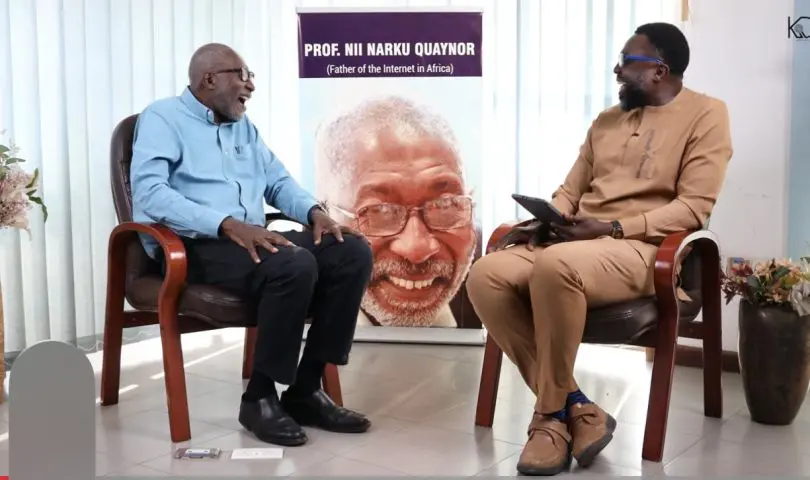
Yet a recent and deeply revealing interview with Prof. Nii Narku Quaynor, the man widely recognized as the “Father of the Internet in Africa,” forces Ghana to confront an uncomfortable truth. For decades, the country has often failed to protect the very pioneers it begs to return.
In 1993, Prof. Quaynor walked away from a highly rewarding career in the United States and returned to Ghana at a time when the internet was still in its infancy. Armed with little more than determination, technical expertise, and a vision for Africa’s digital future, he successfully connected Ghana to the internet before economic giants in Africa, such as South Africa, Kenya, and Nigeria came online.
Through his company, Network Computer Systems (NCS), Prof. Quaynor was not merely providing internet access. He was laying the foundation for an indigenous digital ecosystem. Years before Google, Facebook, or other technology giants became household names, NCS was building internet services, email platforms, search functionality, and domain management systems.
Ghana had a head start that many nations would envy.
NCS could have become our Google.
Instead, it died.
And its death should haunt policymakers to this day.
(The rest of your original body flows well and can remain largely unchanged.)
The Real Lesson for Ghana
The story of Prof. Quaynor is far bigger than one company, one innovator, or one period in our history.
It is a story about how nations either cultivate genius or drive it away.
Around the world, countries that lead in technology and innovation did not arrive there by accident. Their governments deliberately protected innovators, encouraged risk-taking, defended intellectual property, and created environments where pioneers could flourish rather than constantly defend themselves against bureaucratic interference.
Ghana, unfortunately, too often does the opposite.
We celebrate innovators after they succeed elsewhere, but frustrate them while they are trying to build at home. We invite the diaspora to return, yet provide few protections for the businesses, technologies, and intellectual property they create. We spend millions courting foreign investment while overlooking the transformational value sitting within our own global diaspora community.
The consequences are enormous. Every time a returning innovator is discouraged, undermined, or forced out, Ghana loses more than a company. We lose jobs. We lose knowledge transfer. We lose technological independence. We lose the industries that could define our future.
Today, as government seeks to attract investment into artificial intelligence, fintech, digital infrastructure, advanced manufacturing, and emerging technologies, Prof. Quaynor’s experience should serve as a warning.
No serious innovator will bring a world-changing idea into an environment where success makes them vulnerable rather than protected.
No entrepreneur will invest millions into building the future if they believe regulators could become adversaries instead of partners.
No nation can compete globally while treating pioneers as threats to be controlled rather than assets to be nurtured.
If Ghana truly wants the diaspora to come home, the country must offer more than speeches and conferences. It must offer certainty. It must offer protection. It must offer respect for innovation and ownership of ideas.
Most importantly, it must ensure that the next Prof. Quaynor does not suffer the same fate as the first.
Because until Ghana can guarantee that a returning visionary will be protected rather than cannibalized by the very system he or she seeks to improve, our call for the diaspora to “come home” will remain little more than a dangerous invitation.
And every talented Ghanaian watching from Silicon Valley, London, Toronto, Berlin, or Johannesburg will continue to ask a simple question:
If Ghana could not protect the man who brought it the internet, why should it protect me?
Sankofaonline Editorial Board
“A nation that frustrates its innovators mortgages its future to those who do not.”