
Ghana Jollof. Suspected cocaine intercepted in France after allegedly leaving Ghana. EOCO attempting to arrest an opposition MP around the court precincts.
Different facts. Different institutions. Different allegations. But the same political temptation: decide what happened, assign responsibility and manufacture a verdict before the evidence finishes speaking.
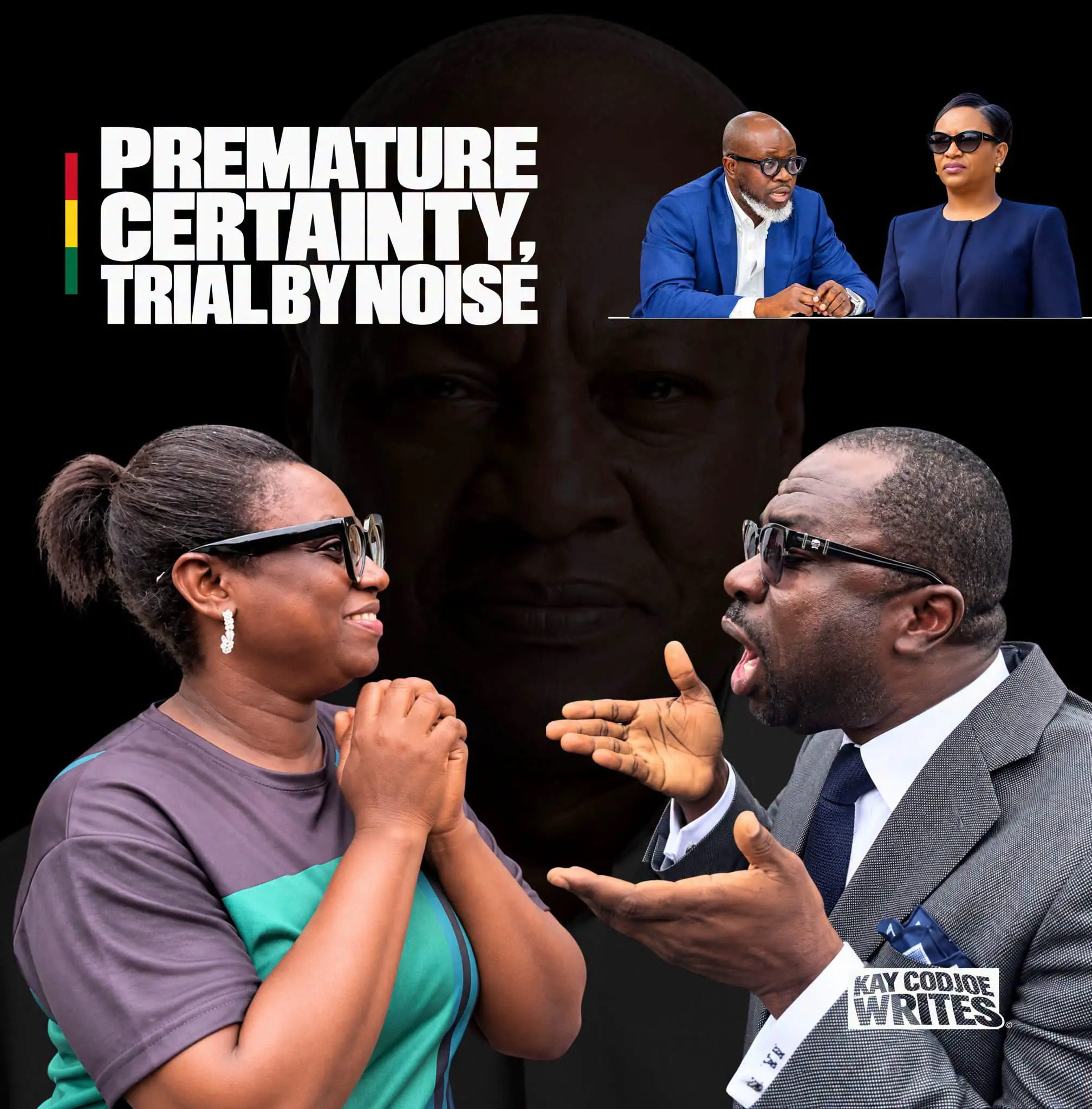
That is what connects these stories. Each tests government power. Each tests opposition responsibility. And each asks whether Ghana’s politics can wait for evidence when accusation is faster.
For the governing NDC, this is an important test. Not because government has been proved culpable in these controversies. It has not. But governments inherit responsibility for how institutions exercise public power during their tenure.
Consider Ghana Jollof.
Police say their investigation has uncovered financial links involving Salomey Awiti Bafoh, Barbara Asantewaa Kodua, known as Ghana Jollof, and allegedly influential persons. Police also allege recruitment and redistribution of unlawful online material. Serious allegations require serious evidence.
If money moved, follow it. If instructions moved, retrieve them. If people were recruited, establish by whom. If influential persons financed unlawful conduct, identify them through evidence. Government should demand nothing less. Opposition should accept nothing less.
Then there is the cocaine intercepted in France after allegedly leaving Ghana. Political nomenclature may rename the controversy. It cannot answer the institutional question: How did it leave?
There are now accused persons before the courts. Desmond Koranteng Curiel, Musah Attah, Kweku Otchere and Jessica Hartog have been charged and remanded. Dutch national Jos Leijdekkers, alias Bolle Jos, is alleged to be at large. Separate proceedings involve six others, including four GRA officers over alleged conduct concerning Customs scanning. These remain allegations requiring proof.
So move beyond politically baptising the cocaine. Reconstruct the chain. Who handled the containers? What did the scanners reveal? Who saw what? Who authorised clearance? Who benefited?
Cocaine has no party card until evidence gives somebody one. Government must explain institutional failure where evidence establishes it. Opposition must not manufacture government complicity where evidence does not.
Then EOCO supplied the third controversy.
Its attempted arrest of Manhyia South MP Nana Agyei Baffour Awuah produced imagery government should avoid: law enforcement, an opposition parliamentarian, disputed procedure and an arrest attempt around the courts.
Then something important happened. Majority Chief Whip Rockson Nelson Dafeamekpor criticised EOCO.
Article 117 is narrower than some commentary suggests, protecting MPs concerning process while going to, attending or returning from parliamentary proceedings. Dafeamekpor nevertheless argues that established practice requires engagement with the Speaker before arresting an MP. That disagreement deserves authoritative determination.
But his intervention matters. A Majority Chief Whip defending an opposition MP’s procedural rights against a state investigative agency demonstrates something democracy desperately needs: institutional principle crossing the aisle.
Government should not defend procedural impropriety because its institution committed it. Opposition should not convert procedural impropriety into immunity from lawful investigation.
Sometimes defending government means correcting government. Sometimes defending opposition means insisting that investigation remains lawful, not preventing investigation altogether.
Then comes Kwame A Plus’s provocative observation that since 1992, opposition parties have not simply won power; governing parties have handed power over to them. It is political theory, not mathematical law. But there is wisdom inside it.
Oppositions campaign against governments. Governments campaign against their records.
For the NDC, therefore, the danger is accumulation. Ghana Jollof becomes intimidation. Cocaine becomes security failure. EOCO becomes institutional overreach. Whether those conclusions are ultimately justified may matter less politically once repeated allegations harden into public perception.
But accumulation has an opposition equivalent: exaggeration. If every investigation becomes persecution, every security failure becomes government conspiracy and every allegation becomes guilt, legitimate scrutiny begins losing credibility.
That is the symmetry.
Government has power and therefore bears the heavier burden of restraint, competence, transparency and lawful procedure. Opposition has scrutiny and therefore bears the burden of evidence, consistency and intellectual honesty.
The government must not use power to manufacture conclusions. The opposition must not use outrage to manufacture conclusions.
That is why these three stories belong together.
Ghana Jollof asks who financed what. The cocaine case asks who enabled what. EOCO asks whether lawful objectives were pursued through lawful means.
Different controversies. Same democratic instruction: do not begin with the political conclusion and work backwards toward evidence.
Follow the money. Trace the cocaine. Let the law lead.
Wherever each ends, let the facts embarrass whoever deserves to be embarrassed.
Kay Codjoe