

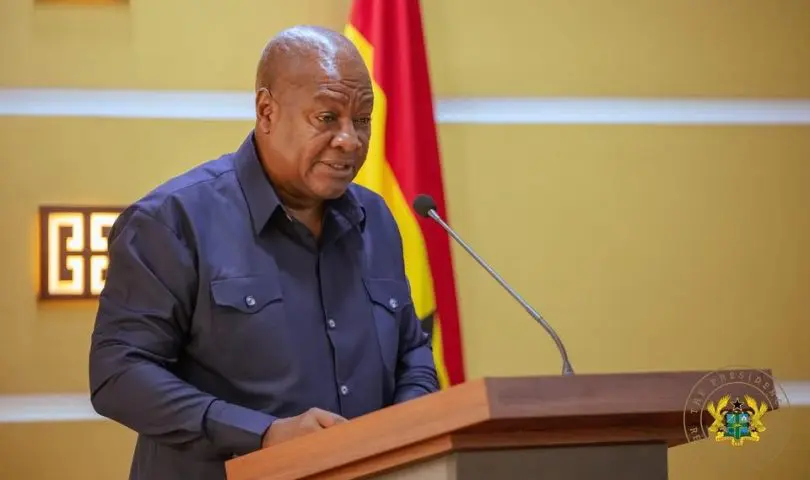

President John Dramani Mahama’s recent directive to cancel all fuel allowances and allocations for political appointees is not merely an act of fiscal restraint. It marks a bold and consequential attempt to uproot a colonial legacy that has long distorted Ghana’s public service ethos and undermined economic justice. Sankofaonline applauds this decisive measure and encourages the President to go further—to confront, dismantle, and replace the entire architecture of inherited privilege with a system built on transparency, equity, and national dignity.
For decades, the scaffolding of Ghana’s public administration has rested upon a framework of benefits modelled on colonial precedents. These were not emoluments of necessity or merit but incentives crafted to entice colonial agents to govern distant lands with unaccountable comfort. Free housing, unlimited utilities, excessive travel allowances, and fleets of government vehicles—these provisions, divorced from the realities of modern governance, have morphed into entrenched entitlements. They remain a corrosive drain on national resources and a source of public disillusionment.
One must ask: why is the total cost of maintaining a single public appointee enveloped in opacity? Why does a system that purports to serve the public enshroud its expenditures in silence? When domestic workers employed by government officials earn more than lifelong civil servants, when net monthly salaries of select appointees eclipse GHS 100,000 while a majority of workers scrape by on less than GHS 2,000, something is fundamentally broken. The four-year ex gratia payments—often exceeding GHS 200,000—stand in jarring contrast to retirement packages for civil servants who, after decades of loyal service, retire with barely a fraction of that sum.
This disparity is not only unsustainable—it is unworthy of a modern democracy. It undermines the moral contract between state and citizen, and perpetuates a culture of exclusion where privilege trumps performance. Ghana must reject this model. It is not reform—it is a reckoning.
By dismantling these colonial-era perks, the President has set in motion a reorientation of values with implications far beyond the executive corridors. First, the financial gains are both immediate and substantial. The resources released could fortify our healthcare systems, rejuvenate educational infrastructure,extend social services to the poor and spur investment in productive sectors. This redirection is no longer optional—it is imperative.
Second, and more profoundly, it signals a shift toward inclusive economic citizenship. A nation cannot flourish when inequality is embedded in the very structures of governance. Bridging the gulf between the elite and the average worker will lift the purchasing power of many, stimulate local enterprise, and fortify the domestic economy from the ground up. The birth of a resilient middle class is not a political slogan—it is a prerequisite for sustained progress.
Third, it renews public faith in leadership. When state officials live by the realities they legislate, when they sacrifice personal comfort for collective advancement, the skepticism that shadows governance begins to recede. The Ghanaian people deserve leaders who serve with humility, who legislate with integrity, and who uphold the principle that public office is a trust—not a windfall.
This is the moment for President Mahama to inscribe his legacy as a reformer—not of appearances, but of substance. The “Ghanaian Dream” must cease to be a distant hope and become a lived reality: a future in which diligence yields dignity, and opportunity is not rationed by status or connection.
If this opening gesture is met with resolve, if the reforms are deepened, broadened, and institutionalized, then Ghana may yet begin to shed the burdens of a post-colonial economy and take its rightful place as a republic defined not by inherited inequalities but by earned progress.
The time to act is now. The nation watches, the people hope—and history awaits its author.

If this true then we will be able to identify the true patriots of Ghana and President live long with these Devine wisdom. Ghana is moving on . God bless President Mahama . God bless Ghana.