

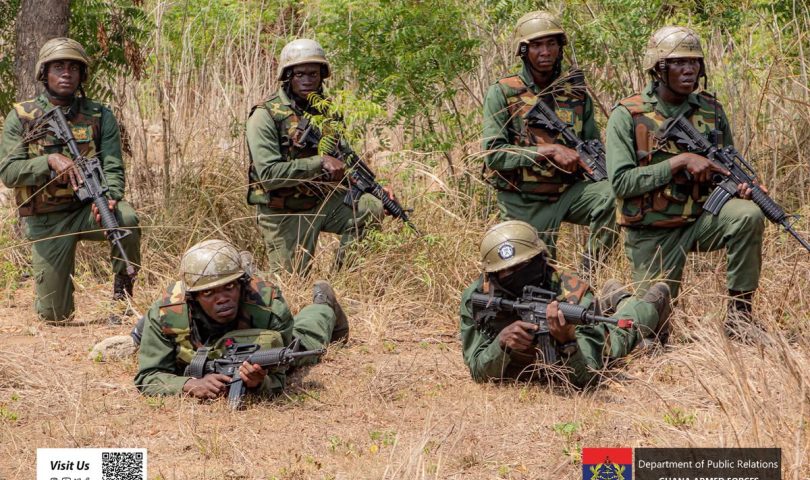

The argument that the Ghana Armed Forces is drifting into confusion because it operates farms, bakeries, block factories, and similar support ventures rests on a narrow and historically inaccurate view of what a modern military is designed to do.
Every serious military in the world is built around one central idea: self-reliance. Not self-reliance only in weapons, but self-reliance in logistics, sustenance, infrastructure, and continuity under stress. A force that cannot feed itself, house itself, or maintain its own basic supply chains in crisis is not combat ready, no matter how advanced its weapons may be.
This is not a Ghanaian invention. It is military orthodoxy.
From the United States to China, from Egypt to Israel, armed forces operate farms, food processing units, engineering works, repair depots, and construction brigades. These are not side hustles. They are force multipliers.
Logistics Wins Wars, Not Just Weapons
History is unforgiving on this point. Armies rarely lose because they lack courage or even firepower. They lose because supply lines collapse. Napoleon learned it in Russia. Germany learned it in North Africa. More recently, conflicts have shown that ammunition without food, fuel, shelter, and maintenance capacity is useless.
A bakery in a barracks is not a symbol of weakness. It is a symbol of logistical independence. A block factory is not mission creep. It is an engineering capability applied inward to reduce cost, delay, and dependence on civilian contractors who may not be available in wartime.
Training soldiers to manage agriculture, construction, and production does not replace combat training. It complements it. Modern soldiers are not just rifle carriers. They are engineers, technicians, logisticians, and planners.
False Choice Between Defence Industry and Self-Sufficiency
The opinion piece presents a false choice: either the military produces food and basic materials, or it develops a defence industrial base. Serious militaries do both.
Defence manufacturing does not emerge in a vacuum. It grows from engineering units, maintenance culture, disciplined production systems, and institutional experience in managing complex supply chains. A force that cannot efficiently run farms, workshops, or construction units will not suddenly excel at ammunition factories or drone assembly lines.
Self-sufficiency at the basic level is often the training ground for higher industrial ambition.
Income Generation Is Not Charity
The criticism of internal fundraising and income generation misunderstands fiscal reality. Around the world, militaries supplement state funding through controlled commercial activity to maintain readiness when public budgets are strained. This is not charity. It is institutional resilience.
The alternative is worse: decaying infrastructure, unpaid contractors, stalled projects, and declining morale. None of these improve combat effectiveness.
A professional military adapts to economic conditions without surrendering its core mission. Generating part of its own logistical support is a sign of seriousness, not desperation.
The Real Risk Is Dependency, Not Diversification
The real danger to national defence is not that soldiers learn to farm or build. It is that the military becomes wholly dependent on fragile civilian supply chains and unpredictable state financing.
In a crisis, borders close, imports stall, and markets panic. A force that cannot feed itself, house itself, or repair its own facilities becomes a hostage to events. That is how armies are neutralized without a shot being fired.
Self-reliance reduces vulnerability. It does not create it.
Conclusion
The Ghana Armed Forces is not abandoning its mission by strengthening its internal logistics and production capacity. It is practicing a principle as old as warfare itself: sustain yourself so you can fight when it matters.
Defence technology, weapons manufacturing, and advanced capabilities are essential goals. But they stand on a foundation of logistics, engineering, and institutional self-sufficiency.
Bread alone does not defend a nation. Neither do bullets alone.
A serious military understands that wars are won by systems, not slogans.
By BRIGHT KWASHIE DZOKOTO aka “JACK BAUER”

As expected — we’ve put the cart before the horse again, and we’re busy justifying it. The horse is limping, but instead of fixing the harness, we blame the weather. Somewhere along the way, people abandoned their core mandates to chase roles better suited for others within the machinery of government. And now? We’re improvising with broken tools and calling it innovation. Phew. We didn’t just lose the plot — we shredded the whole script ages ago.
That is exactly the thinking of the writer and most of our leaders. Their eyes are always right when they are marching so they cannot plan for a better future ! Anything makes sense to them !