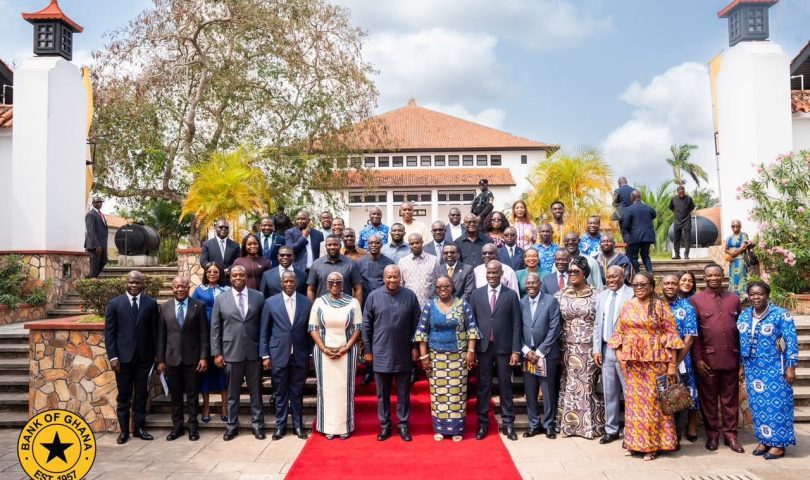

President John Dramani Mahama has announced a comprehensive national roadmap centered on five foundational pillars and a definitive end to International Monetary Fund (IMF) bailouts. Speaking at the opening of the 77th Annual New Year School and Conference at the University of Ghana, the President declared that the nation is at a defining crossroads, necessitating a transition from short-term economic fixes to long-term development anchored by robust institutions. Under the theme “Building the Ghana We Want Together for Sustainable Development,” the President emphasized that the country must break the cycle of discarding economic programmes following regime changes, calling instead for disciplined implementation and a collective national endeavor.
A significant highlight of the President’s address was the confirmation that Ghana is on track to conclude its current Extended Credit Facility with the IMF by the middle of this year. Asserting that this must be the 17th and final time the nation seeks such a bailout, he pointed to a strengthened economic foundation as evidence of newfound stability.
This includes a stable currency, which he noted was the world’s best-performing in 2025, alongside reduced inflation, a lower debt-to-GDP ratio, and bolstered foreign reserves. To safeguard these gains against future political transitions, the President announced major governance reforms, including the inauguration of the Constitutional Review Implementation Committee by the end of this month and the establishment of an Independent Value for Money Office to scrutinize public expenditure.
The President’s economic vision rests on a shift toward mandatory value addition for all minerals, petroleum, and agricultural exports, a move he described as central to the “24-Hour Economy” strategy. This policy aims to deepen manufacturing and create jobs while building national resilience.
Furthermore, the President detailed a “Big Push” infrastructure programme with a GH¢30.8 billion allocation for 2026. This initiative will fund nationwide projects in roads, rail, health, and education, featuring landmark developments such as the construction of the Accra-Kumasi Expressway and the creation of a smart Green Digital City across three regions to alleviate congestion in the capital.
Supporting the President’s vision, the Vice-Chancellor of the University of Ghana, Professor Nana Aba Appiah Amfo, highlighted the university’s role in fostering innovation through projects like the Digital Youth Village, which is over 60 percent complete.
The facility will serve as a hub for the government’s One Million Coders programme. Additionally, the Governor of the Bank of Ghana, Dr. Johnson P. Asiama, reaffirmed the restoration of macroeconomic stability, noting that inflation has eased into single digits for the first time since 2019 and international reserves have risen to $13.8 billion. The conference, which serves as a bridge between academia and policy, will conclude with further insights from the Minister of Finance, Dr. Cassiel Ato Forson, regarding the government’s forward-looking economic strategy.
Ruth Abla ADJORLOLO