


By The Sankofaonline Editorial Board | November 24, 2026
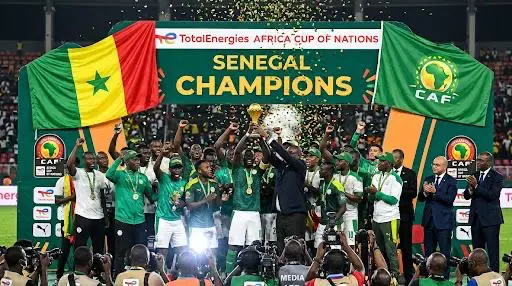
At Sankofaonline, we take no pleasure in saying, “we told you so.” Yet today, as the Court of Arbitration for Sport (CAS) in Lausanne overturns the Confédération Africaine de Football’s controversial decision and restores Senegal as the legitimate champion of the TotalEnergies Africa Cup of Nations 2025, the conclusion is unavoidable. Justice has finally caught up with common sense.
From the very moment CAF sought to award the African crown to Morocco despite Senegal’s triumph on the field of play, Sankofaonline condemned the decision in the strongest possible terms. We warned that African football was drifting into dangerous territory, where political calculations, administrative maneuvering, and institutional arrogance threatened to supersede the sacred verdict of the pitch. We cautioned that if CAF could overturn football results through opaque processes disconnected from the game itself, then no victory, no championship, and no trophy would ever be secure.
Today, Lausanne has vindicated that position.
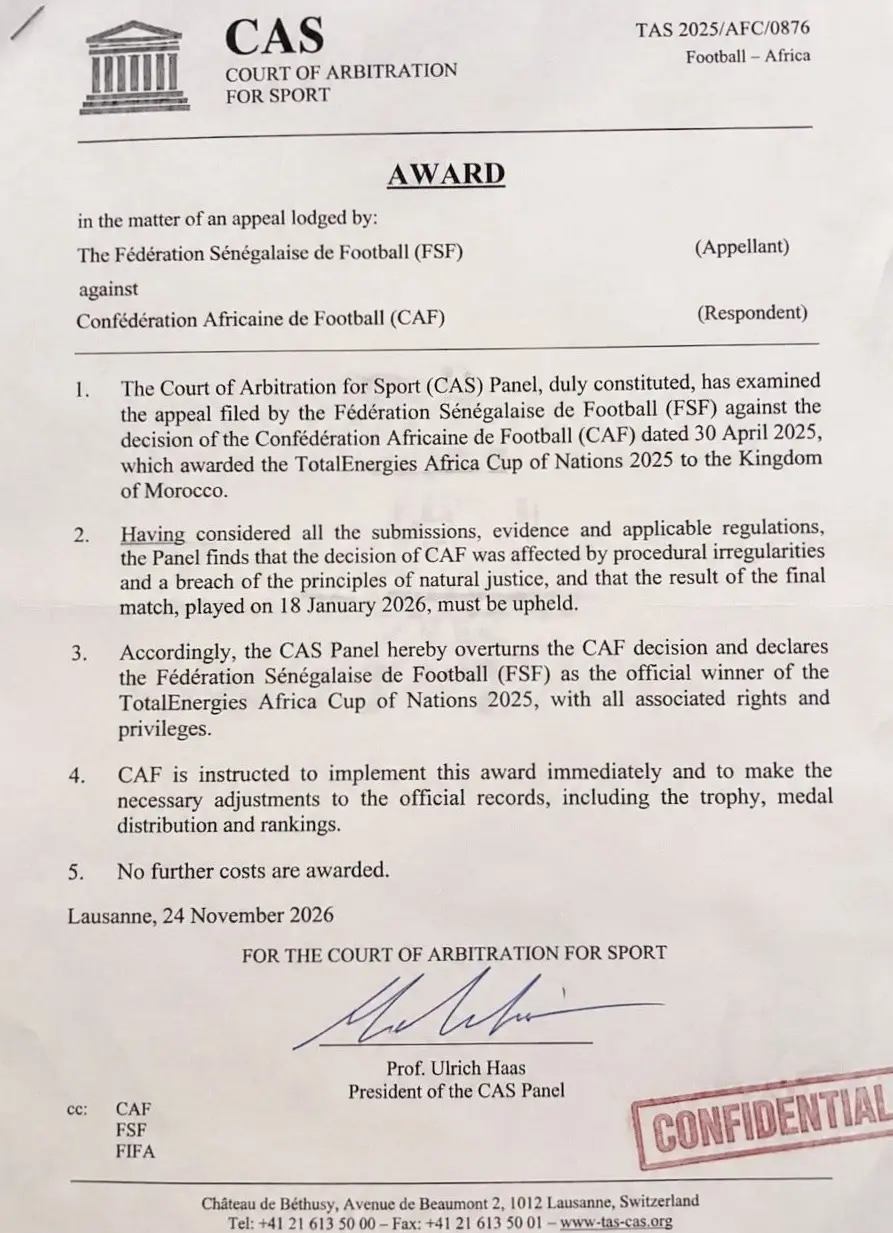
The ruling issued by CAS on November 24, 2026 is not merely a legal victory for Senegal. It is a rebuke of administrative excess. It is a restoration of sporting integrity. Most importantly, it is an affirmation of a principle older than CAF itself: football matches are decided by players, not bureaucrats.
The CAS panel, chaired by Professor Ulrich Haas, found CAF’s actions to be marred by procedural irregularities and a breach of the principles of natural justice. Those words should reverberate through every corridor of African football governance. They are not technical observations. They are an indictment. They expose a disturbing failure of process within the institution entrusted with protecting the credibility of the continent’s most prestigious football competition.
For months, CAF forced African football into an avoidable crisis. Instead of celebrating the brilliance of the tournament and elevating its international prestige, administrators plunged AFCON into uncertainty. They transformed what should have been a triumphant chapter for African sport into a damaging spectacle of controversy, confusion, and institutional embarrassment.
The consequences extended far beyond boardroom disputes.
Millions of supporters across Africa watched with disbelief as the legitimacy of a completed competition was questioned. Senegal’s players, coaches, and supporters were denied the unchallenged recognition they had earned through talent, discipline, sacrifice, and determination. The tournament itself suffered reputational damage. Every day that passed without resolution deepened skepticism about whether African football’s governing structures were capable of upholding fairness and transparency.
This is precisely why Sankofaonline opposed CAF’s decision from the beginning.
The issue was never about Senegal versus Morocco. It was never about nationality, regional allegiance, or political preference. It was about principle. If an organization can disregard what occurred on the field without following strict standards of fairness and due process, then the foundation of competitive sport begins to crumble. The whistle at the end of a final must mean something. The scoreboard must mean something. Victory must mean something.
Otherwise, football ceases to be sport and becomes theatre directed from executive offices.
The CAS verdict should therefore be viewed as a watershed moment for African football governance. It sends a clear and uncompromising message to every sporting administrator on the continent: authority is not absolute. Governing bodies are custodians of the game, not owners of its outcomes. Their mandate is to enforce rules fairly, not manufacture champions. Their responsibility is to protect competition, not manipulate its conclusions.
Let CAF understand this lesson clearly.
The Africa Cup of Nations was built by players, supporters, and generations of Africans who invested their passion into the game. It was not built by committees. It was not built by legal departments. It was not built by executive decrees.
Championships are earned through ninety minutes of courage, tactical discipline, athletic excellence, and competitive sacrifice. They cannot be reassigned through administrative convenience. They cannot be transferred through institutional preference. They cannot be redesigned to fit political narratives.
They are won on the grass.
CAS has now ordered CAF to immediately correct official records, rankings, medal allocations, and trophy recognition. That is the bare minimum required by justice. However, African football deserves more than administrative compliance. It deserves accountability. Supporters deserve answers. The continent deserves assurances that such a fiasco will never be repeated.
African football cannot afford another episode where confidence in its highest institutions is undermined by decisions later dismantled in international arbitration.
Senegal did not become champions today.

Senegal became champions on the pitch.
What happened in Lausanne was simply the restoration of a truth CAF should never have attempted to erase.
The final lesson could not be clearer: trophies belong to those who win them on the field, not to those who claim them in boardrooms. African football must never forget that again.