

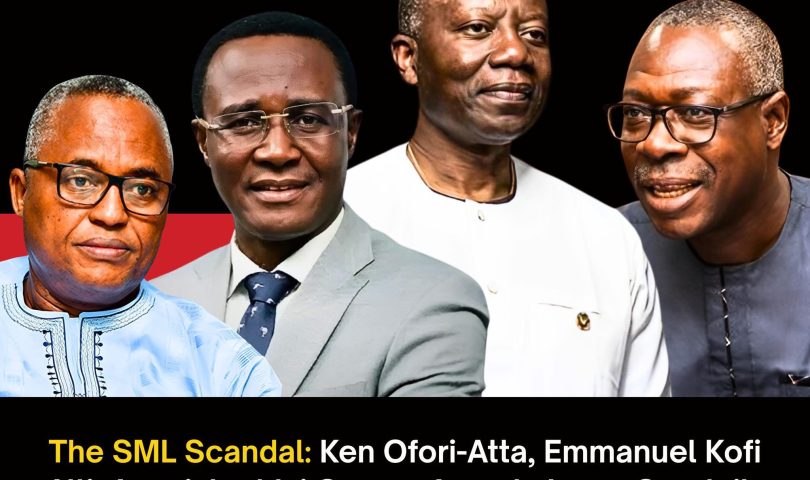

………The SML Scandal: The key players – Ken Ofori-Atta, Emmanuel Kofi Nti, Ammishaddai Owusu-Amoah , Isaac Crentsil and Evans Adusei — C1.4 billion looted.
₵1.4 Billion Strategic Mobilization Loot: When you sit in traffic from Kasoa to Accra, you may wonder why the same road that serves thousands every morning still floods after every rainfall. You may also wonder why the same potholes keep reappearing. Then you learn that a private company, created three weeks after a new Finance Minister took office, received about ₵1.4 billion, roughly one hundred and twenty million dollars ($120 million), of public money for work that was never done.
That company is Strategic Mobilisation Ghana Limited (SML). The Office of the Special Prosecutor (OSP) reports that SML was paid large sums under contracts that were illegal, unapproved, and without measurable value. In effect, the state paid for a service that did not exist.
SML was incorporated on 14 February 2017. It had no track record, technology, or experience in customs or petroleum auditing. Yet within a few months, the Ghana Revenue Authority (GRA) tried three times to award it a contract through sole sourcing. The Public Procurement Authority (PPA) rejected each attempt. The company later changed its name from Strategic Mobilisation Enhancement Limited (SMEL) to Strategic Mobilisation Ghana Limited (SML), keeping the same directors and structure.
Through political influence, SML was attached to West Blue Ghana Limited, which already had a valid contract running the National Single Window system. West Blue had the expertise, SML did not. When West Blue stopped sharing its data, SML’s operations halted, yet payments continued.
In 2019, the GRA extended SML’s expired arrangement directly, without parliamentary approval or procurement clearance. In April that year, a new contract was added for external price verification. Again, there was no approval and no evidence of performance. The OSP’s review of internal communications shows SML repeatedly requesting access to West Blue’s data while the Ministry of Finance and the GRA continued releasing funds. In November 2020, the Minister personally authorised the payment of ₵65,193,701.90 from the Petroleum Revenue Account to SML for audit services already being done by the National Petroleum Authority (NPA).
On 3 October 2019, two five year contracts were signed with SML, one to consolidate its earlier roles and another to audit petroleum volumes. Both lacked legal basis. They were signed by a Commissioner General who had already retired, and his successor continued with the same arrangement. The OSP found that payments were automated and detached from any verified work.
The NPA already had a digital monitoring system for fuel distribution, and Customs had its own system integrated into ICUMS. SML claimed to offer additional verification but only duplicated work already being done while charging the state one percent of the value of every litre of fuel sold.
By December 2024, SML had received approximately ₵1.4 billion. The OSP found no verifiable reports or deliverables. KPMG’s independent audit confirmed the same findings: no lawful procurement, no measurable output, and no justification for the payments. The report concluded that the arrangement caused a significant financial loss to the Republic.
The law forbids public officers from using their positions for private profit. Multi year contracts must be approved by Parliament. Procurement processes must not be influenced by personal interest. The OSP found that these principles were violated. Those named include former Finance Minister Ken Ofori Atta, former GRA Commissioners Emmanuel Kofi Nti and Ammishaddai Owusu Amoah, former Customs Commissioner Isaac Crentsil who later became SML’s General Manager, and SML’s owner, Evans Adusei.
It is important to reflect on what ₵1.4 billion could have done for Ghana. It could have built ten well equipped regional hospitals with maternity and emergency units. It could have rehabilitated over 3,000 kilometres of feeder roads, improving access for farmers and traders. It could have completed the cardiac centre at the Komfo Anokye Teaching Hospital (KATH) and expanded accident and trauma facilities nationwide. It could have funded 250 classroom blocks with teacher accommodation and provided clean water systems for rural districts still dependent on unsafe sources.
Instead, these funds went to a company that the procurement authority had rejected three times and that delivered nothing of value.
This case is more than a financial scandal. It represents a failure of public accountability. While classrooms remain overcrowded and hospitals struggle for basic equipment, millions of cedis were paid to a company with no proven record of performance.
The OSP has done the work of tracing the money, identifying the officials involved, and documenting the breaches. What remains is for the state to act on the evidence. Accountability should not depend on political convenience. If this report is ignored, it will reinforce the belief that corruption in Ghana is not a crime but an entitlement.
₵1.4 billion is not just a number on paper. It represents hospitals unbuilt, roads unrepaired, and opportunities lost. Until these funds are recovered and those responsible held accountable, Ghana will continue to pay the price for looking away.
Kay Codjoe
Ken Ofori Attah is a gentle criminal and he must be dealt with.