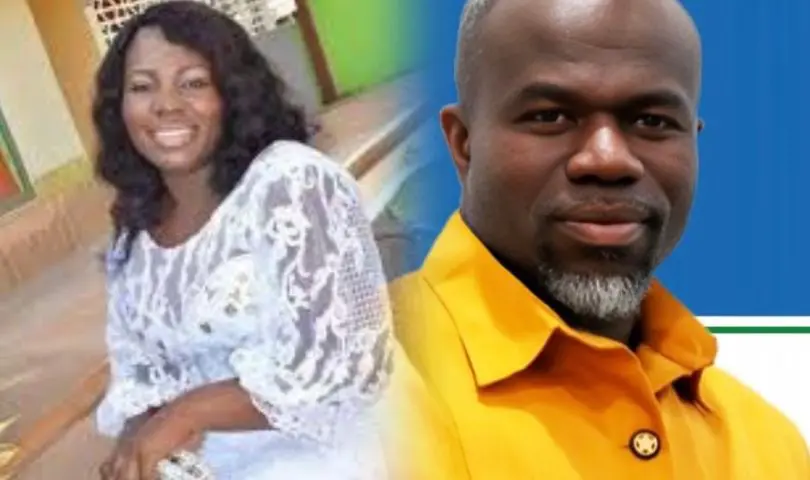

A Call for an Independent Probe Into Questions of Due Process, Institutional Conduct and Political Interference
By Barima Nana Ntiamoah
I have followed the arrest and continued detention of Senior Nursing Officer Salomey Awiti Bafoh with growing concern.
She is a 40-year-old mother of three whose name has become associated with the investigation involving UK-based social-media personality Barbara Asantewaa Kodua, popularly known as “Ghana Jollof.”

The more I follow this case, however, the more I believe it has become about something bigger than Salomey Bafoh.
It is becoming a test of our institutions.
Questions remain about the circumstances of her arrest and continued detention. There are questions about due process. Questions remain about the handling of electronic evidence. There are questions about the welfare of the children left behind. And some questions must be asked about claims concerning information allegedly obtained from a phone in the custody of state investigators finding its way into partisan political commentary.
I am not presenting a conspiracy as a fact.
On the contrary, it is because these questions remain unanswered that I believe an independent and credible investigation is necessary.
WHAT EXACTLY JUSTIFIES THE CONTINUED DETENTION?
Let us begin with what is publicly known.
Ms. Bafoh was arrested at her home near Techiman in September 2026. She was subsequently brought before the Adentan Circuit Court and charged with abetment of crime in relation to the alleged publication of false news.
She pleaded not guilty.
The prosecution alleges that she acted as a liaison for Ghana Jollof and assisted in disseminating her videos. Police have also publicly alleged that their investigations uncovered interactions and financial transactions between the two women.
Those are serious allegations and should be investigated seriously.
But they remain allegations.
They have not become findings of guilt merely because they were announced at a press conference or repeated in the media.
The Adentan Circuit Court refused Ms. Bafoh bail and remanded her into police custody. Her lawyers subsequently went to the High Court seeking her release.
The High Court also refused bail, citing the cyber-related nature of the investigation and concerns that her release at that stage could interfere with the investigation. Significantly, however, the court directed the police to expedite their investigations and indicated that another bail application could be made if circumstances changed.
I respect the independence of Ghana’s judiciary. Judges must decide matters according to the law and evidence before them, free from political intimidation.
But judicial independence does not mean judicial decisions are beyond legitimate public scrutiny.
Neither should respect for the police prevent citizens from questioning how state power is exercised.
When the state takes away a citizen’s liberty before trial, the need for scrutiny becomes greater, not smaller.
The principle at stake is simple and fundamental: Salomey Awiti Bafoh remains presumed innocent unless and until a court of competent jurisdiction finds her guilty.
Her detention should therefore serve a legitimate investigative or judicial purpose. It must never quietly become punishment before conviction.
WHAT ABOUT THE CHILDREN LEFT BEHIND?
There is another aspect of this case that troubles me deeply.
Salomey Bafoh is a mother of three.
Her lawyers have publicly spoken about the impact of her detention on her children, including concerns relating to the Senior High School enrolment of one of them.
So I ask a simple question:
What has been done about these children?
Has the Ministry responsible for Gender, Children and Social Protection taken an interest in their welfare?
Has Social Welfare assessed their circumstances?
Has anybody from the relevant state institution visited them or established what support they may require?
If that has happened, then that should be acknowledged, while protecting the children’s privacy.
But if it has not happened, then we deserve to know why.
Being a mother does not place anyone above the law. That is not my argument.
My point is that when the state removes a parent from the home for an extended period, particularly a mother of minor children, another arm of that same state should at least be interested in what happens to the children left behind.
Justice cannot mean that we remember the accused but forget the innocent children affected by the process.
THE PHONE: A QUESTION THAT DEMANDS AN ANSWER
For me, one of the most troubling aspects of this entire affair concerns the handling of digital information.
A mobile phone today is not merely a telephone.
It can contain years of someone’s private life: messages, photographs, contacts, banking information, family conversations, professional correspondence and other highly sensitive material.
When such a device is seized as part of a criminal investigation, the state assumes an enormous responsibility.
The evidence must be preserved.
The chain of custody must be protected.
Access must be lawful and properly controlled.
And information obtained for an investigation should not become political currency.
This is why I am particularly concerned by claims in the public space suggesting that political communicators know information allegedly obtained from Ms. Bafoh’s phone.
I want to draw a careful distinction here.
I have not seen independently verified evidence proving that any particular NDC communicator received forensic material from Ms. Bafoh’s seized phone directly from National Security, the Police CID, or any other state institution.
It would therefore be irresponsible to state that as a fact.
But if any political communicator has publicly claimed to have seen or obtained information extracted from a device held by investigators, that claim itself deserves investigation.
How did the person obtain it?
Was the information genuine?
Was the claim fabricated for political purposes?
Did it come from another source?
Or did confidential information from an active state investigation somehow reach people outside the investigative and judicial process?
None of those possibilities should simply be brushed aside.
If the claim was false, that should be established.
But if confidential investigative information was actually disclosed to political actors, then we are dealing with something far more serious than the prosecution of one nurse.
We would be dealing with the integrity of the state itself.
STATE INVESTIGATION MUST NEVER BECOME POLITICAL INTELLIGENCE
The Police CID exists to investigate crime.
National Security exists to protect the Republic.
Prosecutors must prosecute according to law and evidence.
The judiciary exists to administer justice independently.
Social Welfare has responsibilities towards vulnerable people and children.
Political communicators engage in partisan political advocacy.
Those functions must not become blurred.
A citizen should be able to surrender a phone to investigators, voluntarily or through lawful seizure, without wondering whether private information will later become ammunition on a political radio programme.
That would be dangerous for our democracy.
Today it may be Salomey Bafoh.
Tomorrow it could be an NDC member.
The next day it could be a journalist, businessman, civil servant, activist or an ordinary Ghanaian who has no political affiliation whatsoever.
Our concern should therefore extend beyond who is currently in government and who is currently in opposition.
State institutions outlive governments.
THE CASE FOR AN INDEPENDENT PROBE
This is why I believe that, at the appropriate time, there must be an independent examination of the circumstances surrounding this case.
Such an inquiry should establish the full chronology of Ms. Bafoh’s arrest and detention and identify the agencies involved.
It should examine the handling and chain of custody of every electronic device seized from her.
It should establish who had authorised access to those devices, when that access occurred and for what investigative purpose.
Most importantly, it should determine whether confidential material obtained during the investigation was disclosed to any unauthorised person, political operative, or communicator.
If no such disclosure occurred, let an independent investigation clear the institutions concerned.
If it did occur, Ghana deserves to know who was responsible and why.
The inquiry should also establish what action, if any, the relevant Social Welfare and child-protection authorities took concerning the welfare of Ms. Bafoh’s children.
And scrutiny of the judicial process should focus on the law, procedure, and institutional safeguards rather than personal attacks on individual judges. Judicial independence is too important to sacrifice, even when citizens strongly disagree with a judicial decision.
LET THE EVIDENCE SPEAK
I am not asking anyone to declare Salomey Awiti Bafoh innocent through political commentary.
That is for the courts.
If the state possesses credible evidence that she committed an offence, put that evidence before the court and prove the case according to law.
If there are genuine national-security implications, demonstrate them through the proper legal process.
But the state must remember that the power to investigate is not the power to punish before conviction.
An arrest is not a conviction.
A police allegation is not a judicial finding.
A press conference is not a trial.
And detention must never become a substitute for proving a case.
A QUESTION FOR GHANA’S NEXT PRESIDENT
I believe whoever next takes the oath of office as President of the Republic should be prepared to look seriously at cases such as this and, where the evidence warrants it, establish an independent probe into possible institutional abuse.
Not because Salomey Bafoh is NPP or NDC.
Not because Ghana Jollof supports one political party or attacks another.
But because the Police Service, National Security, the judiciary, Social Welfare and every other institution implicated in these questions belong to Ghana.
If there was no wrongdoing, an independent examination can help restore confidence.
If mistakes were made, they should be acknowledged and corrected.
If confidential information was unlawfully disclosed, those responsible should answer for it.
And if evidence eventually establishes deliberate coordination among individuals within state institutions and political actors to abuse the investigative or judicial process, accountability must reach everyone involved, irrespective of office, uniform, political affiliation or status.
That is the standard we should demand.
Because this is no longer simply about one nurse.
It is about whether an ordinary Ghanaian can trust the police with evidence.
Whether we can trust investigators with our private digital information.
Whether Social Welfare remembers the children when the state detains their parent.
Whether prosecutors distinguish allegations from guilt.
And whether our courts can simultaneously protect the administration of justice and the constitutional liberty of the individual.
These are not unreasonable questions.
They are questions that a functioning democracy should be strong enough to answer.
And where the institutions involved cannot provide convincing answers, Ghana should not be afraid of an independent probe capable of finding them.
Justice must not only pursue wrongdoing.
It must also restrain the power of the state.
For God and Country.