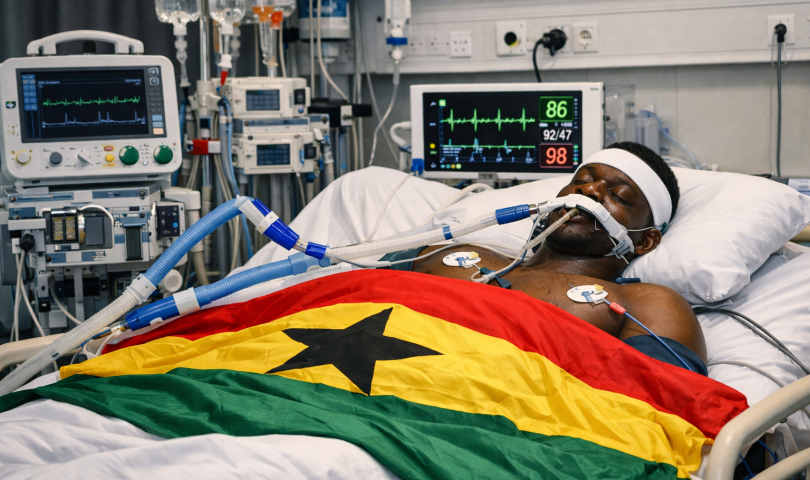

The doctors have been inside for hours. Machines have been beeping. Relatives have been praying quietly. One uncle has already started calling distant family members “just in case.” Everybody is tense because nobody knows whether the patient will survive the night.
Then suddenly, a doctor walks out and says:
“He’s stable now. We’ve moved him out of ICU.”
Nobody hearing those words assumes everything is suddenly fine.
Why?
Because everybody understands something important: stable is not the same as fully healed.
That is perhaps the best way to understand Ghana’s latest IMF announcement.
When Ghana entered the IMF programme under the NPP administration, the economy was under severe pressure. The cedi was weakening sharply. Inflation had become painful. Debt levels had become difficult to sustain. Investor confidence had declined. Government borrowing costs were extremely high. Businesses were struggling. The IMF programme did not happen because things were comfortable. It happened because the economy had reached a point where emergency intervention became unavoidable.
That was the ICU moment.
Then came the 2024 elections. The NDC administration inherited an economy already inside an IMF programme and a population exhausted by years of economic strain.
Now, within roughly one year and four months, government says Ghana has successfully concluded the IMF’s Extended Credit Facility programme and is transitioning into a Policy Coordination Instrument arrangement.
That may sound like ordinary economic jargon, but it is actually significant.
It means Ghana is no longer in economic intensive care.
The IMF is still involved. Monitoring continues. Fiscal discipline is still expected. But the emergency financing phase appears to have eased.
And to be fair, some serious gains have happened within a relatively short period.
Inflation has reportedly slowed significantly. The cedi has regained some strength. Foreign reserves have reportedly risen to around US$14.5 billion. Ghana’s sovereign ratings have improved from restricted default territory to a “B” rating with a positive outlook. Investors who recently spoke about Ghana cautiously are beginning to speak with more confidence.
Those developments are not insignificant.
But the average Ghanaian trader at Makola does not wake up discussing sovereign credit ratings. The trotro driver is not calculating import cover ratios before buying fuel. The chop bar operator is not celebrating because international analysts are optimistic again.
People experience recovery through ordinary life.
Can I afford food more easily now, can my business stay afloat, and can I pay school fees without stress?
That is the economy citizens actually feel.
So while government deserves acknowledgment for stabilizing conditions faster than many expected, it must avoid speaking as though the struggle has completely ended. Recovery can still be fragile. Economic confidence can reverse quickly if discipline weakens or old habits return.
That is why this moment should not become merely a political celebration. It should become a national lesson.
Because nobody leaves a monitored recovery ward and immediately starts sprinting.
You recover carefully. You rebuild patiently.
And you remain conscious of what brought you to the hospital in the first place.
Kay Codjoe