


By Stephen Apolima | 18 June, 2025
Accra, Ghana – In a bold and necessary move to uphold the sanctity of Ghana’s academic space, the Ghana Tertiary Education Commission (GTEC) has formally cautioned [Central Regional Chairman of the NDC], Mr. Richard Kofi Asiedu, CEO of the St. Andrews Group of Schools and Companies, over his continued use of the honorary title “Professor.” In a letter dated June 14, 2025, the Commission directed Mr. Asiedu to cease using the title, citing the misleading nature of such unaccredited academic designations.
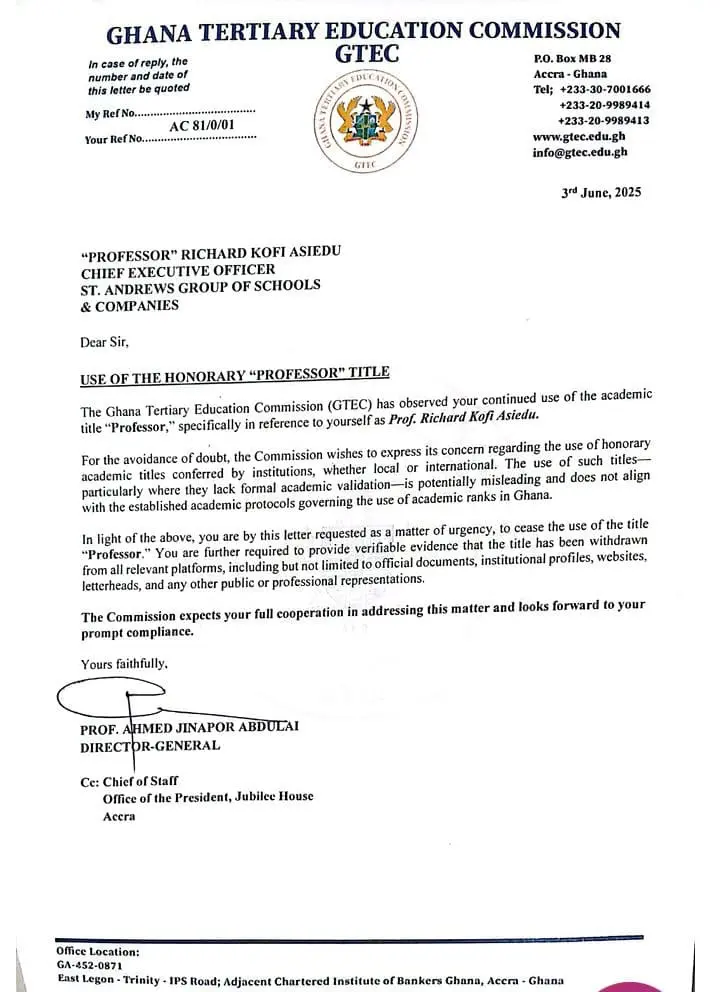
The letter, signed by the Director-General of GTEC, makes it clear that even when titles such as “Professor” are conferred by foreign or honorary institutions, they must not be used in Ghana unless they are formally validated within the country’s academic framework. GTEC warned that the continued use of such a title “is potentially misleading and does not align with the established academic protocols governing the use of academic ranks in Ghana.”
This public caution follows a worrying trend of politicians, businesspeople, and public figures adopting academic titles such as “Dr.” or “Prof.” without fulfilling the rigorous academic requirements these designations imply. While Mr. Asiedu’s case is the latest and perhaps most high-profile, he is not alone.
In recent weeks, Hon. Phillis Naa Koryoo Okunor, Member of Parliament for Awutu Senya East, was similarly cautioned over the unsubstantiated use of the title “Dr.” GTEC, along with other relevant authorities, has insisted that such titles must reflect legitimate academic achievement, not social status or political ambition.
Another individual under scrutiny is Dr. Joseph Obeng, President of the Ghana Union of Traders Association (GUTA). GTEC reportedly warned him against the use of the “Dr.” prefix unless he can verify its academic basis. These interventions, while not punitive, are corrective and necessary to protect the integrity of Ghana’s educational institutions.
Academic titles are not mere decorations. They signify years of study, rigorous research, peer-reviewed scholarship, and in the case of professorships, institutional recognition through competitive academic appointment. When such titles are misused, they not only mislead the public but also devalue the credibility of those who have legitimately earned them.
Furthermore, the misuse of academic titles can influence public trust. Politicians and public figures wield significant influence, and when they present themselves with inflated or unverifiable credentials, it raises ethical questions. Ghana must be vigilant to ensure that credibility is not sacrificed on the altar of populism or prestige.
GTEC’s proactive actions deserve commendation. However, this campaign must not be episodic or reactive. It should be sustained, institutionalized, and backed by public education. The Commission could consider publishing periodic lists of verified academic titleholders or working with the Ministry of Education to establish a national database of accredited titles.
Moreover, media outlets, educational institutions, and civil society groups must all play their part. Fact-checking academic claims should be a standard practice, especially for those seeking or holding public office.
In a society increasingly driven by optics and credentials, preserving the dignity of academic titles is a matter of national interest. GTEC has taken the right first steps, but the road ahead requires consistent enforcement, transparency, and collaboration.
The case of “Prof.” Richard Kofi Asiedu is not just about one man. It is a reflection of a broader issue in Ghanaian society—one that threatens to erode the value of genuine academic achievement. GTEC must be encouraged and supported in this crusade. The dignity of our education system, the honour of our scholars, and the trust of the Ghanaian people depend on it.

Anyone unqualified using such academically unacquired academic title is being deceptive to all mankind. Deception is criminal. Now, the activities of a criminal dangerously impacts society. So we have many such criminals, also foolishly referred to as “honourables” by the citizenry in charge of critical roles of society. Obviously, such a country will never prosper, because many criminals are in charge by virtue of stolen titles!
GTEC must also be blamed. They never proved their relevance or essence of their establishment all these while. So, why now? GTEC is a microcosm of the malaise of society. There are well paid, well resourced public institutions and bodies acting as if they didn’t exist. Then, one day, for some strange reason, (strange, because it’s not normal of them) suddenly swing into action and in a frenzy as if they had had some potent concoction. AMA with vulcanizers plying their trades on half of public streets, Environmental Protection Authority and polluting “mobile chimneys” on our roads and dvla and car owners converting their DV number plates into permanent number plates, with police in constant amicable, happy ending conversations with such offenders. Anyway, GTEC, better late than never though. I will buy a pot of grease to come grease your elbows.
Good step by GTEC
All must support GTEC to sanitize the system
There are many more GTEC must cautioned. Is GTEC making input from the public to identity such individuals with those unaccredited titles?
GTEC, I think you have started a good thing to bring sanity into the system. I am wondering if you can use your own systems and visits to many of the private universities to achieve the needed results. There are a lot more of such in there.