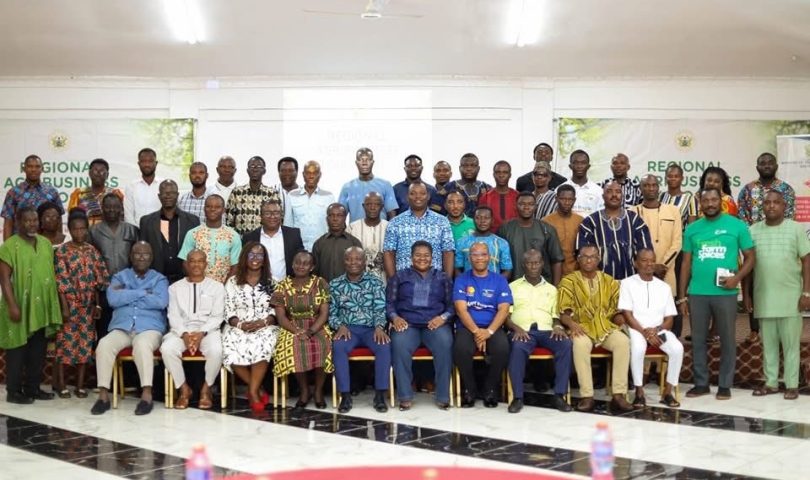

Ghana has reached the final stage in developing its National Agribusiness and Agro-Processing Policy, with the Ministry of Trade, Agribusiness and Industry, in partnership with AGRA and Agri-Impact, concluding the last regional consultation in Ho on Friday, December 12, 2025. This nationwide process is now set for a national validation meeting in the coming days.
At the final dialogue session for the Volta and Oti regions, AGRA’s Country Director, Dr. Betty Annan, expressed pride in supporting Ghana’s national reform agenda aimed at strengthening agribusiness competitiveness and resilience.
Speaking on behalf of the Volta Regional Minister, Alhaji Mohammed Avorna stressed that agribusiness is central to Ghana’s transformation, noting that while the Volta Region is agriculturally diverse, its potential is constrained by post-harvest losses, limited processing capacity, finance, and weak infrastructure. Regional priorities outlined include expanding agro-processing zones, improving irrigation, enhancing feeder roads, promoting climate-smart technologies, and strengthening structured markets.
The Director of Agribusiness at the Ministry of Trade, Agribusiness and Industry, Mr. Kwame Oppong Ntim, reaffirmed the government’s commitment to integrating agribusiness into the broader industrial agenda, citing the Ministry’s restructuring as a deliberate shift toward value addition. He emphasized the need to invest in innovation and value-added processing to remain competitive in a global agribusiness market projected to reach US$5.8 trillion by 2033.
To address the issue of industries operating below capacity due to unreliable raw material supply, Mr. Oppong Ntim highlighted government flagship programmes such as the Feed the Industry Programme and announced a short-term waiver of taxes on agro-processing machinery.
The final National Validation Meeting will consolidate expert inputs gathered nationwide to review, refine, and finalize the draft policy for Cabinet submission, focusing on policy gaps, practical reforms, and implementation mechanisms.
The Gender, Youth and Social Inclusion Manager, Ms. Ama Gyan, emphasized the need for the reforms to address challenges facing women and youth, including weak aggregation systems, limited finance, and climate risks.
Ruth Abla ADJORLOLO