

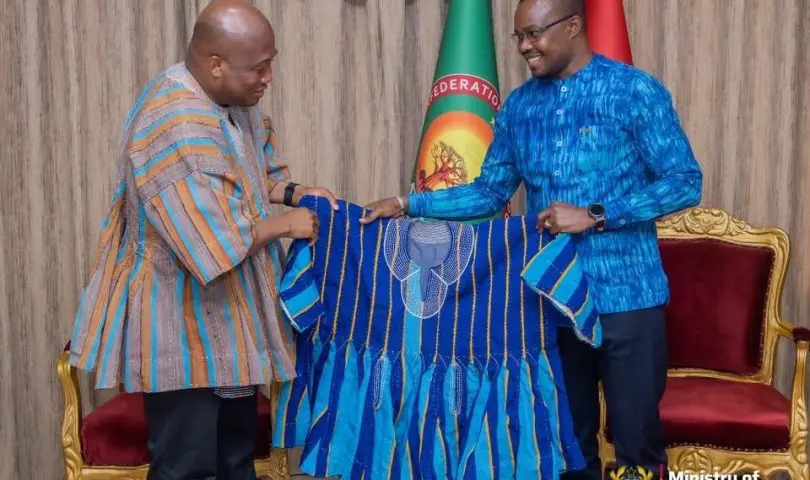

The governments of Ghana and Burkina Faso have formalized a sweeping new partnership aimed at neutralizing regional instability and enhancing bilateral ties following a high-level diplomatic mission to Ouagadougou. Ghana’s Minister for Foreign Affairs and Regional Integration, Samuel Okudzeto Ablakwa, concluded a successful two-day official visit marked by substantive discussions with Burkinabè Prime Minister Rimtalba Jean Emmanuel Ouédraogo and Foreign Minister Karamoko Jean-Marie Traoré.
During the summit, both nations condemned recent terrorist activities and committed to a sophisticated new security framework designed to combat the rising scourge of violent extremism across their shared borders.
A centerpiece of the diplomatic breakthrough was the reactivation of the Permanent Joint Commission for Cooperation (PJCC), an essential bilateral mechanism that had remained dormant for six years.
This revival follows strategic foundational meetings held last year between President John Dramani Mahama and President Captain Ibrahim Traoré. The conclusion of the PJCC sessions culminated in the signing of seven pivotal agreements spanning national security, infrastructure, and humanitarian management. These accords include the mutual recognition of national driver’s licenses, new protocols for transport and road transit, and a comprehensive framework for cross-border cooperation and border reaffirmation.
Addressing long-standing environmental challenges, the two nations established a dedicated partnership on disaster management specifically tailored to mitigate the devastating annual consequences of the Bagré Dam spillage. Further agreements were signed to coordinate the fight against the illicit cultivation and trafficking of narcotic drugs and psychotropic substances.
Minister OKUDZETO Ablakwa described the relations between the two West African neighbors as exceptionally cordial and forward-looking, expressing profound appreciation for the hospitality of the Burkinabè people while emphasizing that the new agreements represent a meaningful step toward a more integrated and secure sub-region.
Ruth Abla ADJORLOLO
