
Sankofaonline News Desk | July 13, 2026
Ghana’s public discourse has been jolted by a corruption case whose shockwaves are still rippling through the political class, civil service, and citizenry. The Economic and Organised Crime Office (EOCO) has confirmed the arrest of Dennis Edward “Miracles” Aboagye, former Executive Secretary of the Inter-Ministerial Coordinating Committee on Decentralisation (IMCCoD), and Gerald Appiah, the Committee’s former Accountant, in connection with suspected misappropriation, diversion, and dissipation of ₵55 million in public funds.
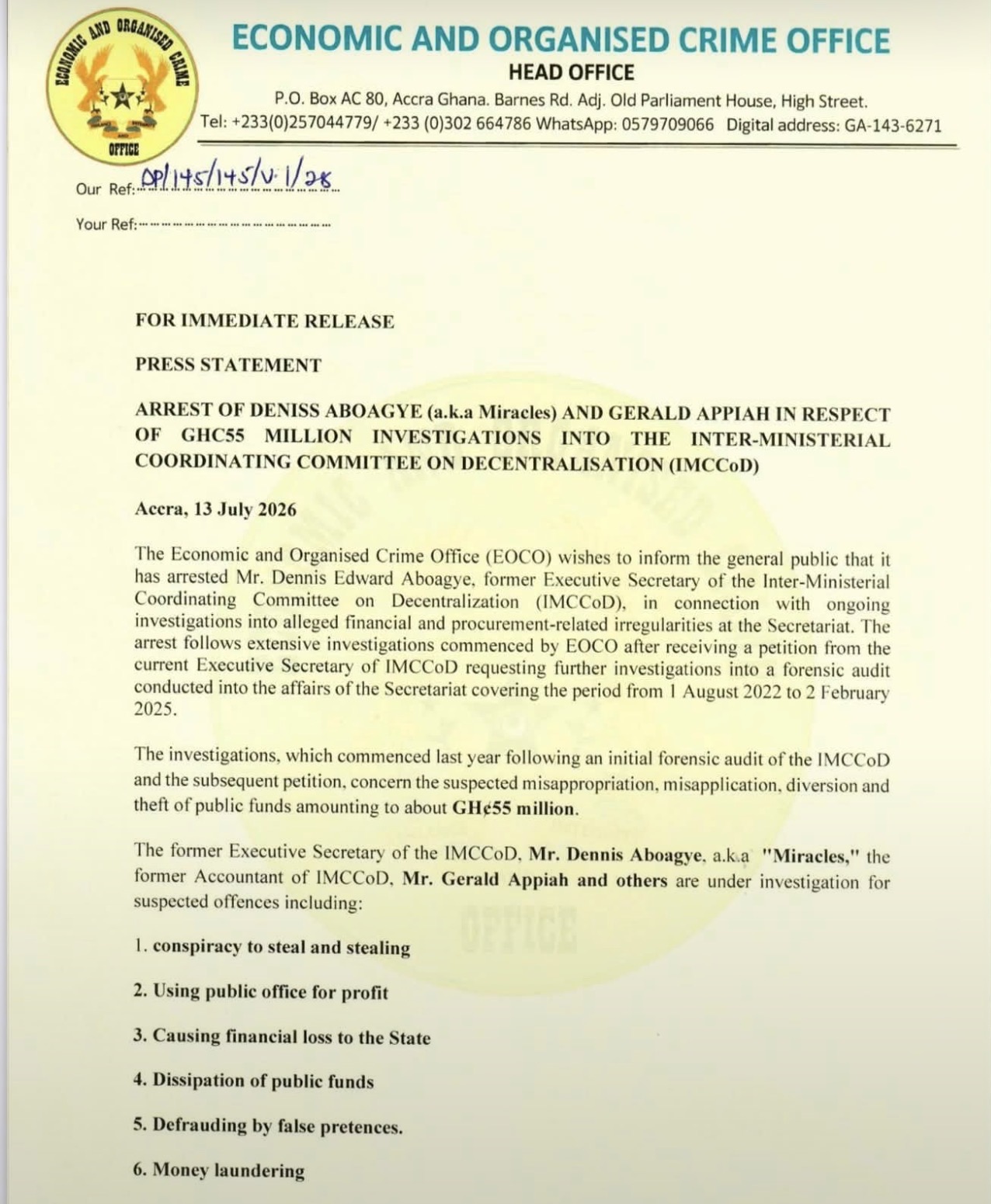
The official EOCO documents attached to this report are stark, methodical, and unflinching. They outline suspected offences including conspiracy to steal, stealing, using public office for profit, causing financial loss to the State, dissipation of public funds, defrauding by false pretences, and money laundering.
The investigation began after the current Executive Secretary of IMCCoD petitioned EOCO for a forensic audit covering August 1, 2022 to February 2, 2025. What auditors uncovered was alarming enough to trigger a full criminal probe. EOCO’s subsequent operational actions, as detailed in the second document, reveal a dramatic sequence: Gerald Appiah has begun refunding portions of the alleged loot; Miracles Aboagye was placed on a Stop Order but had already left the country; upon his return, Immigration officers executed the order and handed him over to EOCO; both men are being processed for bail as investigations continue.
This is not a routine administrative inquiry. It is a confrontation with the culture of impunity that has long plagued Ghana’s public institutions.
The IMCCoD is not a flashy ministry. It is a coordination committee—one of the quiet engines of governance. If ₵55 million can allegedly be siphoned from such a body, what does that say about the broader system? EOCO’s tone signals a shift: a refusal to be intimidated, a commitment to professionalism, and a willingness to pursue public assets aggressively.
The public reaction has been immediate and explosive. Verified reporting from Ghanaian media shows that shock and disbelief dominated early reactions, with many Ghanaians expressing outrage that such a colossal sum could vanish from a decentralisation committee. Supporters of Miracles Aboagye mobilised quickly, leading to protests at EOCO headquarters. Security forces—including military officers and National Security operatives—were deployed to control the crowd. Anti-corruption advocates applauded EOCO’s firmness, while sceptics questioned whether the case would end in conviction, citing Ghana’s history of stalled prosecutions. A trending sentiment across X and Facebook was the demand for transparency: “Publish the audit. Publish the transactions. Publish the names.” Memes and satire exploded, especially around the phrase “returning the loot,” which appeared in EOCO’s own statement.
The next phase of this investigation will determine whether this moment becomes a turning point or another forgotten headline. Will EOCO publish the forensic audit? Will political pressure interfere with the investigation? Will the Attorney-General pursue charges vigorously? Will the alleged ₵55 million be fully traced and recovered? Will this case inspire reforms in procurement, auditing, and decentralisation governance?
Ghana stands at a crossroads. The arrest of Miracles Aboagye and Gerald Appiah is more than a legal event. It is a moral test. It challenges the nation to confront the quiet, bureaucratic corruption that drains public resources and erodes trust. It forces citizens to ask hard questions about oversight, transparency, and the true cost of governance failures. And it reminds every public official that the era of impunity is slowly, painfully, but unmistakably coming to an end.
If you want this transformed into a gloves-off Sankofaonline confrontation piece, a breaking-news bulletin, or a follow-up investigative editorial, I can sharpen it further.