

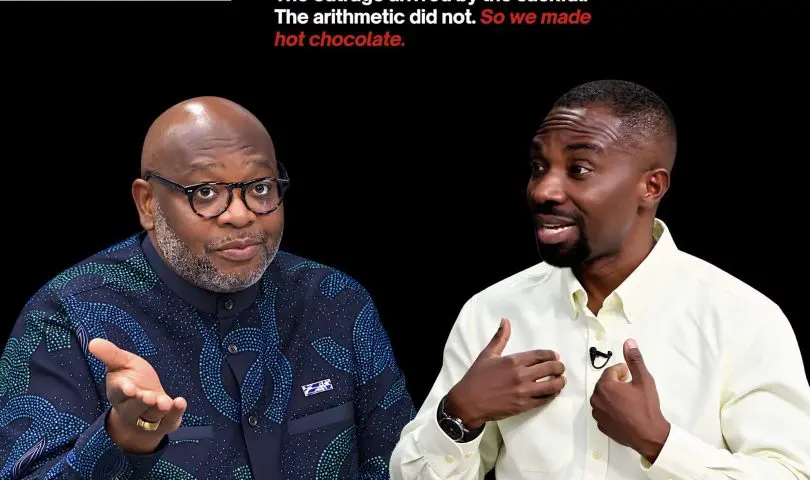


Dennis Miracles Aboagye, who has yet to publicly confirm or deny The New Republic’s report that he is seeking an EOCO plea bargain, has returned to the Cocoa Court of Public Opinion. This time, the alleged crime against humanity is a GH¢63 increase per bag. The congregation has already delivered judgment. The denominator, unfortunately, is still waiting to be called as a witness.
Apparently GH¢2,650 per bag has arrived as the latest exhibit in the prosecution of COCOBOD and its current leadership.
Fine. Prosecute the numbers, not your imagination, and this time, bring a calculator.
Ghana has opened the 2026/27 cocoa season at GH¢42,400 per tonne, or GH¢2,650 per 64kg bag. COCOBOD says this represents 71.18 percent of realised Gross FOB. The Ghana Cocoa Board Act, 2026 guarantees farmers at least 70 percent of realised Gross FOB. On COCOBOD’s published figures, therefore, the price exceeds the statutory floor.
Is GH¢2,650 a magnificent price?
In isolation, that is the wrong question. In context, GH¢2,650 must be judged against what the underlying market arithmetic could have produced.
International cocoa prices have fallen dramatically from the extraordinary levels on which the earlier producer price was built. The relevant question is not simply whether GH¢2,650 is lower than GH¢3,625. It is what producer price today’s realised Gross FOB, exchange rate and legitimate industry costs can reasonably support.
A farmer can receive a lower nominal price than last year while simultaneously receiving a larger share of the value Ghana is now realising from cocoa.
We saw the principle in February. When Gross FOB fell to about US$4,200 per tonne, a 70 percent farmer share meant roughly US$2,940. Government raised it to 90 percent, cushioning farmers at about US$3,780. The percentage rose because the cake had shrunk.
Now COCOBOD says GH¢42,400 per tonne represents 71.18 percent of realised Gross FOB. The arithmetic deserves to be published in full, not because the price is necessarily wrong, but because transparency would put the argument beyond doubt.
So interrogate GH¢2,650, but do it intelligently. Ask what Ghana is actually realising internationally, what exchange rate applies, what legitimate industry costs remain, and whether COCOBOD’s 71.18 percent can be independently reproduced.
If the underlying market would ordinarily justify substantially less, then GH¢2,650 represents meaningful price cushioning. But the precise extent should be demonstrated by publishing the full realised Gross FOB calculation.
What this debate does not deserve is pretending the debt, losses and financial wreckage left behind under Joseph Boahen Aidoo’s leadership never existed.
Randy Abbey and the current COCOBOD leadership did not inherit a clean balance sheet and then suddenly discover that cocoa beans existed. They inherited the bills, debts, losses and unfinished business. The Ministry of Finance reported GH¢32.5 billion in COCOBOD debt, with GH¢9.7 billion due by September 2025. Outstanding cocoa road contracts had reached GH¢21 billion, while only GH¢4.4 billion was reflected in COCOBOD’s financial statements.
That context is not an excuse. It is the opening balance, and opening balances matter.
Against that inheritance, COCOBOD subsequently reported a GH¢5.11 billion profit after a GH¢5.73 billion loss the previous year. Operating revenue rose from GH¢15.8 billion to GH¢48.62 billion. A GH¢4.07 billion operating loss became a GH¢6.17 billion operating profit. Cocoa purchases increased by roughly 33 percent. Interest-bearing liabilities fell by GH¢2.93 billion and total liabilities declined by GH¢4.15 billion.
Those are the figures reported to SIGA, although importantly they remain management accounts.
So when I previously said give Randy Abbey his due and keep the calculator on his neck, apparently some people heard only the first half.
Keep the calculator on his neck. Just don’t remove it when we examine who left the debt behind.
A bigger percentage does not guarantee a bigger payday. The market still writes the cheque.
The international cocoa market does not take instructions from Cocoa House, and Randy Abbey does not set world prices.
And to the Cocoase Jandamists who came at me, armed with outrage, allergic to arithmetic and pelting cocoa beans, I simply endured the barrage over a cup of hot chocolate.
The chronology is uncomplicated. I presented evidence of COCOBOD’s financial recovery while explicitly demanding prompt farmer payments and continued scrutiny. Dennis Miracles and his congregation responded with accusations of whitewashing, insinuations about political paymasters, personality attacks and selective arithmetic, as though acknowledging measurable recovery meant declaring every COCOBOD problem solved.
There are serious people in the NPP who understand commodity economics, public finance and institutional reform. Reducing their party’s cocoa argument to personality attacks and arithmetic by slogan does them a profound disservice.
Because opposition should make government uncomfortable with better evidence, not louder adjectives.
My standard remains simple: verify COCOBOD’s 71.18 percent against the full realised Gross FOB calculation, pay every farmer what is owed, interrogate management when production disappoints, and demand answers whenever debt rises.
But if liabilities fall, operating performance improves and a loss-making institution returns to profitability, record that too.
That is accountability.
Dennis Miracles does not need to praise COCOBOD or its current leadership. His politics may not permit such dangerous extracurricular activity.
But before the congregation announces another cocoa apocalypse, perhaps somebody should open the spreadsheet.
Because cocoa is a commodity.
COCOBOD is an institution.
World prices are a market variable.
And Randy Abbey is not the international cocoa market.
Kay Codjoe
