
Pakistan brokers two-week pause; peace talks set for Islamabad as markets surge and oil prices fall sharply
By Stephen Apolima
Published: April 8, 2026 | Updated: 12:00 AM GMT
WASHINGTON / TEHRAN / TEL AVIV — In a dramatic last-minute diplomatic breakthrough, the United States, Iran, and Israel have agreed to a two-week ceasefire, halting six weeks of devastating conflict that killed thousands across the Middle East, displaced over a million people, and triggered a global energy crisis by strangling the Strait of Hormuz — the world’s most critical oil chokepoint.
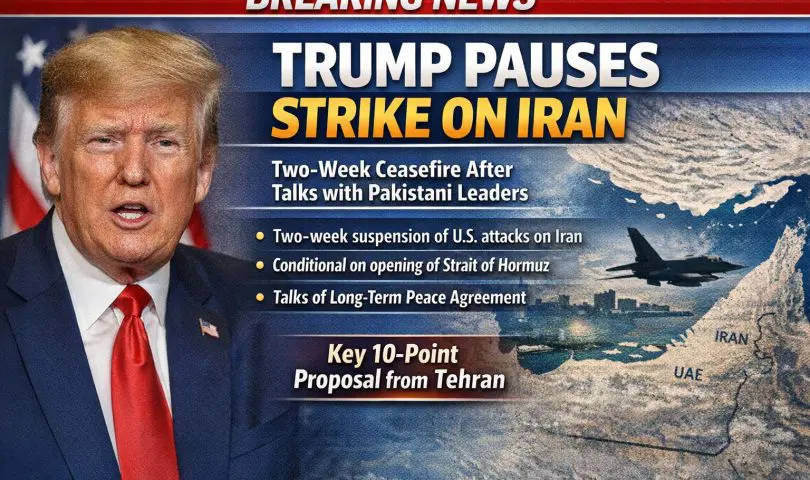
President Donald Trump announced the ceasefire on Tuesday evening, just hours before a self-imposed 8 p.m. ET deadline after which he had threatened to launch “massive” strikes against Iran’s civilian infrastructure. Iran’s Supreme National Security Council accepted the terms, and Israel’s Prime Minister Benjamin Netanyahu confirmed Israeli compliance — though with caveats. Pakistan’s Prime Minister Shehbaz Sharif was credited as the key mediator, having personally appealed to both Trump and Iranian leadership in a frantic round of diplomacy in the final hours before the deadline.
The agreement centres on a simple but consequential exchange: the US and Israel will suspend all strikes on Iran for two weeks, and Iran will allow safe passage of commercial shipping through the Strait of Hormuz for the same period. Formal peace negotiations between Washington and Tehran are expected to begin as early as Friday in Islamabad.
Background: How the War Began
The conflict erupted on February 28, 2026, when the United States and Israel launched a joint military offensive against Iran, targeting the Islamic Republic’s military command structure, nuclear programme, and strategic infrastructure. President Trump and Israeli Prime Minister Netanyahu justified the strikes as necessary to eliminate Iran as a regional threat and prevent it from acquiring nuclear weapons. Legal experts, however, widely described the offensive as an unprovoked attack in violation of international law.
Iran responded with a campaign of missile and drone strikes against Israel, Gulf Arab states, and US military installations across the region. Tehran simultaneously used its strategic control of the Strait of Hormuz to cut off commercial shipping — a move that sent global oil prices soaring and plunged financial markets into turmoil, as roughly one-fifth of the world’s daily oil supply passes through the narrow waterway.
In late March, Hezbollah, the Iran-backed militant group operating in Lebanon, entered the conflict directly, opening a second front against Israel. Israeli forces have since conducted extensive strikes in southern Lebanon and launched a ground incursion, killing more than 1,500 people there and displacing over a million Lebanese civilians. Iran’s total death toll since the start of the war is estimated at nearly 3,400, including more than 1,600 civilians, according to the US-based human rights group HRANA. Thirteen American service members have also been killed in the fighting.
Throughout the conflict, Trump repeatedly set and then extended deadlines for Iran to reopen the Strait of Hormuz, each time pulling back after diplomatic pressure and Iranian resistance. On Tuesday, he pushed the brinkmanship to its furthest extreme, warning on social media that “a whole civilisation will die tonight” if Iran did not comply. Critics, including former House Speaker Nancy Pelosi, called the rhetoric reckless; legal scholars warned that targeting civilian infrastructure would constitute war crimes under international law.
The Ceasefire Deal: Terms and Reactions
The framework agreed on Tuesday is built around Pakistan’s proposal. Trump accepted a two-week suspension of US and Israeli bombing in exchange for Iran opening the Strait of Hormuz for safe passage, subject to coordination with Iranian Armed Forces. Iran’s Foreign Minister Abbas Araghchi confirmed Tehran’s acceptance, and Iran’s Supreme National Security Council noted the ceasefire could be extended if negotiations progress favourably. Iran has also tabled a 10-point peace proposal which Trump described as “a workable basis on which to negotiate,” with most points of contention reportedly already agreed upon.
However, Israel’s position introduced immediate complications. Prime Minister Netanyahu stated that while Israel supports the ceasefire with Iran, it does not extend the pause to Lebanon, where Israeli forces are continuing operations against Hezbollah. Pakistan’s prime minister had stated the ceasefire applied “in Lebanon and elsewhere.” The contradiction left the scope of the ceasefire uncertain and raised fresh questions about Israel’s commitment to the broader peace process.
Global markets reacted with immediate relief. The international oil price benchmark fell by 13 percent, while S&P 500 futures rose sharply. The Strait of Hormuz, through which approximately 20 percent of the world’s oil supply flows daily, is expected to begin reopening to commercial traffic within hours.
Who Is Joe Kent — and Why Does He Matter?
One of the most striking voices calling for restraint — and for ensuring Israel does not derail the ceasefire — is Joe Kent, the former director of the US National Counterterrorism Center (NCTC) and a retired Special Forces soldier with 11 combat deployments to his name.
Born on April 11, 1980, in Sweet Home, Oregon, Kent served 20 years as a US Army Green Beret before leaving the military in 2018 and subsequently working as a paramilitary officer for the CIA. He rose to public prominence after a deeply personal tragedy: his first wife, Navy cryptologist Senior Chief Shannon Kent, was killed in a suicide bombing in Syria in January 2019 while fighting the Islamic State. Her death, he has said repeatedly, hardened his scepticism of US foreign interventionism and “endless wars” in the Middle East.
After leaving government service, Kent launched two consecutive but unsuccessful bids for the US House of Representatives in Washington State as a Republican aligned with Trump’s “America First” movement. Both campaigns attracted significant controversy for their associations with far-right figures, including a Proud Boys member hired as a campaign consultant and alleged links to white nationalist networks — accusations Kent largely denied.
In February 2025, Trump nominated Kent to lead the NCTC. He was confirmed by the Senate in July 2025 by a 52–44 party-line vote, despite strong opposition from Democrats and civil liberties groups. In that role, he served as a close aide to Director of National Intelligence Tulsi Gabbard.
His tenure was short-lived. On March 17, 2026, Kent publicly resigned — becoming the highest-profile official to leave the Trump administration over the Iran war. In a resignation letter posted on social media, he stated that Iran “posed no imminent threat to our nation” and that the war was launched “due to pressure from Israel and its powerful American lobby.” He accused Israeli officials of deploying a “misinformation campaign” to draw the US into the conflict, drawing fierce condemnation from Republican lawmakers and Jewish advocacy groups who labelled the remarks antisemitic. Kent denied those charges, saying he was speaking to a pattern of foreign influence, not targeting Jewish people.
Following his resignation, reports emerged that the FBI had been investigating Kent for allegedly leaking classified information, a probe that reportedly predated his departure. Kent has not publicly responded to those allegations.
In the video recording from which this article draws, Kent — speaking after the ceasefire announcement — welcomed the pause but raised pointed concerns about Israel’s role. He argued that Israel’s strategic interest lies in toppling the Iranian government entirely, putting it at odds with US efforts to achieve a negotiated peace. He called for the US to reduce military support to Israel sufficiently to prevent it from conducting offensive operations against Iran, warning that Israel has a “very bad track record of adhering to these deals.”
Whether or not Kent’s views find a receptive audience in Washington, his perspective reflects a genuine division within the American right — between interventionists aligned with Israel and the more isolationist “America First” wing that has grown increasingly critical of the war.
What Comes Next
Peace talks between the US and Iran are scheduled to begin in Islamabad as early as Friday, with Vice President JD Vance expected to lead the American delegation. The negotiations face significant hurdles. Iran’s 10-point proposal includes demands for the withdrawal of all US combat forces from regional bases, the lifting of all sanctions, the release of frozen Iranian assets abroad, and full compensation for war-related damages — terms that are unlikely to be easily accepted in Washington.
The question of Israel’s nuclear and missile disarmament demands for Iran, the status of Hezbollah in Lebanon, and the unresolved issue of uranium enrichment also loom large. Iran’s Supreme National Security Council was careful to note that the ceasefire “does not signify the termination of the war.”
For now, the guns have fallen silent across one of the most volatile regions on earth. Whether the two-week pause translates into lasting peace — or merely delays the next escalation — will depend on the fragile diplomacy now unfolding in the Pakistani capital.