
Sankofaonline Editorial | Thursday, 5th March 2026
Ghana’s renewed commitment to local rice consumption stands today as one of the most forward‑looking policy choices of the Mahama administration, an initiative that blends economic wisdom with national pride. By championing the “Buy Local Rice” agenda, the government has signaled a decisive shift toward food sovereignty, rural empowerment, and the retention of Ghana’s wealth within Ghanaian hands. It is a policy rooted in common sense and national confidence: that our farmers can produce quality rice, that our industries can process it competitively, and that our people deserve to benefit from the fruits of their own land.
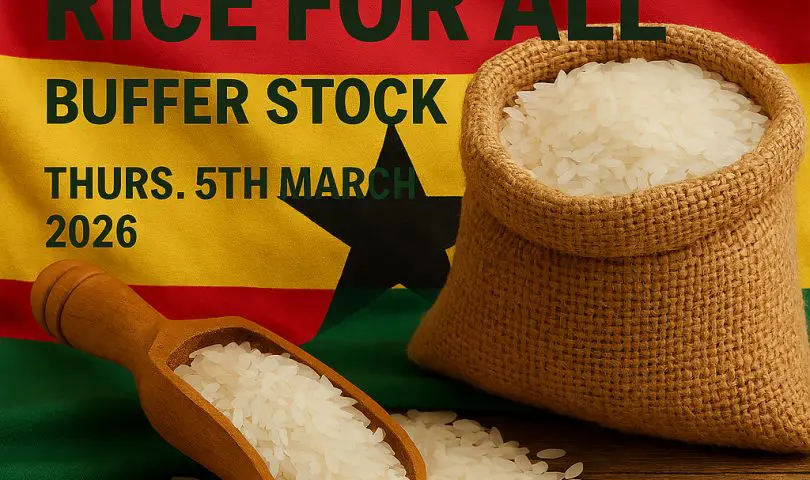
Ghana is standing before a quiet revolution, one that begins not in Parliament, nor in boardrooms, but in kitchens, markets, and the everyday choices of ordinary citizens. The call to Buy Local Rice for All is more than a patriotic chant. It is a national test of seriousness, a measure of our economic maturity, and a declaration of whether we truly believe in Ghana’s capacity to feed itself.
Imported rice has long dominated our shelves, our menus, and our imaginations. But that dominance has come at a cost: drained foreign exchange, weakened local industries, and a generation of farmers whose sweat enriches everyone but themselves. Meanwhile, Ghanaian rice , supported by the National Food Buffer Stock Company, has quietly transformed. The quality is up. The aroma is rich. The packaging is competitive. The supply is stable. Yet the market remains skewed toward foreign brands that have mastered perception even as Ghanaian farmers master production.
This is the contradiction we must confront: Ghanaian rice is ready. Ghanaian commitment is not.
The Economic Reality We Can No Longer Ignore
Every bag of imported rice is a silent export of Ghana’s wealth. It is money that could have built irrigation systems, expanded mills, modernized farming, and created thousands of jobs. Instead, it strengthens foreign economies while our own farmers struggle to break even.
Buying local rice is not charity. It is economic strategy. It is the difference between a nation that consumes what others produce and a nation that produces what it consumes.
The People Behind the Grain
Behind every bag of Ghana rice is a chain of livelihoods, farmers in Fumbisi, millers in Sefwi, traders in Tamale, transporters, aggregators, and young entrepreneurs building brands from scratch. When we choose local rice, we choose to keep these families working, these communities thriving, and these dreams alive.
When we choose imported rice, we choose to dim those possibilities.
Buffer Stock’s Mandate and Ghana’s Responsibility
The National Food Buffer Stock Company has invested heavily in stabilizing production and ensuring availability. But Buffer Stock cannot succeed alone. Policy must meet consumer behavior. Government must meet private sector innovation. And citizens must meet their responsibility to the nation.
A country that cannot feed itself cannot claim true independence. A country that refuses to support its own farmers cannot claim to value development.
Changing Perception, Changing Palates, Changing Ghana
The old argument that imported rice is “better” no longer holds. Today’s Ghana rice is aromatic, clean, nutritious, and increasingly well-packaged. What remains is perception, a perception shaped by decades of marketing that made foreign rice fashionable and local rice invisible.
That era must end.
Restaurants, hotels, caterers, schools, and households must lead the shift. Media must amplify it. Government must enforce it. And consumers must embrace it.
The transformation of Ghana’s rice economy will not happen in policy documents; it will happen in kitchens, markets, and dining tables across the country.
A National Call to Action
Buying local rice is not merely a consumer choice, it is a declaration of national pride. It is a vote for Ghanaian labor, Ghanaian innovation, and Ghanaian resilience. It is a commitment to food sovereignty in a world where nations are increasingly turning inward to protect their own.
If we want a stronger cedi, we must buy Ghanaian.
If we want thriving rural economies, we must buy Ghanaian.
If we want sustainable food security, we must buy Ghanaian.
If we want dignity in agriculture, we must buy Ghanaian.
The path to national prosperity begins with the choices we make every day. And today, the choice is clear: Buy Local Rice for All.