


An Opinion by Daniel Nii Okine for Sankofaonline
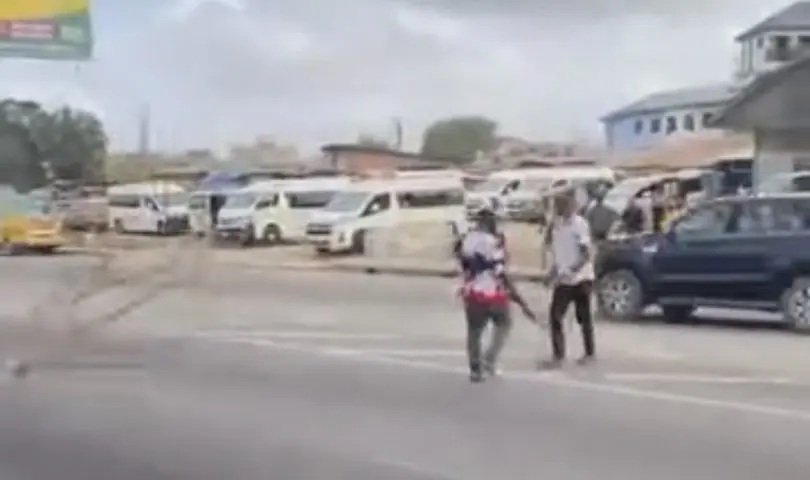
There was something profoundly unsettling about the scene that unfolded on the Pokuase-Amasaman Highway on the morning of Monday, November 2, 2026. As thousands of commuters hurried to work, school, and business, a group of taxi drivers made an extraordinary decision. They parked their vehicles, abandoned their earnings for the day, and took it upon themselves to do what government agencies had failed to do for years: save lives.
From as early as 6:30 a.m., the drivers positioned themselves at a notorious illegal crossing point along the expressway and began directing pedestrians away from speeding traffic and toward the overhead footbridge built specifically for their safety. Some reportedly refused to transport passengers who insisted on crossing the road through the dangerous median opening. Others stood guard, pleading with commuters not to gamble with their lives.
Their frustration was understandable.
For years, the stretch of road has become synonymous with preventable tragedy. Despite the presence of a footbridge, scores of pedestrians continue to ignore it, choosing instead to dash across multiple lanes of fast-moving traffic in an effort to save a few minutes. The result has been a horrifying cycle of accidents, serious injuries, and deaths that residents and commercial drivers say have become all too common.
The drivers’ action was not a publicity stunt. It was a desperate response to a crisis they witness almost every day.
Video clips circulating on social media show visibly distressed drivers lamenting the carnage that has unfolded repeatedly before their eyes. One driver captured the frustration shared by many.
“Government built a footbridge right here for everyone’s safety, yet people refuse to use it. Every Monday people are getting struck and killed by oncoming vehicles. We had to park our cars and physically redirect them today because we can no longer sit back and watch people die.”
Those words should be troubling to every public official responsible for road safety in Ghana.
The reality is that this dangerous crossing point is not hidden from authorities. Officials of the Ga West Municipal Assembly, the Ghana Highway Authority, and the National Road Safety Authority travel this corridor regularly. They see the illegal crossings. They observe the daily risk-taking. They know a gap in the median has effectively become an unofficial pedestrian route across a high-speed expressway.
Yet the situation remains largely unchanged.
No substantial fencing has been erected to block access. No permanent barriers have been installed. Enforcement is virtually non-existent. The danger has been allowed to persist until ordinary taxi drivers, people with no legal mandate and no public budget, felt compelled to intervene themselves.
That failure should concern all of us.
To be sure, responsibility does not rest solely with the authorities. Pedestrians who knowingly ignore the footbridge and choose to run across speeding traffic are engaging in behavior that is both reckless and dangerous. No appointment, no workplace, no destination is worth risking a human life over a few minutes of convenience.
But governments do not build safety infrastructure because everyone behaves responsibly. They build safety measures precisely because people often don’t. Effective road design anticipates human behavior and minimizes opportunities for fatal mistakes. That is why highways around the world are equipped with fences, barriers, railings, and enforcement mechanisms. They are designed to make dangerous choices difficult or impossible.
At Pokuase-Amasaman, that duty appears to have been neglected.
What unfolded on Monday was therefore bigger than a traffic management exercise. It was a symbolic indictment of institutional inertia. It exposed the uncomfortable reality that citizens are increasingly being forced to perform functions that public institutions should be carrying out.
When taxi drivers become road safety officers, something has gone wrong.
When commercial drivers abandon their livelihoods to prevent deaths, someone in authority has failed.
And when ordinary citizens become the last line of defense between commuters and tragedy, government agencies must ask themselves hard questions.
How many more people must die before the median is fenced?
How many more grieving families must be created before barriers are installed?
How many more Monday mornings must begin with pedestrians risking their lives while authorities watch from a distance?
The solutions are neither revolutionary nor expensive. The Ga West Municipal Assembly, working together with the Ghana Highway Authority, should immediately install heavy-duty fencing and barrier extensions to eliminate access to the illegal crossing point. The National Road Safety Authority should conduct an urgent safety audit of the corridor. The Motor Traffic and Transport Department must enforce existing traffic regulations and discourage dangerous pedestrian behavior. At the same time, the footbridge must remain clean, secure, properly illuminated, and accessible at all hours.
These are basic responsibilities, not extraordinary requests.
The taxi drivers who stood guard on Monday deserve commendation for their civic courage. They demonstrated a commitment to human life that many public institutions would do well to emulate. Yet the very fact that their intervention was necessary should be a source of national embarrassment.
Citizens should not be forced to choose between earning a living and preventing avoidable deaths.
The blood that continues to stain this stretch of highway is not merely the consequence of reckless pedestrian behavior. It is also the result of official indifference, bureaucratic delay, and a failure to address a known danger despite repeated warnings.
The people have spoken. The taxi drivers have acted.
The question now is whether the authorities will finally do the same before another life is lost.
