Author: Administrator

  • Covid-19: Education Minister Detained At UGMC, Awaiting Test Results

    Covid-19: Education Minister Detained At UGMC, Awaiting Test Results

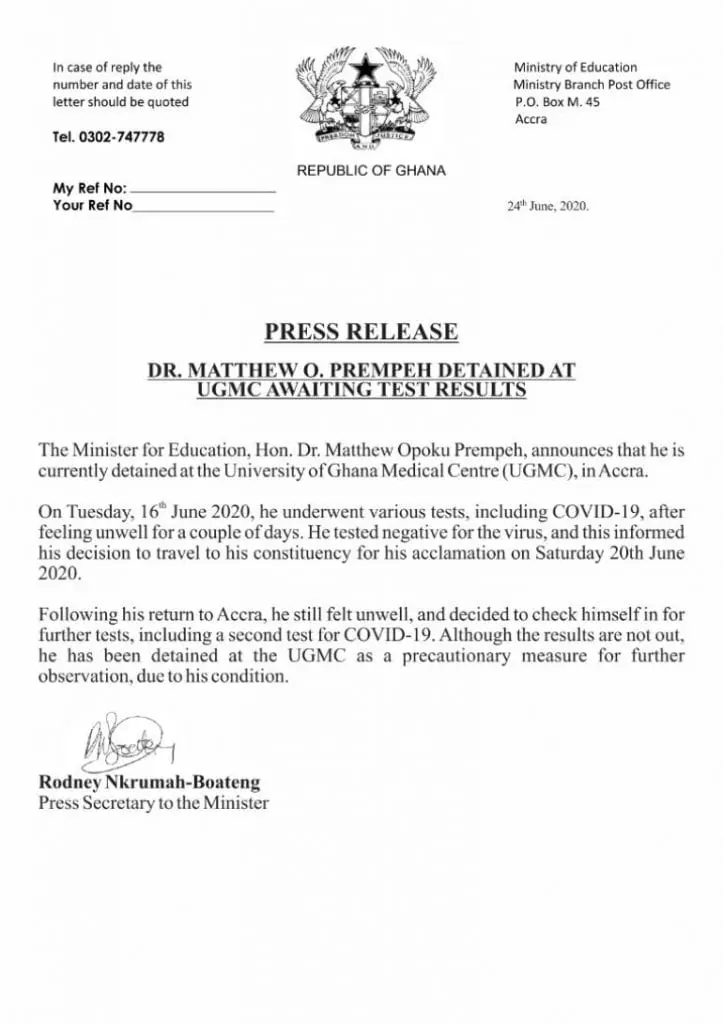
    The Education Minister, Dr. Matthew Opoku Prempeh, has been detained at the University of Ghana Medical Centre (UGMC) over fears of contracting COVID-19.

    He is awaiting his COVID-19 test results after reporting himself to the facility when he felt unwell.

    This is the second time he has been tested for COVID-19, according to a statement from the Ministry of Education.

    “On Tuesday, 16th June 2020, he underwent various tests, including COVID-19, after feeling unwell for a couple of days. He tested negative for the virus, and this informed his decision to travel to his constituency for his acclamation on Saturday, 20th June 2020.”

    “Following his return to Accra, he still felt unwell, and decided to check himself for further tests, including second test for COVID-19,” the statement noted.

    Although the results are not out, the Education Ministry said the Minister “has been detained at the UGMC as a precautionary measure for further observation, due to his condition.

    This development follows reports that the Chief Executive Officer of the Korle Bu Teaching hospital, Dr. Daniel Asare, tested positive for the virus.

    Ghana’s Health Minister, Kweku Agyeman Manu, and the Chief Executive Officer of the National Health Insurance Authority, Lydia Dsane-Selby are among the high profile government appointees who have tested positive for COVID-19.

    The Metropolitan Chief Executive of Sekondi-Takoradi, Anthony K.K. Sam, also contracted the virus and unfortunately passed away.

    Ghana’s COVID-19 case count is now 14,568 with 10,907 recoveries and 95 deaths.

    Find below a statement from the Education Ministry

    source:citinewsroom

  • Ivory Coast nabs terrorist leader after deadly border post raid

    Ivory Coast nabs terrorist leader after deadly border post raid

    Source: africanews.com

    Ivorian authorities on Monday announced the capture of a terrorist leader who led a deadly attack on a military post at Kafolo, on the northeastern border with Burkina Faso on June 11 following a large scale raid.

    According to defense minister Hamed Bakayoko, the raid resulted in the arrests of other people directly involved in the attack.

    “We traced it back to the commander in Mali, who was arrested. And I can tell you that the head of the commando who led the action was taken yesterday. And with our investigations, we will go further. We will establish who he was in contact with. Who is behind it,” Minister Bakayoko disclosed.

    He added that the arrests of people who took part in the assault came thanks to photos retrieved from mobile phones.

    The Ivorian military said around 10 soldiers died and six others were wounded in the June 11 attack when dozens of terrorists mounted a pre-dawn attack on the border post.

    It was the first by extremists on Ivorian soil since March 2016, when a raid on the southeastern beach resort of Grand-Bassam left 19 people dead.

  • Ghanaian Players Abroad: Top Scorers

    Ghanaian Players Abroad: Top Scorers

    NOTE: Only LEAGUE Goals for the 2009-10 season in TOP divisions are recorded

    13 Goals

    Asamoah Gyan (Rennes, France)
    Eric Bekoe(Petrojet, Egypt)
    12 Goals


    10 Goals

    Mathew Amoah (NAC, Netherlands)
    9 Goals

    Eric Sackey(Dacia Chisinau, Moldovia)
    8 Goals

    Sam Yeboah (Hapoel Tel Aviv, Israel/Genk, Belgium)
    Yaw Antwi (FK Napredak Krusevac, Serbia )
    7 Goals

    Junior Agogo (Apollon Limassol, Cyprus)
    Papa Arko (El Geish, Egypt)
    6 Goals

    William Tierro(Academica, POR)
    5 Goals

    Derek Asamoah (Lokomotiv Sofia, Bulgaria)
    Sadat Bukari (Etoile Sportive du Sahel, Tunisia)
    4 Goals

    Patrick Nyarko (Chicago Fire, USA)
    3 Goals

    Cofie Bekoe (Petrojet, Egypt)
    Bennard Yao Kumordzi (Panionios, Greece)
    Joe Tex Frimpong(Lucerne, ENG)
    Michael Essien (Chelsea, England)
    Yusif Chibsah(Gefle, Sweden)
    2 Goals

    Prince Tagoe (Hoffenheim, Germany)
    Abdul Razak Ismail (Hapoel Acco,ISR)
    Awudu Samadu (Maccabi Netanya, Israel)
    Samuel Kyere (Police Union, Egypt)
    Quincy Owusu-Abeyie(Spartak, RUS/Portmouth, ENG)
    1 Goal

    Richmond Boakye(Genoa, ITA)
    P. Buaben(Dundee United, SCO)
    Mohammed Abubakari (Levadiakos, GRE)
    Kwadwo Asamoah(Udinese, ITA)
    Nana Asare (FC Utrecht, Netherlands)
    John Mensah (Sunderland, England)
    Haminu Dramani (Kuban Krasnodar, RUS)
    Dominic Oduro (Houston, MLS)
    Sulley Muntari (Inter Milan, Italy)
    Ibrahim Ayew (El Zamalek, Egypt)
    Isah (Red Star Belgrade, Serbia) <
    A. Iddi (KV Mechelen, Belgium)
    Francis Dickoh(FC Utrecht, Netherlands)
    Nana Eshun (Asyut Petrol, EGY)
    Daniel Addo(Hapoel Petah Tikva, ISR)

  • Mayor Lightfoot and CDPH Announce Chicago Ready to Move to Phase Four on Friday, June 26

    Mayor Lightfoot and CDPH Announce Chicago Ready to Move to Phase Four on Friday, June 26

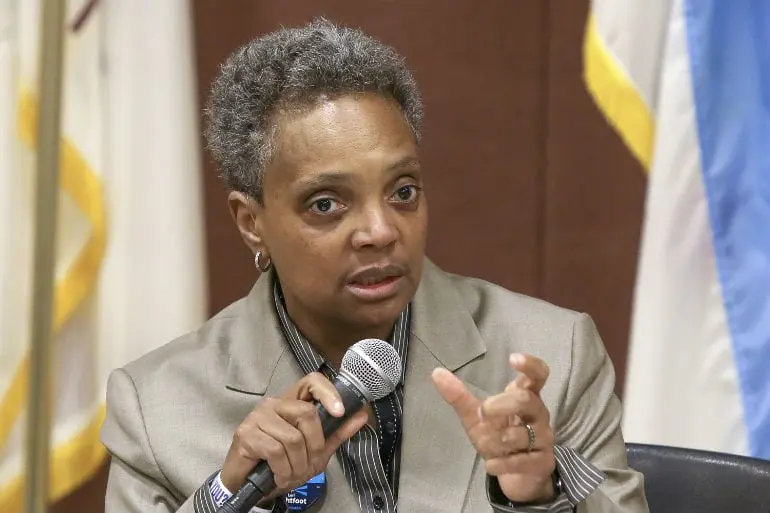
    CHICAGO – Mayor Lori E. Lightfoot and the Chicago Department of Public Health (CDPH) today announced that Chicago is on track to transition to phase four of the “Protecting Chicago” framework on Friday, June 26, alongside the rest of Illinois. The guidelines are aligned with the State-issued guidelines, with additional specificity included for Chicago’s context, which has experienced a different arc of COVID-19 than other parts of the state. Phase four – ‘Gradually Resume’ – will allow additional businesses and public amenities to open with limited capacities and appropriate safeguards. Although progress has been made in order to move to phase four, all residents should continue to abide by important guidance including: physically distancing and wearing a face covering; limiting non-business, social gatherings to 50 persons for indoor events and 100 for outdoors; staying at home if you are considered vulnerable, feel ill or have come into contact with someone with COVID-19; and getting tested if you have symptoms.

    “The service and sacrifice made by Chicagoans from every corner of our city and every walk of life has allowed us to safely reach the point where we are now,” said Mayor Lightfoot. “It includes the incredible work done by our healthcare professionals, first responders, and essential workers who have cared for our residents and kept our city running. Everything we’ve done to meet this moment has been the direct result of the hard work and sacrifice of our residents, which has not only saved the lives of thousands of Chicagoans over these past three months, but also helped lay the groundwork for the transformative recovery that will follow.”

    The following industries will open for the first time at the beginning of phase four in Chicago:

    Indoor seating in bars and restaurants
    Museums and zoos
    Performance venues
    Summer camps / youth activities
    Phase four will also include adjustments to other industries that have previously reopened, and detailed information can be found at chicago.gov/reopening. To allow businesses and organizations to prepare for the next phase, Mayor Lightfoot, in partnership with CDPH, industry leaders, labor leaders, and public officials from around Chicago, released an additional set of industry-specific guidelines for businesses, employees, and customers to follow as the city moves into phase four. Industry-specific guidelines include details such as how businesses can encourage healthy interactions between workers and customers, how to maintain safe working spaces and conditions, and how to design and monitor workplace operations to create flexibility and maintain safety for employees and customers.

    To inform businesses of the new guidelines for phase four, the Department of Business Affairs and Consumer Protection (BACP) will hold a series of educational webinars this week. Webinars will be held for newly reopening industries such as arts/performance venues and museums and industries that will be following new guidelines in phase four, such as health and fitness centers and personal services. To register and learn more, visit chicago.gov/businessworkshops.

    The COVID-19 data in Chicago continues to trend positively and the city is on pace to meet the metrics to move into phase four:

    Continued decline in the number of newly diagnosed COVID-19 cases, across all race-ethnicity groups. These numbers have continued to steadily decline since peaking in early May, even as testing has increased, a sign that the outbreak has remained in good control locally as industries have begun cautiously reopening.
    Continued decline in the number of COVID-19 hospitalizations, deaths, and emergency department visits.
    Continued decline in percent positivity (the percentage of people tested who are positive), which is now down to approximately 5%. The goal to move into phase four had been less than 7%. This is also declining across all race-ethnicity groups.
    Adequate hospital and ICU capacity, which are currently more than adequate and continue to improve as COVID-19 hospitalizations decline.
    Adequate testing capacity, and specifically conducting at least 4,500 tests per day, which represents the ability to test 5% of Chicago’s population each month. The city is back above this mark after testing disruptions due to street protests and inclement weather.
    Adequate response capacity, with at least 90% of new COVID-19 cases being assigned for investigation within 24 hours. This metric has been achieved
    To move into phase four, Chicago had set a requirement of stable or declining cases along with a goal of reaching fewer than 200 new COVID-19 cases per day, which it has now achieved, with a current 7-day average of 167 new cases per day. Based on the city’s population and national metrics from the CDC, this will move Chicago from a high-incidence to a moderate-high incidence level.

    “The data continue to show that we’re making progress and we’ll be ready to move into phase four later this week,” said CDPH Commissioner Allison Arwady, M.D. “However, we still have a lot of COVID-19 cases here in Chicago; we’re just now moving from a high-risk to a medium-high-risk city for COVID-19 spread, based on our numbers, and we need to move ahead cautiously. I can’t emphasize enough the need for people and businesses to continue to abide by the public health guidance so we can avoid the spike in cases we’re seeing in other cities and states that re-opened before us.”

    If and when Chicago continues to make progress against COVID-19, capacity restrictions will be loosened further within phase four. For example, right now, while Chicago is still at a moderate-high level of new cases, there is approximately a 15% chance that a gathering of 50 Chicagoans will include someone with active COVID-19 infection. This is concerning because many people may not have symptoms but can still spread COVID-19, which is why keeping a 6-foot distance and wearing a face covering is so important. Once Chicago has fewer than 100 new cases per day, the city will move to a moderate-incidence level by national standards, and gathering sizes and capacity limits can more safely increase.

    CDPH will continue to follow the same health metrics to help guide the City’s decision-making process, with easy color-coding:

    Green – Go: cautious progress, continued progress or advanced progress
    Yellow – Caution: pause and monitor
    Red – Stop: may need to reinstate certain restrictions

    Currently, the city is in green for all metrics. The City recently launched a data dashboard here where individuals can explore these metrics. The new data dashboard was prompted by the desire to make community-level data more accessible, particularly for African American and Latinx residents who have been most impacted by the outbreak. The Racial Equity Rapid Response Team, which was launched by the City to be responsive to these communities, wanted a clearer understanding of the change in the COVID-19 outbreak by race, ethnicity, and neighborhood. The dashboard can be accessed from the ‘Latest Data’ tab on the COVID-19 website. It was developed in partnership with community groups, the CDPH Office of Epidemiology and Slalom Consulting, with support from the Civic Consulting Alliance, and will be constantly updated so community organizations and residents are encouraged to continue to provide input.

  • Mayor Lori Lightfoot Announces COVID-19 Mobile Testing Pilot Program

    Mayor Lori Lightfoot Announces COVID-19 Mobile Testing Pilot Program

    CHICAGO – Mayor Lori E. Lightfoot today launched a COVID-19 mobile testing pilot program to further the City’s mission of reaching residents in communities that are experiencing a disproportionate impact from the COVID-19 virus. The first community-based mobile testing site will begin operating today at Austin Health Center and a second community-based site will begin operating later in the week at Kennedy King College as operations transition there from the static site to mobile testing. Also starting today, the City will begin operating mobile testing on the Northwest and Southwest sides to specifically serve first responders on the frontlines of the pandemic.

    “I am very pleased Chicago is taking this latest, critical step in expanding our city’s testing capabilities with the launch of our mobile pilot program,” said Mayor Lightfoot. “As we continue to safely reopen our city while still preventing further spread of COVID-19, these additional sites will play a vital role in not only allowing us to continue to increase the number of residents being tested, but to do so equitably in order to support our communities most in need.”

    Each mobile testing site will have the capacity to test up to 500 persons per day and will have the flexibility to travel, allowing testing to be directed toward communities most impacted by the virus. Mobile testing sites will be working in close partnership with community organizations in order to best ensure the needs of local residents are being prioritized. The City will review the success of the pilot based on key metrics of percent positivity and testing volume to determine how to best expand the mobile testing offerings throughout Chicago, which will be done in coordination with outreach from Community Organized Relief Effort (CORE) and the City’s Racial Equity Rapid Response (RERR) team.

    The City today also launched mobile testing to expand its capabilities for first responders. These testing sites will function similar to other City-run mobile testing sites however, they will focus specifically on first responders. Any resident that is not a first responder and would like to be tested is encouraged to visit the local testing center nearest to them.

    The testing expansion comes as the City looks to move into phase four of its ‘Protecting Chicago’ reopening framework and must continue meeting its benchmark of 4500 tests per day. All residents are encouraged to self-monitor and get tested if they meet eligibility criteria, which was expanded last week to allow for testing of anyone who has had a recent high-risk exposure including participation in protests that have happened throughout the city, and as residents continue expanding their social circles amid the Citywide reopening.

    Diagnostic testing for COVID-19 is free for all residents and, the City strongly encourages anyone who thinks they may need to be tested to visit one of these sites. Workers at the sites can accommodate several language needs in order to provide the best experience and educate residents. No questions will be asked about citizenship status, and no documentation related to citizenship will be requested. The data collected for testing appointments whether online or onsite and returned from the tests will only be shared with the City of Chicago’s Department of Public Health.

    The testing sites are open Monday to Friday from 10 a.m. to 4 p.m. and are located at:

    Maria Saucedo Scholastic Academy
    Horizon Science Academy – Southwest
    Dr. Jorge Prieto Math & Science Academy
    Gately Park
    Columbus Park
    Any Chicago resident should be tested at the early onset of these symptoms:

    Fever or chills
    Cough
    Mild or moderate difficulty breathing
    Sore throat
    Muscle aches or body aches
    New loss of taste or smell
    Nausea or vomiting
    If you do not have any new symptoms, you should get tested if you had a recent high-risk exposure, which includes any of the below:

    Recent contact to someone who has, or is suspected to have, COVID-19
    Recent high-risk exposures, including close contact with many other people in a large group gathering or crowd
    First responders or other essential workers with potential recent exposures
    All City-run sites can accommodate testing for healthcare workers and first responders who are more frequently exposed to COVID-19. However, it is important to note that testing criteria and guidelines may be different for healthcare workers and first responders. Workers should follow guidance from their employer to determine eligibility.

    Getting tested is the best way to know if you have COVID-19, and the City strongly encourages anyone getting tested to schedule an appointment online if possible. Knowing if you have the virus can help to best ensure health needs are met and allow for preventative actions earlier on to keep others safe and prevent further spread. To learn more about the City’s testing sites, or to register to get tested, please visit chi.gov/covidtesting.