


By Sankofaonline Editorial Desk
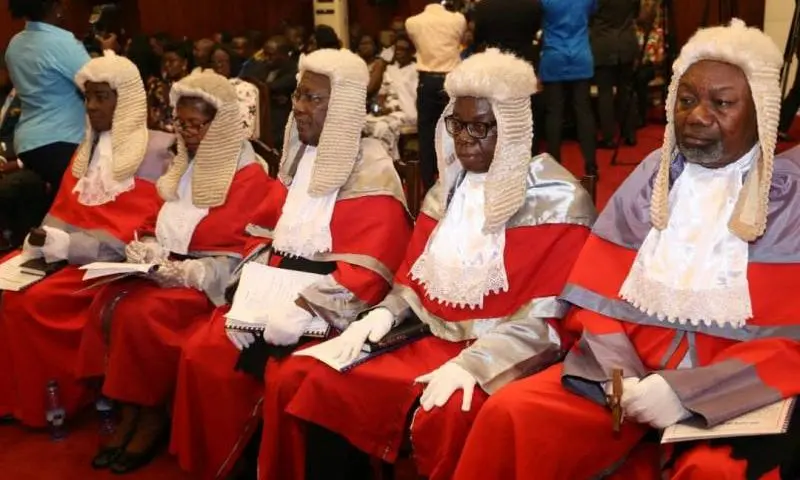
Ghana’s Supreme Court has not merely issued a ruling, it has detonated a political earthquake. In a bold 5 to 2 majority, the Court has dismantled the long‑protected delegate cartel and returned political power to the only legitimate owners of Ghana’s democracy, “We The people”.
This is judicial courage at its highest expression, a constitutional correction that exposes and uproots decades of political manipulation dressed up as party procedure.
For years, the delegate system operated as a quiet but corrosive element on Ghana’s democracy. What was once a logistical convenience mutated into a marketplace of influence, where a tiny, easily targeted bloc of delegates determined who would lead a nation of more than thirty million people. Primaries became cash‑driven bazaars, merit was sidelined, and political vision was routinely suffocated by money, patronage, and transactional loyalty.
That era has collapsed, and the Court has made it unmistakably clear, good riddance!
Restoring Article 55 and the Constitutional Order
The Court’s ruling is not a suggestion, it is a constitutional enforcement. Article 55(5) demands internal democracy within political parties, and the delegate system violated that principle with impunity. When a handful of delegates decide who appears on the national ballot, millions of party members are effectively disenfranchised.
The dues‑paying organizer, the community mobilizer, the polling station defender, the party loyalist who sacrifices time and resources, all were pushed aside during the most consequential stage of political decision making. By mandating universal internal voting, the Court has declared that internal democracy is not a courtesy, it is a constitutional command that parties can no longer ignore.
Breaking the Back of Political Monetization
The ruling strikes directly at the heart of money politics. Buying influence among a few hundred delegates in a hotel ballroom was easy for wealthy aspirants. Buying influence among hundreds of thousands of registered party members across 275 constituencies is structurally impossible.
With the franchise expanded to the full membership base:
- Integrity replaces inflation, candidates must persuade real voters rather than outspend rivals.
- Meritocracy returns to public service, allowing capable leaders without elite backing to compete fairly.
- Accountability shifts back to communities, elected officials will owe their survival to the people, not to brokers.
Respect for the Party Faithful
For far too long, party members were treated as foot soldiers, useful only during general elections and disposable during internal selections. This ruling ends that disrespect. The grassroots are no longer background noise, they are now the decisive voice.
The organizer who walks miles to mobilize voters, the community leader who defends the party’s reputation, the citizen who stands in the rain on election day, all now hold the power to determine who leads their party and, ultimately, their nation.
A Stronger Fourth Republic
A democracy is only as strong as the institutions that feed into it. When political parties operate through exclusion, the nation suffers.
Ghana’s Supreme Court has demonstrated constitutional fidelity and institutional bravery, setting a new benchmark for democratic practice across the country and Africa as a whole.
The transition to universal internal voting will require clean membership registers, disciplined administration, and transparent processes. But the direction is clear. The age of leadership determined by the highest bidder is over, and political power has been returned to the people, exactly where the Constitution placed it.
A Call to the Diaspora
This ruling is not only a victory for those within Ghana’s borders, it is a call to action for Ghanaians abroad. The diaspora contributes capital, expertise, advocacy, and global perspective. With internal elections now opened to all registered party members, Ghanaians abroad must not remain distant observers.
Register, engage, participate, and help shape the internal democratic processes of your preferred political party. The future of Ghana’s democracy will be shaped by those who step forward, and the diaspora must be part of that process.

By far, and what I am seing on social and traditional medial, this is by far the most popular constitutional decision of the Supreme Court in recent memory!