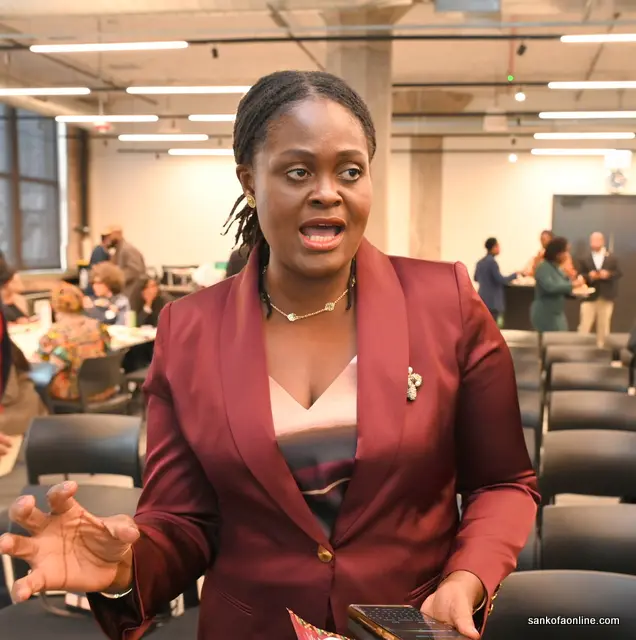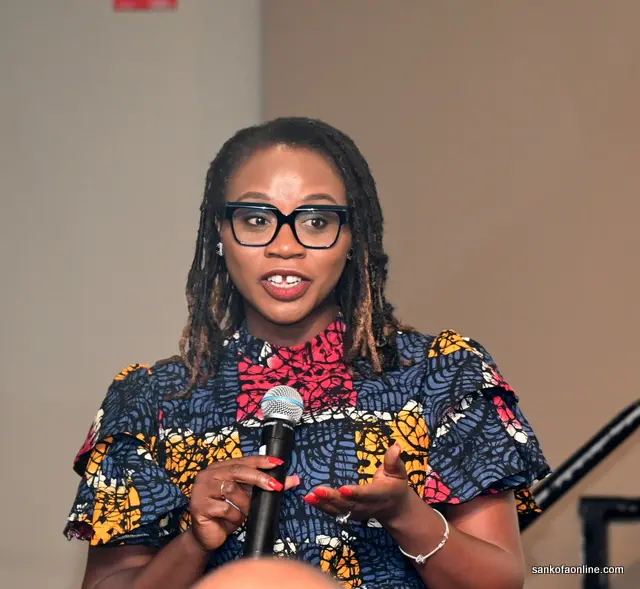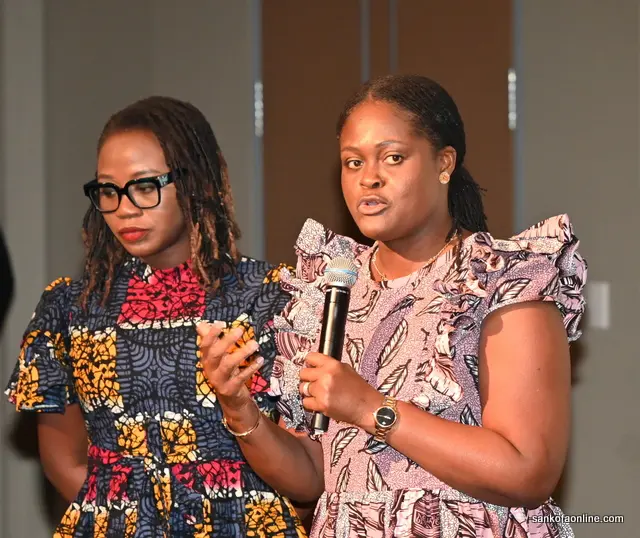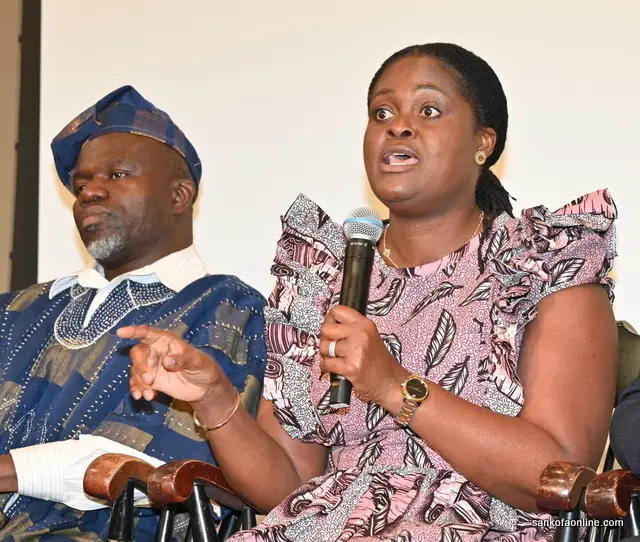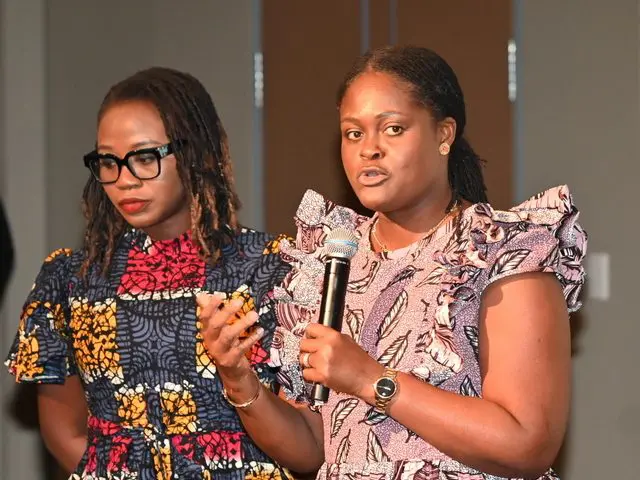

…Chief Executive Director Maabena Ohene-Kena Webb and Chief Operating Officer Rosca Sasu unveil a bold economic vision during Ambassador Victor Smith’s Chicago Town Hall Meeting
By Sankofaonline News | Chicago, Illinois
There are speeches that inspire audiences for a moment, and there are speeches that force communities to confront difficult truths. During His Excellency Ambassador Victor Emmanuel Smith’s landmark Chicago Town Hall Meeting on November 13, 2026, two Ghanaian diaspora leaders delivered a message that did both.
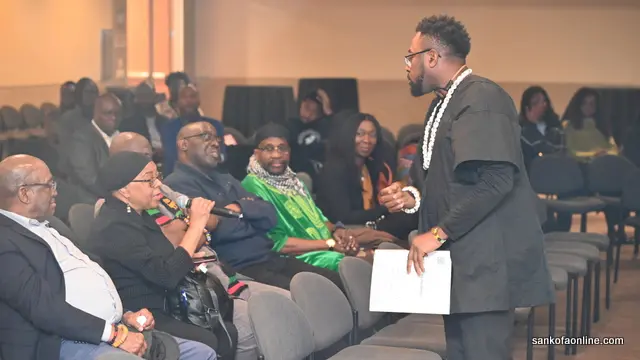
Standing before the audience of professionals, entrepreneurs, community leaders, elders, and young change-makers gathered under the theme “The Future of Ghana,” Maabena Ohene-Kena Webb, Chief Executive Director of Region 17, and Mrs. Rosca Sasu, Chief Operating Officer of Region 17, challenged Ghanaians abroad to rethink their relationship with the homeland. Their presentation was not merely an introduction to a new organization. It was a direct challenge to transform diaspora wealth, expertise, and influence into collective ownership of Ghana’s economic future.
At the heart of their message lay a question that resonated throughout the hall:
How can a diaspora that sends billions of dollars home every year still own so little of the economic future it helps finance?
That question became the foundation for a compelling presentation that many attendees described as one of the most consequential discussions of the evening.
Introducing Ghana’s 17th Region
The presentation formally introduced Region 17 (R17GH.com), a diaspora mobilization platform that emerged from Ambassador Victor Emmanuel Smith’s nationwide economic diplomacy tour across the United States. The initiative draws inspiration from a historic declaration made by President John Dramani Mahama during the 2025 Diaspora Summit in Accra, where the Ghanaian diaspora was officially recognized as the nation’s 17th Region.
The designation carried significance far beyond symbolism. It acknowledged that millions of Ghanaians living abroad are no longer simply contributors sending money home. They are stakeholders whose economic power, professional expertise, and global networks position them as critical partners in Ghana’s development.
For Region 17, that recognition comes with responsibility.
“We have a seat at the table,” the presentation suggested. “The question is whether we are prepared to use it.”
The $7.8 Billion Wake-Up Call
Ms.Webb grounded her remarks in a striking economic reality. According to figures presented during the town hall, remittances from the Ghanaian diaspora reached approximately $7.8 billion in 2025, making them one of the country’s largest sources of foreign exchange and placing them just behind gold exports among Ghana’s leading external revenue streams.
Yet Webb argued that the true significance of that figure extends far beyond economics. It represents the sacrifices of millions of Ghanaians abroad who work long hours, raise families in foreign lands, and consistently send money home to support relatives, fund education, pay hospital bills, build homes, and sustain communities.
Those contributions have undoubtedly transformed countless lives. However, Webb challenged attendees to consider an uncomfortable reality: despite this enormous financial contribution, very little of that collective wealth has been organized into large-scale, diaspora-owned enterprises capable of creating sustainable jobs, generating long-term wealth, or reshaping Ghana’s economic landscape.
Every year, billions flow into consumption. Families are supported, obligations are met, and immediate needs are addressed. What remains largely absent, Webb argued, are the factories, industries, investment funds, and major corporations that could convert those same resources into lasting economic ownership.
Rather than criticizing remittances, she urged the audience to imagine what could happen if even a fraction of that annual capital were strategically pooled and invested.
From Cocoa Producers to Industrial Owners
To illustrate the magnitude of the opportunity, she turned to one of Ghana’s greatest natural assets: cocoa.
Ghana and neighboring Côte d’Ivoire together produce more than sixty percent of the world’s cocoa beans, yet they capture only a small fraction of the wealth generated by a global chocolate industry valued at more than $100 billion. The bulk of the profits remain in processing, branding, manufacturing, packaging, distribution, and retailing, sectors that are largely controlled outside Africa.
For Ms.Webb, this reality represents a broader pattern that has repeated itself throughout Africa’s economic history. Nations rich in resources often export raw materials while others capture the higher-value stages of production.
That reality prompted one of the evening’s most provocative questions.
If the Ghanaian diaspora can mobilize nearly $8 billion annually for household support and consumption, why can it not mobilize resources to own a major chocolate manufacturing company in Ghana? Why not create investment vehicles supported by thousands of Ghanaians abroad? Why not establish factories capable of creating jobs for young people while generating returns for shareholders?
The challenge was not theoretical. It was practical. Webb argued that building collective ownership would require a shift in mindset, moving beyond individual transactions toward shared economic participation.
“Imagine what even a fraction of that money could accomplish if we worked together,” was the underlying message that echoed throughout the hall.
Ghana at 70: Will Ghanaians Have a Seat at Their Own Table?
As Ghana approaches seventy years of independence in 2027, she delivered one of the most memorable moments of the evening, drawing on a metaphor that instantly connected with the audience.
She asked attendees to imagine leaving their parents’ home for many years only to return and discover a lavish celebration underway. Guests are eating, drinking, dancing, and enjoying the blessings of the household. Yet the children of the home, whose inheritance it is, have no seat at the table.
The analogy drew knowing nods throughout the room.
Webb acknowledged that Ghana is experiencing tremendous growth and attracting increasing international attention from investors around the world. New businesses continue to emerge, infrastructure is expanding, and global interest in the country’s economic prospects continues to rise.
However, she warned that the critical question is not whether investment is coming.
The critical question is whether Ghanaians themselves will own meaningful portions of the opportunities being created.
Having lived and worked in both the United States and Ghana, Webb reflected on the transformation she has witnessed firsthand. With every trip between the two countries, she sees new businesses, new construction, and new opportunities emerging. Yet many of those opportunities, she noted, are increasingly being seized by foreign investors who have recognized Ghana’s potential and acted decisively.
Her appeal was straightforward:
“Please, let us not allow that to become our story.”
At the Table or on the Menu
Perhaps no phrase captured the spirit of the presentation more powerfully than Webb’s warning that those who fail to secure a seat at the table often find themselves on the menu.
The statement underscored Region 17’s central mission. While individual acts of generosity remain important and worthy, fragmented financial efforts rarely translate into ownership, influence, or participation in economic decision-making.
Region 17 seeks to provide a framework through which the diaspora can organize its considerable resources, not merely to support development but to actively participate in it. The goal is to convert goodwill into economic power, individual contributions into collective leverage, and scattered efforts into coordinated action.
For Webb, the conversation was never solely about money. It was about position, influence, and ensuring that Ghanaians abroad help shape the future of the nation they continue to support so faithfully.
Rosca Sasu Brings the Vision Down to Earth
If Ms. Webb presented the vision, Mrs. Rosca Sasu focused on the practical path to achieving it.
Taking the microphone after the keynote presentation, Sasu addressed a question she said repeatedly emerges wherever the concept of diaspora investment is discussed:
“How do we do this?”
Drawing on conversations with students, young professionals, entrepreneurs, and diaspora organizations, Sasu acknowledged that many Ghanaians genuinely want to contribute to national development but often struggle to identify a trustworthy and structured mechanism for doing so.
According to her, Region 17 aims to provide that mechanism.
She spoke candidly about the challenges involved, noting that membership in any organization does not magically eliminate bureaucracy, regulatory hurdles, or operational difficulties. Those realities exist and must be confronted honestly.
What changes, she argued, is the ability to tackle those challenges collectively rather than individually.
By pooling ideas, resources, expertise, and networks, members can overcome obstacles that would be difficult for a single person to navigate alone. The strength of Region 17 therefore lies not only in the money participants contribute, but also in the collective knowledge, professional experience, and relationships they bring to the table.
Beyond Capital: Bringing Skills Home
One of the most compelling aspects of Region 17’s message was its emphasis on something even more valuable than financial resources.
Human capital.
Across North America and around the globe, Ghanaian professionals have distinguished themselves in medicine, engineering, information technology, education, finance, manufacturing, entrepreneurship, and public service. They have acquired skills, systems, and experiences that have enabled them to thrive in highly competitive environments.
Ms.Webb emphasized that Ghana’s future requires not only investment dollars but also the transfer of those skills, ideas, and professional standards to the next generation.
For Region 17, development means bringing home expertise as well as capital, leadership as well as money, and innovation as well as investment.
A Movement for Ownership
As the presentation concluded, Webb and Sasu expressed gratitude to the Ghana National Council of Metropolitan Chicago, President Effah Ameyaw, and the local organizing team whose efforts helped make Ambassador Victor Emmanuel Smith’s Chicago visit a success.
Yet the lasting impression left on the audience was not one of ceremony, but of challenge.
Region 17 was presented not as another diaspora organization seeking members, but as a movement seeking builders, owners, investors, innovators, and nation-shapers. Its message was clear: the era of simply watching Ghana’s transformation from a distance must give way to an era of active participation and collective ownership.
As the applause filled the room, attendees were left to reflect on a question that may define the next chapter of Ghana’s development.
Will the diaspora remain one of the nation’s greatest sources of financial support, or will it become one of its greatest owners, builders, and economic architects?
For Region 17, the answer begins with a simple conviction: Ghana’s children should not be standing outside the room looking in. They should be seated at the table helping decide what comes next.
Watch the Full Region 17 Presentation
YouTube: Watch the Chicago Town Hall Presentation
Learn More
Region 17: Visit R17GH.com
Sankofaonline News
Bridging the Diaspora, Preserving Heritage, Building the Future.