


By Kay Codjoe
In 1973, during a bank robbery in Stockholm, hostages were held for days. When they were freed, some surprised the world by defending their captors and speaking of them with sympathy. Psychologists later called this response Stockholm Syndrome: the way fear and dependence can make victims emotionally lean toward those who control their fate.
It sounds irrational, until you remember something simple. When people are trapped and afraid, the mind is not trying to be brave. It is trying to survive. It clings to small mercies and tells itself a story it can live inside.
Today, experts use words like trauma bonding or coercive control. But the old story still helps us recognize something about ourselves, not just in crime dramas, but in everyday life and, if we are honest, in our politics.
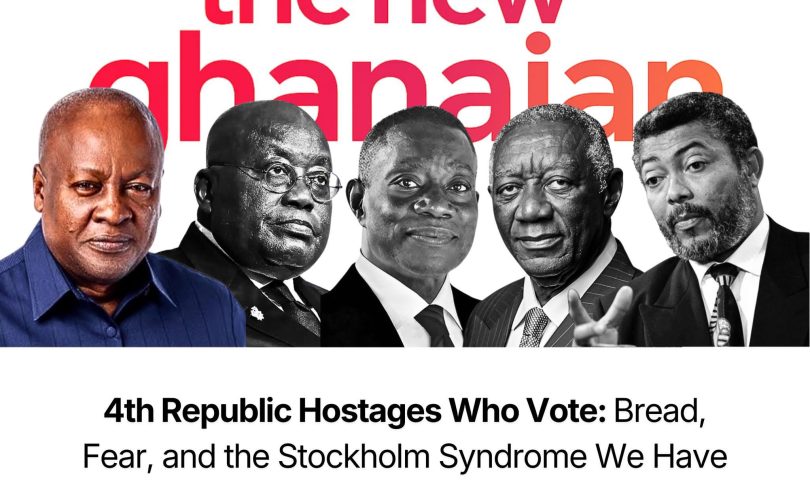
Because something very similar lives inside Ghana.
For many people, politics is not about manifestos or ideology. It is about who can help you get a job. Who can get your transfer approved. Who can make a call when your name is stuck somewhere on a list. In a hard economy, these things are not luxuries. They are lifelines. And when a party becomes your lifeline, you do not relate to it like an idea. You relate to it like air.
This is how loyalty slowly stops being a choice and starts becoming a habit of fear.
If you want to see why, go and stand at Ghana’s border and look sideways. Think of the economic reality of a primary school teacher in West Africa. It is a lesson in geographic destiny. Same tired feet. Yet completely different lives.
In much of Francophone West Africa, that teacher is paid in a currency tied to the euro. In Ghana, the teacher is paid in a currency that has turned daily life into a negotiation with uncertainty. Here, even a loaf of bread is no longer just food. It has become a barometer of the social contract.
In 2026, a simple comparison tells a painful story. Economists call it the “bread runway”, the number of days a single month’s salary can sustain a household on the most basic staple. An Ivorian teacher enjoys over 650 days of bread security on one month’s pay. A Ghanaian teacher manages about 115 days. The difference is not effort. It is structure.
Because the cedi does not have the same protection as the CFA, every meal in Ghana is quietly exposed to exchange rates swings, shipping costs, and global prices. Basic nutrition has been quietly financialized. The teacher is no longer just teaching. Every day, they are also gambling with forces they do not control.
Then the state takes its share. In Ghana, a teacher loses about 22.4 percent, nearly a fifth, of their pay to taxes and social security, far more than in places like Togo, where the burden is closer to 10.6 percent. So the person whose money buys the least is also asked to give up the most. And while other countries protect basic foods with legally enforced price controls, Ghana leaves it to the market. So the worker carries the full weight of global shocks, port inefficiencies, and currency weakness alone. Sovereignty here has quietly become a surcharge.
This is the pressure people have been living under through much of the 4th Republic. And this is the soil in which blind loyalty grows.
You hear it in everyday talk. Yes, things are hard, but at least our people fixed this road. Yes, money was stolen, but our side built a school. Yes, the system hurts, but it once helped me or someone I love. Small mercies become proof of virtue. Big wrong things become “not that bad.”
This is not because Ghanaians are foolish. It is because human beings remember who helped them breathe when they were drowning.
Slowly, partisan identity becomes personal identity. Criticism feels like an insult, evidence feels like an attack, and people end up defending what should trouble them and fighting institutions not because they are perfect, but because they threaten a fragile sense of safety.
In places where politics comes with intimidation and threats, people quickly learn which opinions are safe. Silence becomes wisdom, praise becomes insurance, and even those who try to walk the middle are soon assigned a side, depending on who their words unsettle.
And when you only hear one side, your world slowly becomes that side. You do not just believe the story, you defend it, not always because it is true, but because it is familiar.
This is where the old Stockholm story fits.
Like hostages, people under constant pressure can start to emotionally side with the very systems that keep them anxious. Not because those systems are good, but because the idea of stepping outside them feels terrifying. The known pain starts to feel safer than the unknown freedom.
This is not a Ghanaian defect but a human one, and no democracy can flourish when people relate to political parties the way captives relate to captors, grateful for small favors and afraid of open doors.
The answer is not changing parties, but changing the relationship itself. When jobs become rights, food stops being a gamble, institutions matter more than colors, and people can say “my party is wrong” and still feel whole, the country finally exhales.
Until then, we will keep voting, but many of us will vote like hostages negotiate, quietly, carefully, and imprisoned by fear.
And no nation is truly free when its citizens must bargain with their own chains just to breathe.
Kay Codjoe
Thank you for this great piece of some truths well told !
Please, what might a realistically readily doable, call to tangibly and measurably effective individual action by everyone be?
With warm regards from Winneba,
Eric.