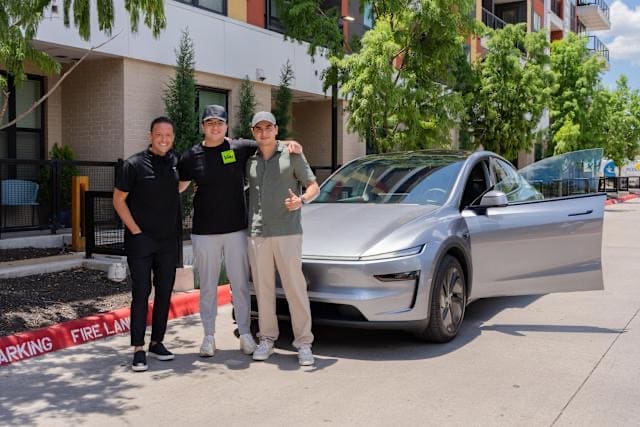

Austin, Texas — June 27, 2025. The sun hadn’t yet reached its zenith when a sleek, obsidian Tesla Model Y rolled silently through the gates of the Gigafactory. No driver. No remote operator. Just a whisper of code and a bold vision in motion. For the first time in U.S. history, a car delivered itself to its new owner.
Tesla’s announcement sent shockwaves through the automotive world: a fully autonomous vehicle had completed a 30-minute journey from factory to front door, navigating highways, intersections, and city streets without a single human touch.

A Machine with a Mission
The Model Y’s journey wasn’t just a test—it was a statement. Captured in a 30-minute video, the vehicle obeyed traffic signals, yielded at red lights, and merged onto highways with the confidence of a seasoned commuter B. It even parked itself neatly at the curb, where the new owner stood waiting, flanked by Tesla engineers and a few wide-eyed onlookers.
Elon Musk, never one to underplay a milestone, declared on X: “There were no people in the car at all and no remote operators in control at any point. FULLY autonomous!”
The Tech Behind the Wheel
The feat was powered by Tesla’s Full Self-Driving (FSD) version 12, a neural network-based system designed to mimic human decision-making. Unlike traditional rule-based programming, this AI learns from experience—an evolving digital brain behind the wheel.
While Tesla hasn’t disclosed the exact software-hardware stack used in the delivery, the company’s in-house AI chip design and real-time learning algorithms are believed to be at the core of this breakthrough .
A Road Paved with Questions
Not everyone is convinced. Critics point out that Tesla’s FSD is still classified as Level 2 automation, meaning human supervision is technically required. Regulatory bodies like the National Highway Traffic Safety Administration (NHTSA) are watching closely, especially as Tesla’s robotaxi pilot also launched in Austin this week .
And then there’s the competition. Waymo and Cruise have already been offering driverless rides in select cities. But Tesla’s delivery wasn’t just a ride—it was a symbolic handoff, a car that didn’t just drive itself, but delivered itself.
A Glimpse into Tomorrow
For Tesla, this isn’t just a milestone—it’s a manifesto. A declaration that the future isn’t coming. It’s already in the driveway.
And for the rest of us? It’s a moment to pause and imagine: What happens when the machines don’t just serve us—but show up at our door, ready to begin?
Sankofaonline