

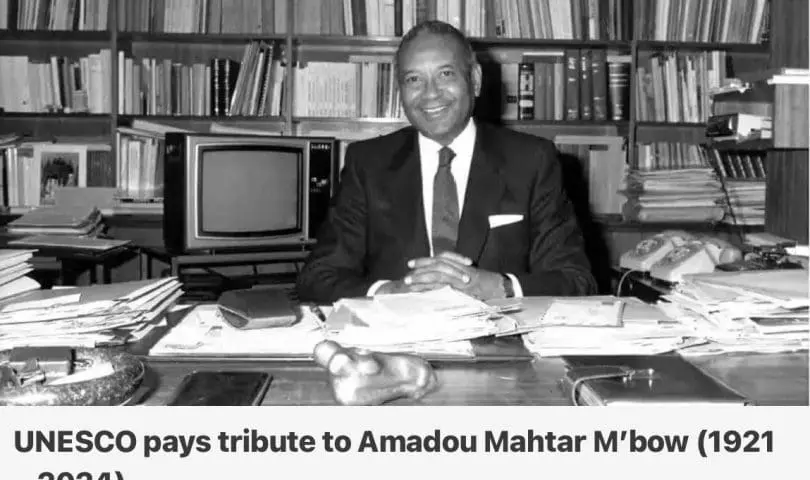

Amadou Mahtar M’Bow was a man of profound wisdom and vision, who left an indelible mark on the world. As the first African Director-General of UNESCO, he paved the way for a more inclusive and equitable world. Born in Dakar, Senegal in 1921, M’Bow’s journey was a testament to his unwavering dedication to education, culture, and the betterment of humanity.
M’Bow’s early life was marked by his attendance at a colonial school and a Koranic school, where he developed a deep appreciation for knowledge and culture. He later became active in Senegalese politics, serving as Minister for Education and Culture from 1957 to 1958. His commitment to the fight for independence led him to resign from his position, and he later became Minister of National Education, Culture, and Youth.
In 1970, M’Bow was named Under-Director General of UNESCO for Education, and four years later, he was elected Director-General, becoming the first African to lead a United Nations agency. During his 13-year tenure, M’Bow oversaw several groundbreaking projects, including the World Heritage Convention and the compilation of the first sites on the World Heritage List in 1978 .
M’Bow’s vision for a more equitable world was evident in his advocacy for a “New World Order of Information and Communication.” He believed that humanity had an obligation to live in solidarity, and his work at UNESCO reflected this commitment. The International Programme for the Development of Communication, launched in 1981, was a testament to his dedication to promoting global understanding and cooperation.
Throughout his career, M’Bow was a fierce advocate against all forms of racism or discrimination and a strong opponent to the Apartheid. His legacy shows this deep commitment to equality and culture for everyone to share. As UNESCO Director-General Audrey Azoulay so eloquently put it, “He had the grace to share his knowledge and wisdom, and was keenly aware of both the strengths and weaknesses of our Organization”.
M’Bow’s contributions to UNESCO’s mission are immeasurable. He launched the General History of Africa project, which aimed to remedy the ignorance about Africa’s past. He also presided over the designation of the first biospheres, recognizing protected areas as model regions that balanced conservation of biodiversity and sustainable development.
In addition to his work at UNESCO, M’Bow was a prolific author, publishing numerous books and articles on UNESCO’s missions and various cultural, political, economic, and social problems of the world. His writings often offered an African perspective, providing valuable insights into the complexities of global issues.
Today, UNESCO pays tribute to Amadou Mahtar M’Bow, a true champion of humanity. His legacy serves as a reminder of the power of education, culture, and international cooperation to create a better world for all.
Ruth Abla ADJORLOLO
