


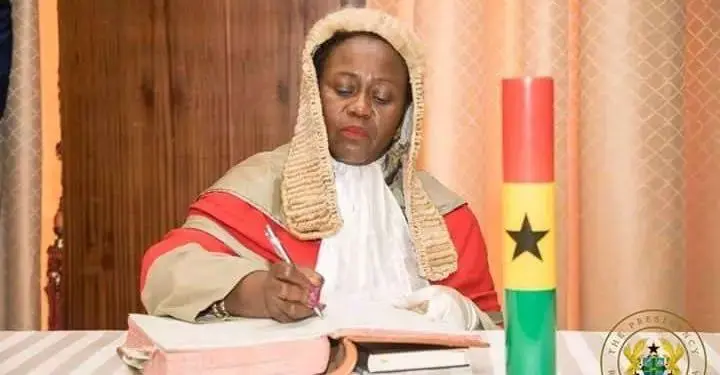
In a move that has sent shockwaves through Ghana’s legal and political landscape, President John Dramani Mahama has removed Chief Justice Gertrude Araba Esaaba Sackey Torkornoo from office on grounds of “stated misbehaviour.” The decision, described by many in the legal fraternity as a “tsunami,” marks an unprecedented moment in Ghana’s constitutional history and sets a bold precedent for judicial accountability across the continent.
The removal follows a constitutional inquiry conducted under Article 146 of the 1992 Constitution, a process that has been hailed as both rigorous and unyielding.
The Constitutional Gauntlet: A Process of Unyielding Scrutiny
This was no political whim. The removal of the Chief Justice was the culmination of a constitutional drama that began in March, when President Mahama received multiple petitions calling for her dismissal. In accordance with Article 146(6), and in consultation with the Council of State, the President established a five-member committee to investigate the allegations in camera.
Among the petitions, one filed by Ghanaian citizen Daniel Ofori accused the Chief Justice of “stated misbehaviour” under Article 146(1). The committee’s inquiry was quasi-judicial in nature and of immense gravity. It heard testimony from 13 witnesses supporting the petition and 12 witnesses, including legal experts, defending the Chief Justice. Thousands of pages of documentary evidence were reviewed.
According to a statement from the presidency, the committee concluded that the grounds for removal were “established” and recommended her dismissal. Under Article 146(9), the President is constitutionally bound to act on such a recommendation. He did so by issuing a warrant for her immediate removal, an act not of discretion, but of constitutional obligation.
This architecture ensures that the process remains insulated from political influence, placing investigative authority in the hands of an independent committee and rendering the President’s role procedural.
A Seismic Shift for Ghana’s Judiciary and Jurisprudence
The removal of a sitting Chief Justice is a seismic event,the first of its kind in Ghana’s history. Its implications are far-reaching.
First, it fortifies the rule of law. The process affirms that no individual, regardless of rank, is above the constitution. It reinforces the principle of accountability and signals that judicial office is not immune to scrutiny. This could foster a more transparent and confident judiciary, reminding judges that their conduct is subject to constitutional checks.
Second, it may usher in a new era of jurisprudence. The precedent set by this removal will likely influence future interpretations of judicial misconduct. Though the details remain confidential, the outcome may prompt a re-examination of judicial codes and a renewed emphasis on integrity and impartiality. Legal scholars and practitioners alike will find fertile ground for debate and reform.
A Lesson for Africa: Upholding the Law Above All Else
This landmark decision reverberates beyond Ghana’s borders. In a continent where judicial independence is often tenuous, Ghana’s example offers a compelling lesson: constitutional democracy must hold its highest judicial officers accountable through lawful means.
The message to future Chief Justices and judges is clear, the law is sovereign, and judicial officers are its stewards. Their loyalty must lie with the constitution and the citizenry, not with political factions or personal interests. Ghana’s action stands as a bold repudiation of judicial partisanship and a clarion call for integrity.
The removal of Chief Justice Torkornoo serves as a powerful deterrent. It underscores that judicial authority is derived from public trust, and that trust is forfeited when the law is manipulated for personal or partisan gain.
In a continent where democracy remains a work in progress, Ghana’s move is a beacon of hope. It demonstrates that constitutional provisions, when faithfully executed, can combat corruption and institutional decay. Justice, like a river, will find its course,no matter the obstruction.
