

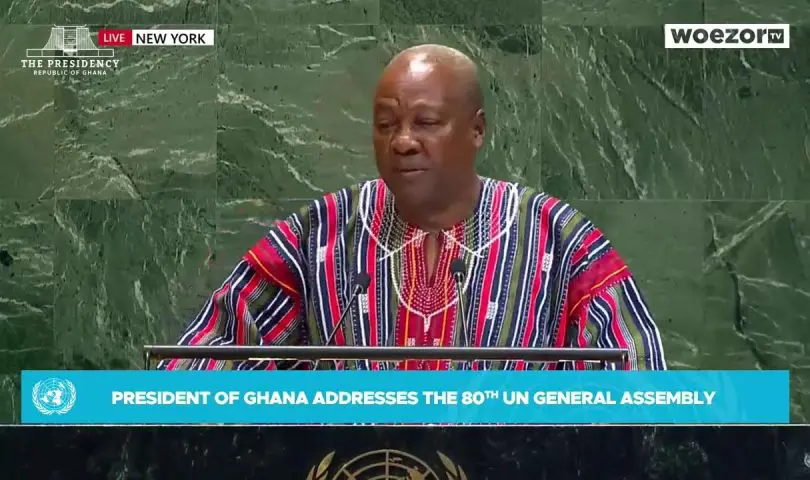

Sankofaonline News Desk: UN Headquarters New York. September 25, 2025
In a searing address to the United Nations General Assembly today, President John Dramani Mahama of Ghana cast a spotlight on the world’s most urgent humanitarian catastrophe,the conflict in Sudan,and issued a moral challenge to the global community to confront the intertwined crises of forced migration and climate injustice.
Calling the Sudan conflict “the world’s largest humanitarian crisis,” Mahama revealed that over 12 million people have been displaced, a staggering figure that demands immediate and equitable international response. He urged member nations to extend the same level of aid and compassion to Sudanese refugees as they did to those fleeing Ukraine, warning against selective empathy and geopolitical bias.
Mahama then turned to the deeper forces driving migration, challenging the dominant narratives in Western political discourse. “When leaders of Western nations speak of migration problems,” he said, “they are often referring to immigrants from the Global South.” He emphasized that many of these migrants are not economic opportunists but climate refugees,victims of a global imbalance they did not create.
He laid bare the stark inequity at the heart of the climate crisis: the Global North emits 75 percent more greenhouse gases than the Global South, yet the latter bears the brunt of the devastation. With fewer resources to adapt, communities in Africa face desertification, collapsing ecosystems, and the slow disappearance of habitable land. “When the desert approaches our villages and towns,” Mahama said, “we are forced to flee.”
To humanize the perilous journeys undertaken by displaced people, Mahama invoked the words of Somali-British poet Waa Sangshiri from her poem “Home”: “No one puts their children in a boat unless the water is safer than the land.” It was a poignant reminder that migration is not a choice, it is a last resort.
Rejecting xenophobia and racism, Mahama celebrated the contributions of migrants to their adopted homelands. He named Mami Eusi Mensah Frimpong, the first Black female judge on any of California’s federal district courts; Peter Bosman, the first Black mayor in Slovenia and Eastern Europe; T. Michael, the Ghanaian-Norwegian designer; and the late Kofi Annan, Nobel Peace Prize laureate and former UN Secretary-General. “These are not invaders,” Mahama declared. “These are the architects of progress.”
President Mahama’s speech was a clarion call to confront the uncomfortable truths of global inequality. It demanded that the world look beyond borders and politics to recognize the shared humanity of those displaced by war, climate, and indifference. In a time of rising walls and shrinking compassion, his words stood as a powerful appeal for justice, dignity, and solidarity.
