
By Stephen Apolima | 25th May, 2025
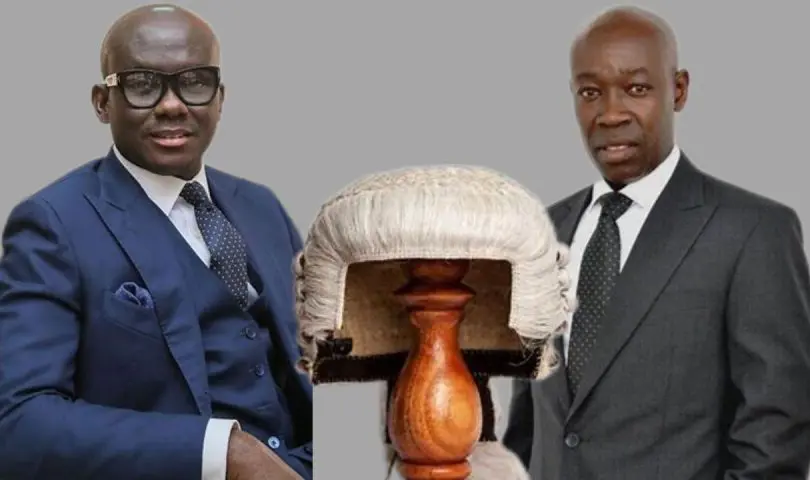
Accra, Ghana – When senior lawyers in Ghana exchange biting words not in the courtroom but on Facebook, the nation must pause and reflect—not just on the rhetoric, but on the fragile relationship between law, politics, and public trust. In a recent heated online encounter, renowned lawyer Thaddeus Sory delivered a stinging rebuttal to remarks made by former Attorney-General Godfred Yeboah Dame, branding him, unapologetically, the “Incongruous Cry Baby.”
What began as a dispute over alleged political bias in the ongoing legal saga surrounding the suspended Chief Justice quickly turned into a broader war of words—raising uncomfortable questions about the integrity of the legal profession, the politicization of Ghana’s judiciary, and the conduct of those who wield or once wielded legal authority.
From Courtroom to Facebook Battlefield
The controversy took root when the former Attorney-General, speaking on Joy FM’s Top Story, lamented the perceived politicization of legal proceedings involving the Chief Justice. Specifically, he pointed to the legal team representing the petitioners—including Tsatsu Tsikata, Oliver Barker-Vormawor, and Thaddeus Sory—as a group of NDC-aligned lawyers with vested political interests.
Sory’s response was swift, scathing, and uncompromising. In a post titled “THE INCONGRUOUS CRY BABY AGAIN…”, he accused Godfred Dame of hypocrisy, moral inconsistency, and professional misconduct.
“Mr. Cry Baby [Incongruous is his first name] has once again started screaming,” Sory wrote. “This time, the forum for his mostly infamous screams is Joy FM’s Top Story programme, not his favourite forum [and you know where].”
He then went on to dismantle Dame’s claims with a detailed catalogue of his own legal record—highlighting clients from both political parties, including Ambrose Dery, O.B. Amoah, and Kwaku Kwarteng. Sory stressed that legal professionalism is not defined by political affiliation but by service to the law, guided by ethical standards like Rule 65.
“If your memory is programmed to interpret everything through an NDC lens, you have my sympathy.”
The Bigger Picture: Law, Politics, and Power
The public spat is more than personal. It opens a larger window into a judiciary increasingly perceived—rightly or wrongly—as politicized.
Can a lawyer’s past clientele become a badge of political allegiance? Can a former Attorney-General, who was a political appointee, claim neutrality while accusing others of partisanship? And perhaps most importantly, what happens to public confidence when justice appears to be a matter of party colours?
Sory’s accusations against Dame were not just rhetorical—they were surgical. He questioned Dame’s involvement in cases directly affecting the suspended Chief Justice, flagged alleged misconduct such as “coaching an accused person to implicate a co-accused,” and accused him of defending ex parte orders that appeared to short-circuit due process.
“There is no Attorney-General who has contributed more to the low rating of the judiciary than you,” he wrote. “What has changed now?”
The Erosion of Public Trust
At the heart of this Facebook feud lies a silent victim: public trust in the legal system. The judiciary, meant to be impartial and removed from political skirmishes, is now caught in the crosshairs of partisan rhetoric.
The irony is stark. Both Sory and Dame are elite legal minds. Both have served high-profile clients. And both claim to uphold the rule of law. But when disagreements erupt in social media posts laced with sarcasm, mockery, and thinly veiled threats, one must ask: is this the professional decorum expected of the gatekeepers of justice?
Sory, at one point, even warned:
“The next ‘knock’ may not be a gentle tap. It will land like a sledgehammer.”
If such public exchanges continue unmoderated, the line between professional disagreement and personal vendetta risks being permanently blurred.
The Legal Fraternity Must Step In
This episode should not be dismissed as mere drama. It is a cry—perhaps not from a cry baby, but from a legal system under pressure. The Ghana Bar Association, Judicial Council, and civil society actors must not remain silent.
Where are the codes of professional conduct when lawyers, especially those in public office or with recent influence, air grievances in the public square? Where is the room for sober, institutional dialogue on matters that affect the rule of law?
Conclusion: When the Gavel Echoes on Facebook
In the end, the Sory-Dame feud reflects more than a clash of egos—it is a loud, digital echo of a silent institutional crisis. When two leading lawyers can so publicly question each other’s integrity, motives, and professional record, the rest of us must wonder: what does justice look like behind the scenes?
Perhaps the next “Top Story” is not about who shouted loudest but who upheld the dignity of the law when it mattered most.
Follow us for more legal commentary and political insights. Share your thoughts: Is this feud a healthy airing of truths, or a troubling descent into legal populism?