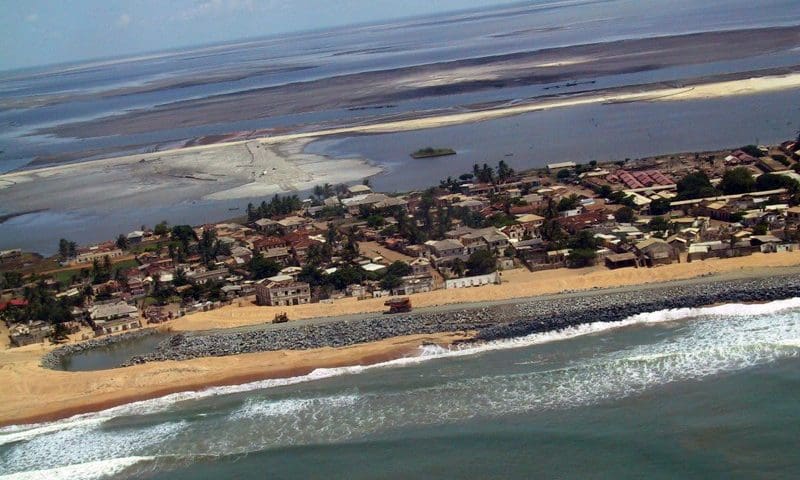

Keta is a funny old town. 60-80% of it lies beneath the Atlantic Ocean–submerged, destroyed, washed away. If you dive deep enough beneath the waves you might see ghost mansions and the remnant of businesses of bygone decades and tree stumps that are centuries old. But the name Keta stands strong still and now refers to the small part of it that remains and all the adjoining towns and villages from Kedzikope, through Abutiakope, Dzelukope, Nukpesekope and Vui, where Jubilee Radio and Cereno Homes Hotel and Restaurant are located.
It’s now just a small strip of land lying between two water bodies–the Gulf of Guinea or Atlantic to the South, which the fisher folks fish almost everyday and the Keta Lagoon to the North, which contains a wetland area and Ramsar site to which rare birds from other parts of the globe migrate to every year. It’s the best place for bird watching in Ghana.
Keta was once the capital of the Volta Region and a hub of commercial activity. But the sea decimated her and took away her grandeur and splendour. On any given day you could see merchants from every part of Ghana trading their wares and doing business and even Arabs coming down to sell their stuff. Some of their progeny still remain among us.
Those were the days when the schoolboys in town like Uncle Smiles of Uncle Smiles Photos (not far from the Vodafone office) and N.K.K. Gidiglo (my former English teacher at Ketasco now Choir Master at Vui Zion Church) run to the market to write letters for the market women who wanted to communicate with their business partners in Kumasi or Axim. It was a decent opportunity for a schoolboy to earn some much needed cash as recently as 50-60 years ago.
Alas, all that is gone now. Keta is now a shell of what it was, a testament to bygone days of her grandeur and spellbinding beauty, a relic of something beautiful. She is like the exceptional woman who wedded an idiot, became neglected, was abused and lost her elegance and aura overtime.
But here is hope. Keta is rising. We are on the move.
Keta’s golden beaches are now her foremost asset. There have been a gradual increase in the number of local and foreign tourists trooping to her beaches, and the earlier we take advantage of this the better we will fare in returning her to the glory days. Keta must rise again. Keta must be great again. Keta is great already.
The beach resorts and local hotels and guest houses that have sprung up at our beaches should charge for lodging reasonably in order to not scare would-be local tourists away. The Anloga District and Keta Municipal Assemblies should put their heads together and come up with a local tourism development plan that can make us the preferred tourism destination for local tourists and foreigners. Tourism is not just about leasing beachfront lands for people to build guest houses along the shores, you need a plan to get people visiting every weekend. If you don’t have the men and the women to do it, get in touch. We can.
Our beaches are the cleanest in Ghana. Walking barefooted in the sand is therapeutic and inhaling the breeze can reinvigorate you and get you ready to achieve greatness once you finish enjoying your weekend get away or long vacation. If the local government leaders are not sure about how to harness Keta’s tourism potential, they should talk to Joel Degue–he is a tourism and resource development expert and an indigene.
States like the Maldives, Macau, British Virgin Islands, Grenada, Cape Verde and even France and Italy have significant percentages of their GDP reliant on tourism. We can reap a similar benefit as well.The Keta enclave has potential enough to generate 5-10% of Ghana’s Gross Domestic Product, create employment for many indigenes and have a ripple effect on other tourism hubs in Ghana.
Degue Joel documented over 40 tourist attractions in the Keta-Anloga enclave. There is a slave market at Atorkor, an underwater mountain at Woe–which necessitated the building of the Cape St. Paul’s Lighthouse to warn ships on the waters, the location for Torkor Atorlia killings in the Hogbe Park area at Anloga, the Keta Fort and a host of other scenic and historical attractions. There are other high tourism and socio-economic development projects on the drawing tables.
Gold and diamonds we do not have, but we have sandy beaches and water bodies aplenty. Why not harness them for such development? Gold and diamonds are not forever, but new resources we can create and experiences we can sell forever.
“Resources are not, they become. Resources are not known, fixed things; they are what humans employ to service wants at a given time.” – Erich Zimmermann
Let’s do this.
By Stan Dugah
StantheStoryTeller
+233505615705
01/08/2022