

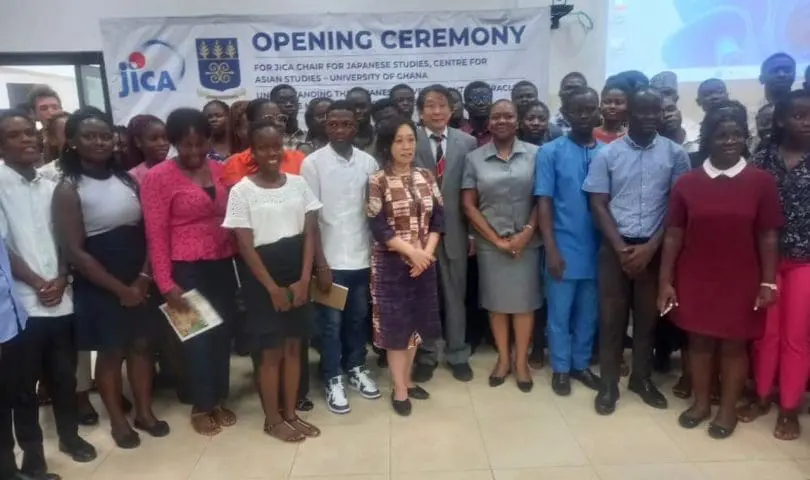

The Japan International Cooperation Agency (JICA) has launched its Chair Program for Japanese Studies at the Center for Asian Studies, University of Ghana. This initiative aims to provide Ghanaian students, researchers, and professionals with a platform to explore Japan’s unique experiences in modernization, human capital development, technological advancement, and international cooperation.
The program seeks to foster innovation and resilient industrialization in Ghana by promoting academic collaboration and equipping participants with skills for economic transformation. According to Suzuki Momoko, Chief Representative of JICA Ghana, this program will not only enhance workforce skills but also open international communication and networking opportunities for Ghana’s professional landscape.
Implemented in various universities globally, the JICA Chair Program aims to develop innovative leaders, particularly in developing countries like Ghana. JICA envisions this partnership with the University of Ghana as a path to strengthen Japan-Ghana relations and equip Ghanaians with the tools to address global challenges.
The program’s potential to boost employability and global career prospects for participants was highlighted by Momoko Suzuki, who stated, “This will equip individuals who can dream of a better future and realize their diverse potentials.” The Japanese Ambassador to Ghana, H.E. Mochizuki Hisanobu, commended Ghana’s developmental progress but noted that the country still faces infrastructural challenges.
Dr. Lloyd Adu Amoah, Director of the Center for Asian Studies at the University of Ghana, emphasized the importance of this program in positioning Ghanaians to engage more effectively with Asia. “To position Ghanaians in a better state to engage the Asian world is crucial for tapping into innovative advantages,” he noted.
The launch event, themed “Understanding Japan’s Developmental ‘Miracle’ from the Meiji Revolution to the Present,” brought together policymakers, academic experts, business leaders, and students to discuss the promising role of Japanese studies in Ghana’s future. This program is part of JICA’s efforts to promote Japanese studies globally, with similar programs launched in various universities across Asia, Latin America, Africa, and the Middle East.
GBC/Ruth Abla ADJORLOLO
