

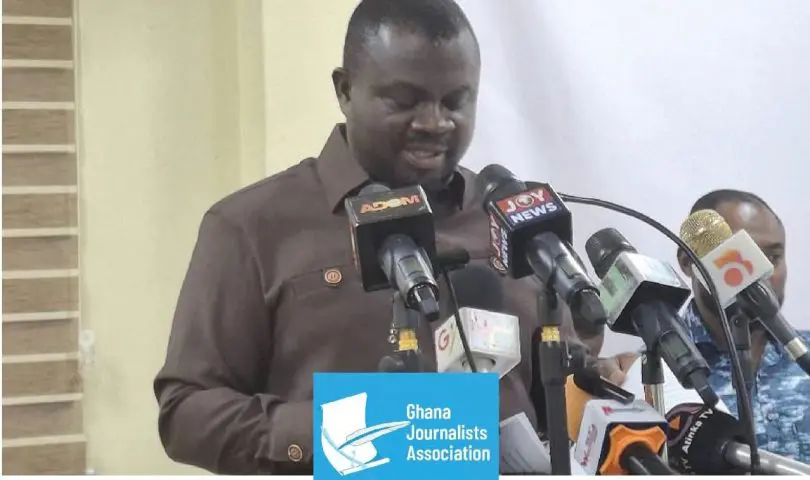

The government and the Ghana Journalists Association (GJA) have found themselves in a tense standoff following the attempted arrest of a JoyNews reporter and the assault of an eyewitness by a soldier at a demolition site. While the government has condemned the actions and ordered an investigation, the GJA views the official response as insufficient and has issued a strong warning of a potential nationwide media blackout.
A statement from the Office of President John Dramani Mahama, communicated by spokesperson Felix Kwakye Ofosu, described the soldier’s actions as “utterly unacceptable” and having “no place in our democratic society.” The government reaffirmed its “unwavering commitment to the freedom and safety of journalists” and the press’s role as a cornerstone of democracy.
President Mahama has directed the Minister for Defence and the National Security Coordinator to launch an investigation and ensure “appropriate punishment is immediately imposed” to prevent future incidents.
However, the GJA, in its own statement, noted the government’s condemnation as an “important symbolic gesture” but insisted it was “not enough.” The association called on the government to “match words with decisive action,” warning that Ghana’s reputation as a “beacon of democracy may be at risk if those who attack journalists with impunity continue to go unpunished.”
In a clear escalation, the GJA has given the Ghana Police Service an ultimatum: if it fails to “act decisively within the next 7 days,” the association will announce a “nationwide media blackout of all police activities.” This unprecedented measure would involve instructing members to withhold coverage of police events, refuse participation in press briefings, and suspend all editorial engagement with the police.
Furthermore, the GJA outlined a series of resolute actions it plans to take to combat impunity. These include filing personal civil assault lawsuits against officers who attack journalists, collaborating with international human rights bodies, and engaging with key embassies to seek visa denials for identified security officers. The association also plans to petition security councils to disqualify offending officers from promotion and will launch a “Press Freedom Blacklist” by publicly publishing the names, ranks, and photos of all identified journalist attackers, labeling them “Enemies of Democracy and Press Freedom.”
The GJA called on the Ghana Armed Forces to publish the full details of the soldiers involved in the incident within seven days. The GJA’s statement also touched upon broader national issues, expressing concern over rising insecurity in several regions, including Bawku and Asawase. The association urged professionalism in conflict reporting, cautioning journalists against spreading disinformation or inciting violence and warning that it would not shield any media practitioner who breaches ethical standards or national security laws.
The GJA concluded with a firm restatement of its core belief that “Journalism is not a crime,” and attacks against journalists are “attacks against the soul of democracy.” It affirmed its commitment to fighting for the safety and dignity of journalists, stating, “We will not be quiet. We will not be intimidated.”
Ruth Abla ADJORLOLO
