

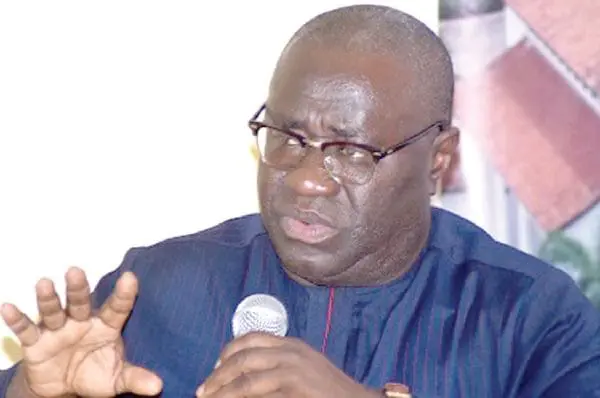

Renowned security analyst Prof. Emmanuel Kwesi Aning has sounded the alarm on Ghana’s slide into a ‘GalamState’, where the failure to tackle illegal mining, or galamsey, has become a recipe for disaster. Speaking at a CSO post-engagement with political parties on mining at Aburi, Prof. Aning warned that the country is on the cusp of catastrophic security, environmental, and economic consequences.
“Ghana has now been characterized as a ‘GalamState’, a state captured and linked to grand corruption,” Prof. Aning cautioned. In this scenario, galamsey is normalized, and citizens are silenced or relegated to powerless protests. The lines between criminally-minded politicians and politically-minded criminal gangs have become perilously blurred, creating a hybrid governance system where the rule of law is effectively nonexistent.
Prof. Aning’s grim prediction is that Ghana is poised to see the emergence of mafia-style criminal gangs, fueled by entrenched corruption and institutional complicity. “The crimes and collusion are so intertwined,” he emphasized. “To stop galamsey, we need to examine the multiple institutions that enable these crimes and address the embedded individual and group interests.”
Galamsey’s devastating impact on Ghana’s environment is well-documented. Deforestation, water pollution, and land degradation have become rampant, with forest reserves shrinking from 9.17 million hectares in 1995 to 5,768,678 hectares in 2017 ¹. The illegal mining sector has also contributed significantly to Ghana’s gold production, with small-scale mining accounting for 43% of total gold production in 2018.
As Ghana struggles to contain the galamsey menace, Prof. Aning’s warnings serve as a stark reminder of the urgent need for collective action to prevent the country’s slide into further chaos.
CNR/Ruth Abla ADJORLOLO
