
By Leslie Mensah TAMAKLOE
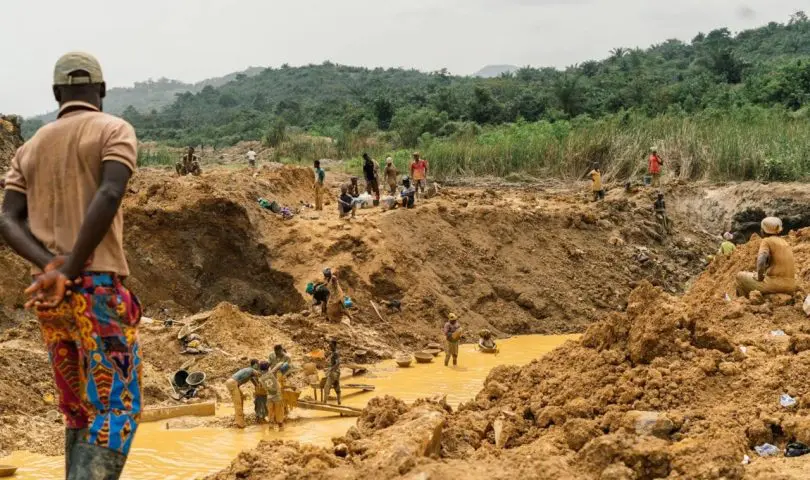
Illegal small-scale gold mining, known as Galamsey, continues to devastate Ghana’s forests, waterways, and farmlands. The recent brazen attack on the Administrator of the Minerals Development Fund (MDF), Dr. Hannah Bissiw, coupled with allegations of complicity among security agencies, a surging gold price exceeding $3200 per ounce, and the reported weaponization of miners, collectively demand a “War Room” approach to tackle this national crisis.
While past military interventions yielded limited success, the recent ban on excavator imports represents a critical intervention, with limiting fuel transport to these machines as the logical next step. Worrying media reports of over 1000 new excavators awaiting clearance at Ghanaian ports and an additional 3000 on the high seas illustrate a nation under siege.
In this 21st century, with advancements in robotic vehicles on Mars, high-resolution satellite imaging of distant planets, AI-powered self-driving cars, and food delivery bots, it is imperative to leverage similar technological tools to effectively monitor, manage, and control illegal mining in Ghana. This approach aims to deter and arrest illegal activities without risking the lives of officials like Dr. Bissiw.
Galamsey necessitates a fundamental “RESET.” This article explores new, technology-driven strategies combining high-resolution satellite imagery, low-cost drones, and artificial intelligence analysis to turn the tide. These methodologies and lessons can empower government authorities to more effectively detect, deter, and prosecute illegal mining operations.
The term “War Room” is not a call for military action against fellow Ghanaians but rather a metaphor for a high-intensity, mission-oriented, centrally managed effort to halt Galamsey swiftly. This tactical operations center would be optimized for rapid decision-making, fostering collaboration among all stakeholders, and establishing clear lines of command and control from the War Room to field operational centers, enabling critical and decisive action against the menace. It brings together the right people, information, and technological tools to overcome significant challenges in suppressing and eliminating Galamsey in Ghana.
A central command and control system is crucial. The War Room would centralize and integrate data for rapid response through a unified portal that fuses satellite alerts, satellite and drone footage, and GPS-tagged citizen reports. Upon detection of a new site, automated alerts with geolocated notifications would be sent via SMS or a secure app to rapid-response security agencies.
The initial task in the War Room is to “See and establish the Big Picture.” This involves engaging commercial satellites to generate high-resolution imagery of all mining sites nationwide, both legal and illegal, with resolutions as fine as 30 cm per pixel.
This level of detail can pinpoint individuals, gold washing setups, excavators, and vehicles, accurately mapping the size of any mining zone. By comparing successive images, analysts can easily spot newly cleared lands or sediment plumes in rivers, serving as early warnings of illicit digging.
Understanding the big picture also entails overlaying both legal and illegal mining sites on these high-resolution satellite images. By integrating licensed mining sites and their boundaries, past Galamsey locations, forest reserves, road networks, and waterways into AI mapping models, authorities gain high-level awareness of Ghana’s mining landscape. Geofencing licensed areas creates virtual boundaries around legal concessions, instantly triggering investigations for any detected disturbance outside permitted zones.
AI modeling can also predict where illegal activity is most likely to emerge next. In the War Room, frequently updated high-resolution satellite images, aided by machine learning models, can automatically detect changes in vegetation loss or water turbidity, flagging suspicious alterations outside licensed zones for urgent review by security agencies.
On-the-ground reconnaissance can be made more effective by deploying drones for localized precision, directed from the War Room to security agencies. Fixed-wing drones would be used for wide-area mapping, covering tens of square kilometers per flight and producing detailed orthomosaic maps revealing excavation trenches and tailings piles.
Security agencies associated with the War Room would also be equipped with versatile, lightweight quadcopters with standard and multispectral cameras to hover over hard-to-reach riverbanks and forest edges, streaming live video to enforcement teams. Drone reconnaissance would guide security forces directly to active camps, minimizing manpower risks and collateral damage.
Drones equipped with night thermal surveillance would enable day and night operations, detecting active machinery or campfires after dark, exposing operations that typically pause when drones are not overhead. Inspired by the low cost of drones in recent conflicts, lost or damaged drones should be considered part of the operational budget, ensuring their bold and frequent deployment is not deterred.
For enforcement and legal action, high-resolution images and video provided by drones would serve as irrefutable court evidence, strengthening prosecutions and reducing dismissals, addressing the perception of limited sentencing due to a lack of evidence.
Engaging communities and building trust is crucial. Training sessions for assembly members and community leaders would equip them with basic drone-piloting and data-analysis skills, creating a grassroots network of “first responders” to the War Room. A public reporting application would allow citizens to upload GPS-tagged photos of suspected Galamsey sites, with real-time natural-language processing and translation to receive credible tips in any language.
Publishing a live map of legal concessions, active investigations, and enforcement outcomes via social media, radio, and TV would foster transparency and dissuade would-be offenders.
A roadmap for implementation could include a three-month pilot phase involving contracts with HR satellite operators, image analytics training, testing on known hotspots, and training of trainers for Galamsey-endemic areas. A six-month scale-up would involve setting up and operationalizing the War Room, analytical tools, training on all technology platforms, satellite-based communications, procuring and training drone pilots, deploying drone fleets nationwide, and integrating all regional Geological Information System (GIS) data streams.
Full enforcement within nine months would see the establishment of specialized security units (e.g., North, Middle, South), formalizing rapid-response protocols and rules of engagement, and bolstering legal frameworks for aerial evidence. Sustained operations would include annual technology effectiveness reviews, regular community engagement and refresher training, and independently monitored crisis simulations.
In conclusion, by marrying macro-scale satellite surveillance with nimble, low-cost drone reconnaissance, interwoven with AI-driven alerts and community engagement, all managed from a war room command and control center, Ghana can mount a sustained, data-driven offensive against Galamsey.
This multi-layered approach not only enhances detection and enforcement but also builds public trust and fortifies the country’s legal arsenal. As these tools are adopted and refined, Ghana can emerge as a regional leader in leveraging technology for environmental protection and sustainable resource management.
Sankofaonline