

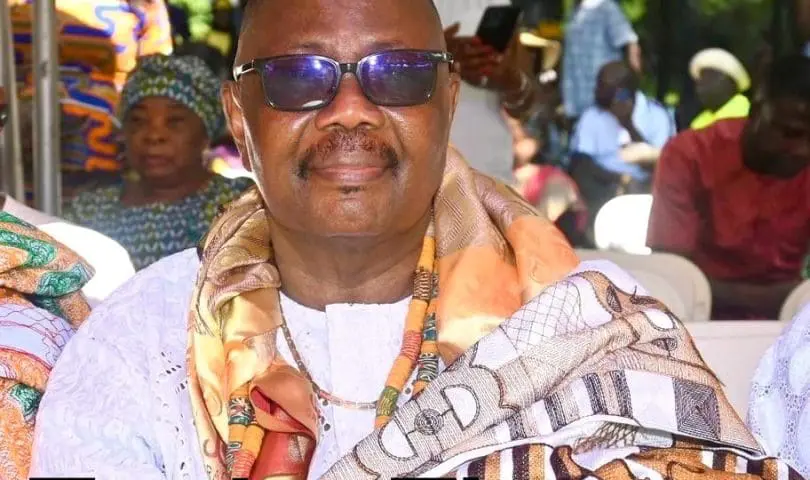

Ghanaians in America are going back to basics for cultural identity with Chieftaincy. Chieftaincy is one of the most successful Indigenous political institutions ever established in Ghana. Currently, observers believe that it is being used as a means of social integration and group cohesiveness.
During the period of colonization, the British ruled indirectly through chiefs. In fact, historians credit the success of colonial rule in Ghana to the existence of chieftaincy institutions. Thus, soon after independence in 1957, as discussed in the Fall 1992 issue of The Volta Sun titled, How Does One Become A Chief in Ghana? The author quoted the First President of Ghana, Dr.Kwame Nkrumah, as saying, “If Chiefs continued to involve themselves in the country’s politics as they were doing—litigation and factional politics—they would run away and leave their sandals behind.
This foregoing statement marked the beginning of what was feared to be the Clash of the Titans—the Government versus Chieftaincy. The government, composed of the executive, legislative, and judiciary, was on a collision course with chieftaincy, consisting of chiefs, advisors, and a council of elders.
Today, Chieftaincy is alive and well in Ghana, operating side by side with a democratic government, and it is now gaining roots in America!
Milenovisi Habobo of Chicago, Illinois, the Band-Wagon 1993.
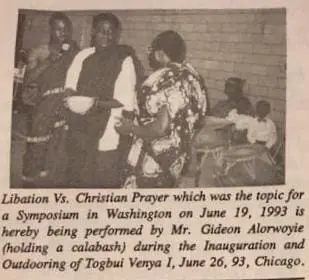
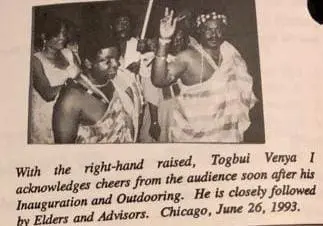
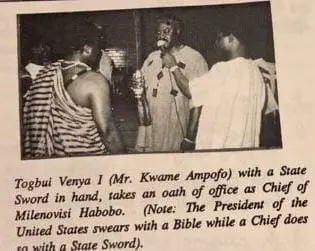
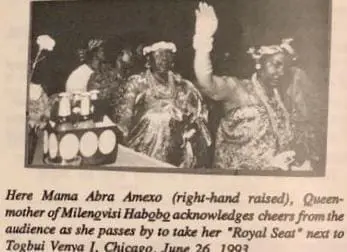
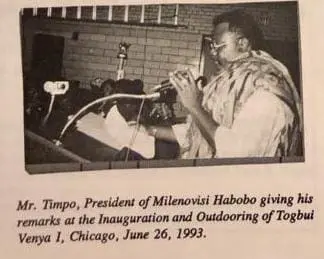
The latest Ghanaian association to join the bandwagon to install a chief and a queen-mother is Milenovisi Habobo of Chicago, Illinois. Milenovisi, formed in 1974, inaugurated outdoors their chief and queen-mother on June 26, 1993, at the South Central Community Center in Chicago amid pomp and pageantry—an event the Volta Club sent representatives. Pictured on page 14 are some of the regal moments. The Volta Sun cameraman captured. In an interview with the President of the association, Mr. Clement D. Timpo, the members of the association felt a need to install a chief and therefore amended their 19-year-old constitution to create a position for a Chief, Togbui Venya I, known in private life as Mr. Kwame Ampofo, former president of the association and a Queen-mother, Mama Abra Amexo. The installation, Mr. Timposaid, “is to show Americans part of our culture—at least the system of government before colonial rule to dispel the notion that Africans, for that matter, Ghanaians are not barbaric as portrayed in Tarzan movies. The need arose about four years ago, probably from New York City, where a durbar of chiefs was held.
Since then, an annual festival of Ghanaians involving a durbar of chiefs and people has converged in Chicago every July. The occasion is graced by the mayor of Chicago. He denied that the move to install a chief arose from an increasing Ghanaian population and its associated pressure to have socio-cultural control in the community. He said, “Out of the seven other Ghanaian associations in the Chicago area, only two—Asante Kotoko and Kwahuman have installed chiefs and queen-mothers as figureheads as they have done. The remaining associations have their presidents who also act as chiefs during the festival. They are Fanti Benevolent Society, Haske representing Northern Ghana ethnic groups, Okuapeman Fekuw, Okyeman Association of Chicago, and Unity Club (Ga Adangbe ethnic group).
Three of the ten Ghanaian associations in New York City have chiefs, including Ewe Harborbor, AsantemanAssociation, and Ga Adangbe. In Washington, D.C., four of the fourteen associations have chiefs. According to Mr. Timpo, Togbui Venya, I would serve as the association’s ceremonial figurehead, while he and his executive officers would be responsible for the organization’s day-to-day administration.
Milenovisi Habobo of Chicago 1994.
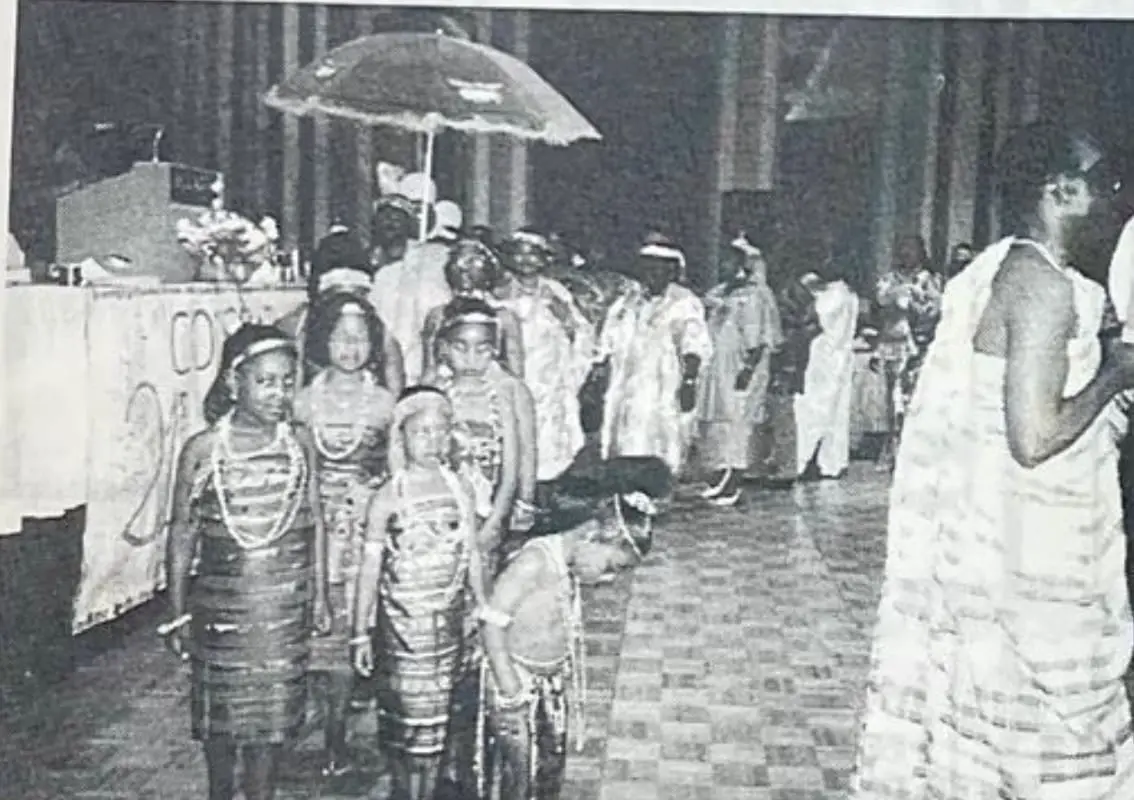
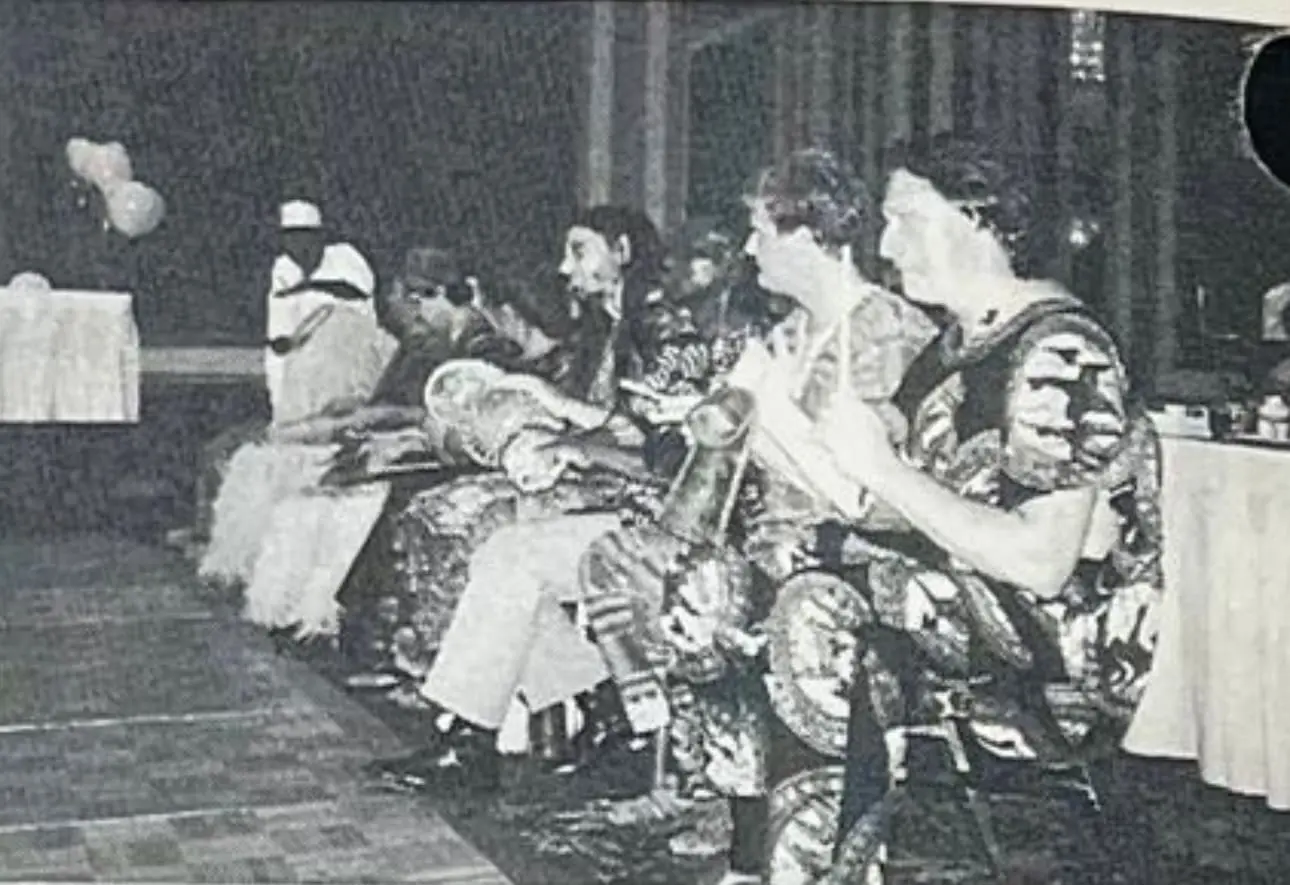
This is one of the three scenes that characterized the 21st-anniversary celebration of Milenovisi Habobo of Chicago at the Hyatt Regency Hotel in Downtown Chicago. Above, TogbeVenya I (Kwame Ampofo), Chief of Milenovisi Habobo, with the Queen-mother, Salma Tahir, at his left, walking regally under an umbrella as they acknowledge cheers from participants. Tsiami Gilbert Kodzo Ntow, the linguist, leads the procession, bearing the chief’s staff – a symbol of power and authority. Two other chiefs, Togbe Kofi Tsai, Chief of Ewe Habobo of New York City, and Togbe Adza Gbeklui I, Chief of the Ewe Cultural Organization of Ontario, Toronto, Canada, also made similar entries to the ballroom amid drumming of Adevu. Several other chiefs representing other Ghanaian associations attended the grand ball. Other dignitaries who had roles to play include Dr.Evans Z. Fiakpui, who served as chairman for the occasion and presented awards of recognition to deserving members of Milenovisi Habobo. The next day, he joined the Milenovisidelegates to discuss the interim constitution draft of the Council of Ewe Associations in North America. Alhadji Baba-Cisse, General Secretary of the Ghana National Council of Chicago, also addressed participants and extended messages of goodwill from all other Ghanaian associations to Milenovisi Habobo. In his address, Mr. Clement D. Timpo, President of Milenovisi Habob, said, “A few years back, it would have sounded incredulous to ever think of bringing together people of a common heritage. A people who, due to their individual economic desires and aspirations, have journeyed thousands of miles to the American shores and have been scattered all over North America. Therefore, many thanks go to the Volta Club of Washington D.C., whose 10th-anniversary celebration last year brought us together and helped give birth to this beautiful child, the Council of Ewe Associations in North America.
Ms. Otilia Tette led the gathering in singing “Miade NyigbaLolo la,” a patriotic song.
Dr. Samuel Oklu, the first president (1974) of Milenovisi, Presented observations on Milenovisi’s roles for the past 21 years in the pursuit of a larger group interest. He said, “We can now look forward with great anticipation that in a not too distant future, we may very well re-assemble in Chicago to play host to a Convention of Ghana Associations in North America. Better still), he stressed, “We can look to even that day when a Convention of Ghana Associations, in turn, plays host to that mother of all conventions, the Convention of African Nationals in North America.”
Two Reverend Ministers, John Akoto of the Ewe Association of Atlanta, Georgia, and Albert Wurapa of the Volta Club of Washington were also present, and they took turns blessing all activities during the celebration.
Source: Clement Timpo / Volta Star
