


The five-year boycott announced by the Pokuase Union of Prostitutes against members of the Ghana Police Service reads like a sensational headline—but beneath the provocation lies a sobering indictment of systemic abuse. This protest, unusual by any measure, isn’t about spectacle. It’s a desperate attempt to assert human dignity in the face of alleged harassment and disrespect by the very officers tasked with protecting all citizens.
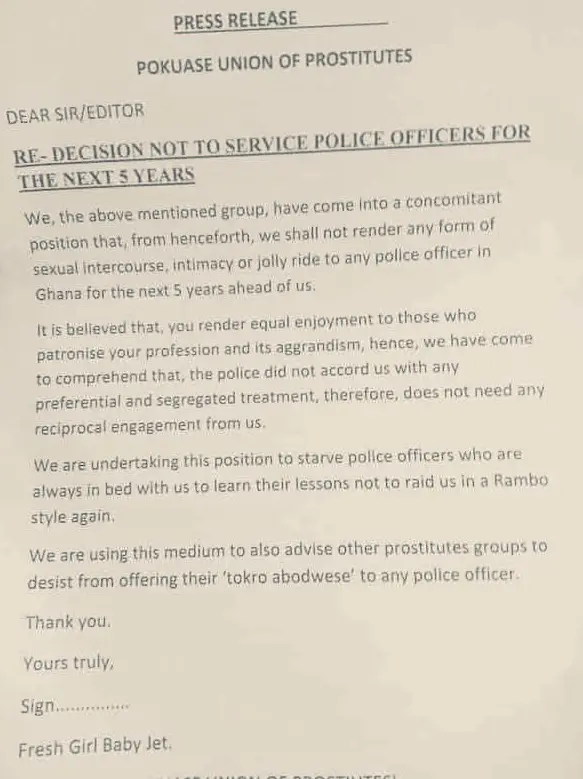
Their message is unambiguous: enough is enough. By refusing to offer services to officers, these women are spotlighting claims of degrading treatment, intimidation, and “Rambo-style” raids that suggest not law enforcement, but unchecked power. One damning assertion stands out: the police “did not accord us any preferential and segregated treatment.” It’s a sentence that speaks volumes—suggesting not just indifference but targeted mistreatment.
This isn’t just about sex work. It’s about the rule of law and who gets to claim protection under it. That individuals must resort to an unprecedented boycott to be heard reveals both their vulnerability and the scale of their trauma. If true, these allegations represent a grave abuse of authority and an institutional failure to uphold human rights.
The Ghana Police Service must treat this protest not as provocation but as provable warning. Are officers respecting procedural safeguards? Are raids being conducted within legal bounds? Are vulnerable communities being targeted in ways that undermine public trust? This is a moment for institutional reflection—not defensive denial.
The incident also reopens a national debate long shelved: who gets to claim citizenship rights, and on what terms? Regardless of the moral or legal debates around prostitution in Ghana, every person—regardless of profession—is entitled to protection against violence, humiliation, and abuse.
The women of the Pokuase Union may not conform to societal expectations, but their action demands attention. What they seek isn’t exception—it’s recognition. To dismiss them would be to ignore broader truths about power, marginalization, and the fragile state of civic trust. Their protest is not just symbolic defiance; it’s a cry for visibility, for justice, and for safety.
In moments like this, a democratic society must ask: whom do our institutions serve? The answer, and the actions that follow, will determine whether Ghana’s commitment to human dignity is mere aspiration—or binding principle.
