


Accra, Ghana – The Bank of Ghana (BoG) has reported an operating loss of GH¢9.49 billion for the 2024 financial year, signaling mounting fiscal and policy pressures confronting the central bank amidst ongoing macroeconomic volatility. The loss—disclosed in the bank’s published financial statements—is largely driven by costly monetary policy operations and significant exchange rate losses, underscoring the growing challenge of maintaining monetary stability under strained public finance conditions.
Financial Snapshot: Revenues vs. Expenditures
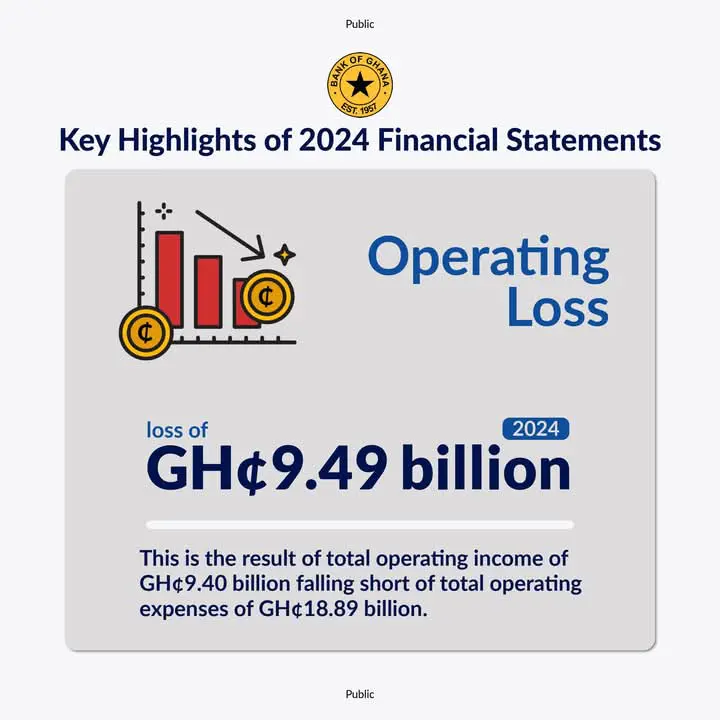
In 2024, the BoG generated total operating income of GH¢9.40 billion. However, this was eclipsed by operating expenses totaling GH¢18.89 billion, resulting in a net operating loss of GH¢9.49 billion. The gap between revenue generation and policy-related expenditures reflects not just cyclical economic stress, but also structural inefficiencies in the bank’s monetary transmission framework.
Cost Drivers: OMO and Exchange Rate Exposure
Two key elements contributed to the bulk of the losses:
- Open Market Operations (OMO) Costs:
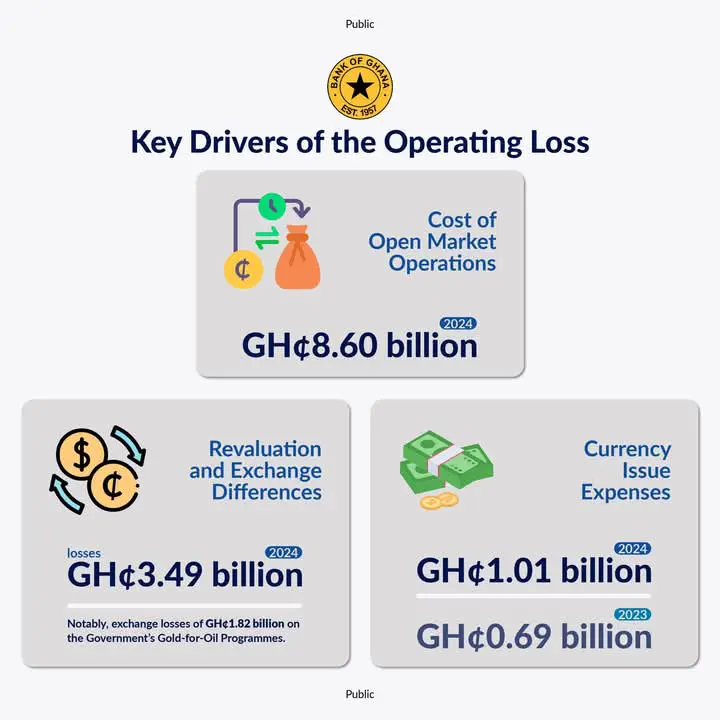
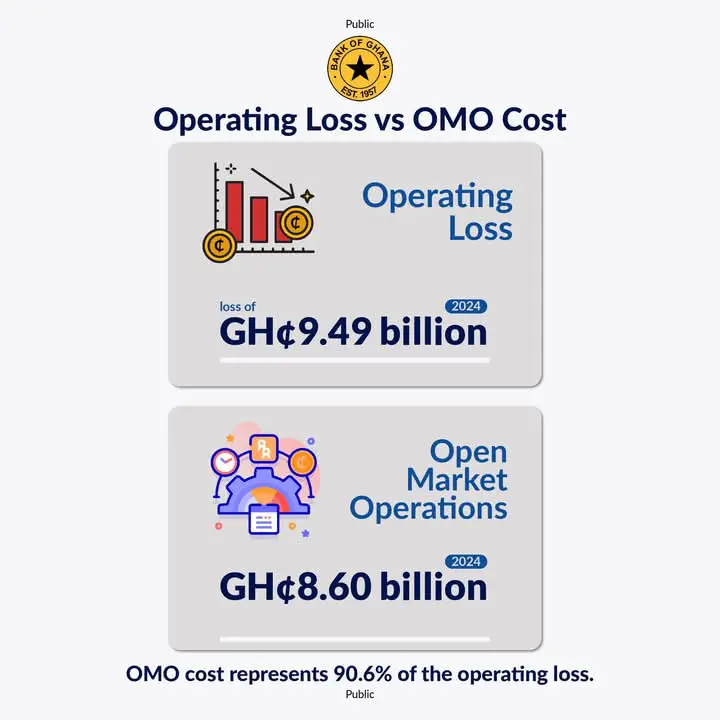
The BoG incurred GH¢8.60 billion in OMO-related expenditures, representing approximately 90.6% of the overall loss. These costs stem primarily from aggressive liquidity management through the issuance of short-term instruments—an approach that, while intended to curb inflation and mop up excess liquidity, has led to substantial interest obligations amid elevated domestic borrowing rates. - Foreign Exchange Losses:
The central bank also recorded FX-related losses totaling GH¢3.49 billion, a portion of which—GH¢1.82 billion—is directly attributable to the Gold-for-Oil Programme. While this initiative was designed to stabilize fuel prices and preserve foreign reserves, the FX mismatch arising from commodity-backed swaps and exchange differentials has had a detrimental impact on the BoG’s financial position.
Policy Implications and Strategic Considerations
The scale of the operating loss raises important questions about the sustainability of current monetary policy tools, particularly the cost-effectiveness of OMO instruments in the current high-interest environment. Analysts have long cautioned that persistent reliance on expensive sterilization tools, absent a parallel deepening of capital markets and fiscal consolidation, could impair the central bank’s balance sheet over time.
The exchange losses, on the other hand, highlight the risks embedded in quasi-fiscal operations and unconventional policy instruments such as the Gold-for-Oil arrangement. Without corresponding improvements in forex risk management and transparency in commodity-linked transactions, such initiatives may continue to exacerbate the bank’s vulnerabilities.
Transparency, Market Confidence, and Institutional Credibility
To its credit, the Bank of Ghana has demonstrated commendable transparency by publishing its 2024 financial results on its official platforms, including social media. This openness provides a foundation for constructive engagement with stakeholders, including Parliament, the financial sector, and development partners. It also allows for a more nuanced debate around the appropriate role of the central bank in non-traditional fiscal interventions.
Looking Ahead: Recalibrating for Stability
The central bank’s financial performance is intricately linked to its policy credibility, operational autonomy, and ability to anchor inflation expectations. In the face of tightening global financial conditions, currency pressures, and domestic fiscal imbalances, the BoG will need to recalibrate its strategy—balancing the imperatives of macroeconomic stabilization with prudent risk management and cost control.
A forward-looking approach may involve:
- Revisiting the structure and frequency of OMO operations,
- Enhancing coordination with fiscal authorities to reduce the burden of monetary financing,
- Strengthening FX hedging mechanisms and pricing transparency in public procurement programs,
- And progressively rebuilding capital buffers to restore institutional resilience.
As Ghana charts a path toward macroeconomic recovery, the integrity and efficiency of its monetary authority will be critical to restoring investor confidence and fostering sustainable economic growth.
