
By Stephen Apolima
8th May 2025
Accra, Ghana – In revelations that have sent shockwaves through the legal and political communities, Kwabena Adu-Boahene, former Director-General of the National Signals Bureau (NSB), stands accused of unlawfully diverting GH¢49 million in state funds to private entities, Members of Parliament, and an opposition political party. The matter, now pending before the Criminal Court, has provoked intense scrutiny among legal practitioners, with distinguished lawyer Mr. Edudzi Tamakloe critically assessing the defence’s posture.
The Alleged Diversions: A Forensic Breakdown
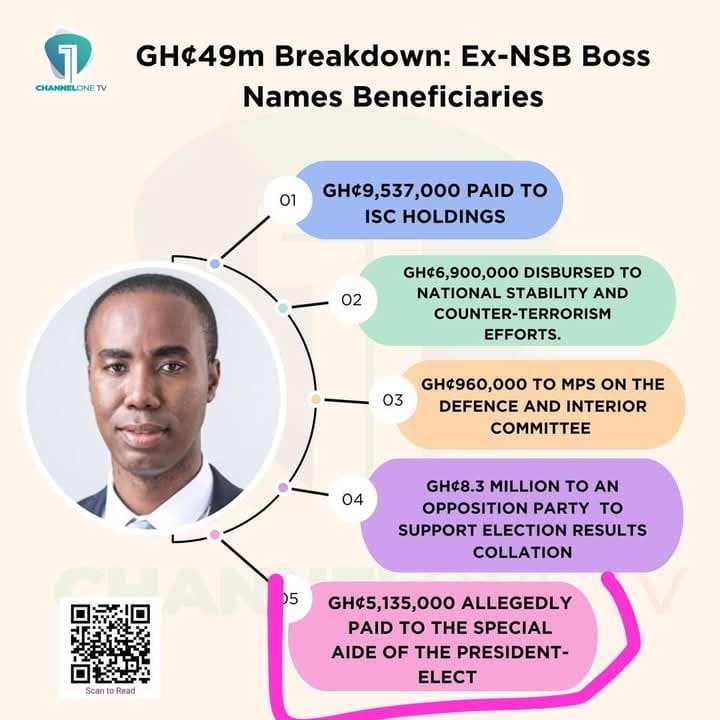
Documents reviewed by sankofaonline.com suggest the misappropriated funds were disbursed as follows:
- GH¢9.5 million – Paid to ISC Holdings, an Israeli security contractor, under circumstances suggesting fraudulence.
- GH¢6.9 million – Allocated ostensibly for national stability and counter-terrorism operations, though lacking proper accountability.
- GH¢960,000 – Disbursed among MPs on the Defence and Interior Committee, raising grave concerns of bribery.
- GH¢8.3 million – Allegedly channelled to an opposition political party to facilitate election results collation.
- GH¢5.1 million – Transferred to a senior aide of the President-elect, suggesting potential complicity at the highest echelons.
According to senior legal analysts, if established, these facts could sustain charges of fraud, misappropriation of public funds, abuse of office, and electoral interference.
The Legal Contest: Prosecution versus Defence
Prosecution’s Theory
The Attorney-General contends that Mr. Adu-Boahene:
- Established a private entity that mimicked the NSB’s structure with the deliberate intention of diverting state resources.
- Dishonestly appropriated public funds by transferring them to his private company under the guise of legitimate transactions.
- Breach of anti-corruption statutes, particularly through improper disbursements to MPs and political operatives.
Defence’s Strategy – Under Scrutiny
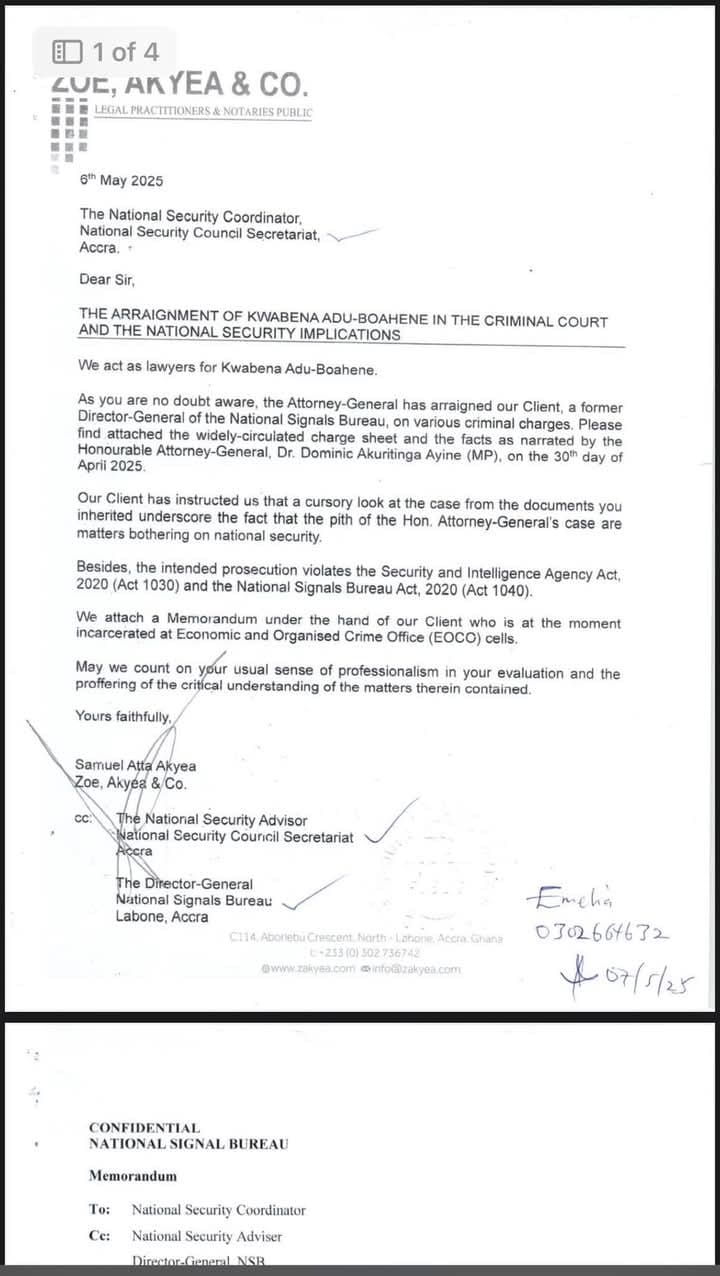
Represented by the firm Zoe, Akyea & Co., Mr. Adu-Boahene’s defence asserts that:
- The charges offend the provisions of the Security and Intelligence Agencies Act, 2020 (Act 1030) and the National Signals Bureau Act, 2020 (Act 1040).
- The matter, touching upon national security interests, should properly be subjected to oversight by the National Security Council.
However, Mr. Edudzi Tamakloe, Director of Legal Affairs for the National Democratic Congress (NDC), has offered a scathing critique of this defence, observing:
“A cursory examination of the charge sheet reveals that the alleged offences occurred between January and March 2020. It is a matter of public record that the Security and Intelligence Agencies Act was assented to in October 2020. Accordingly, the accused’s reliance on an Act that was not in force at the material time is, respectfully, untenable.”

“As counsel, we owe an ethical obligation to guide our clients properly. Defence counsel must refrain from strategies that may compound their client’s legal jeopardy. Criminal defence is an art requiring both dexterity and prudence.”*
Tamakloe further expounded:
“The gravamen of the prosecution’s case is straightforward: that the accused, while serving as Director of the NSB, executed a contract with ISC Holdings in January 2020 and contemporaneously incorporated a private company bearing similarities to the NSB, into which he diverted public funds. The dishonest appropriation forms the substratum of the stealing charges.”*
“If the accused does not comprehend the essence of the charges, he cannot mount an effective defence.”*
Political Ramifications: A Wider Web of Implication
Leaked documents intimate that MPs, a major opposition party, and a senior aide to the President-elect may have been complicit or benefitted improperly from the disbursements. Should the allegations be substantiated:
- Implicated MPs could face prosecution under Ghana’s Criminal Offences Act for corruption and bribery of public officials.
- The opposition party could attract investigations for electoral malpractice and unlawful funding.
- The presidential aide could be embroiled in high-profile corruption proceedings, further entangling the incoming administration.
What Lies Ahead for Adu-Boahene?
Respected practitioners suggest that:
- The defence would be well-advised to abandon the “retroactive legislation” argument, which appears legally unsustainable.
- Plea bargaining may offer a pragmatic route to mitigate a potential custodial sentence that could span up to twenty-five years under existing anti-corruption and criminal statutes.
- Secondary investigations targeting political beneficiaries are imminent and may widen the scope of the scandal.
Conclusion: A Crucible for Ghana’s Anti-Corruption Drive
This matter transcends the fate of one public officer; it represents a critical test of the resilience of Ghana’s legal and anti-corruption framework. Will the courts assert the primacy of the rule of law over political expediency? Will the integrity of prosecutorial processes withstand external pressures?
As the courtroom battles intensify, the citizenry watches keenly, mindful that the fight against impunity demands not only rhetoric but results.
Disclaimer: This article is based on authenticated documentation and legal commentary. All accused persons are presumed innocent until proven guilty by a court of competent jurisdiction.