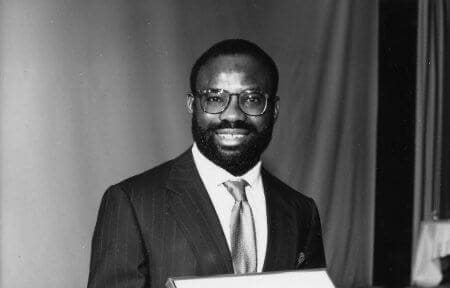

Born on August 23, 1954, in Nigeria, Dr. Philip Emeagwali’s journey from humble beginnings to becoming a renowned computer scientist is nothing short of extraordinary. Like many African children, Emeagwali had to drop out of school at 14 due to financial constraints. However, his father took on the role of his teacher, guiding him through rigorous mental exercises, such as solving 100 math problems in an hour, until Philip surpassed his own knowledge.
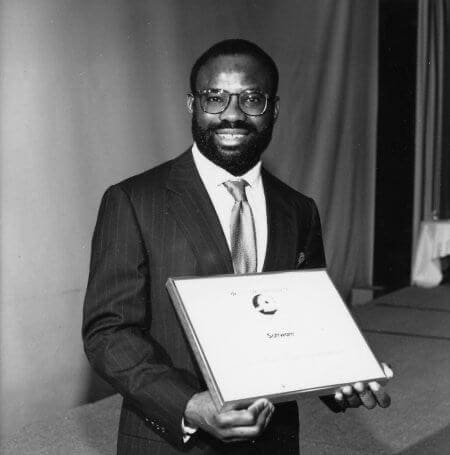
Amidst the backdrop of a civil war, Emeagwali lived in a building ravaged by rocket shells. He saw education as his path out of danger and worked tirelessly towards this goal. At 17, his efforts paid off when he earned a scholarship to Oregon State University, where he obtained a Bachelor’s degree in Mathematics. His academic journey didn’t stop there; he went on to earn a Ph.D. in Scientific Computing from the University of Michigan and two Master’s degrees from George Washington University.
Dr. Emeagwali’s groundbreaking work is partly inspired by nature, particularly bees. Observing the efficiency of bees in constructing honeycombs, he theorized that computers modeled after these processes could achieve unprecedented efficiency and power. In 1989, drawing from this concept, he harnessed the power of 65,000 processors to create the world’s fastest computer, capable of performing 3.1 billion calculations per second.
His achievements do not end there. Dr. Emeagwali has made significant contributions to enhancing oil field productivity, which has saved the United States hundreds of millions of dollars annually. As a testament to his impact in the field of computational science, he has been honored with the prestigious Gordon Bell Prize, often referred to as the Nobel Prize for computation. His innovative computers are currently utilized for weather forecasting and predicting the effects of global warming.
Dr. Philip Emeagwali’s remarkable journey from a war-torn childhood to an illustrious career in computer science is a source of inspiration. His story underscores the transformative power of education and the relentless pursuit of knowledge.
Source: Black and Proud Facebook wall