

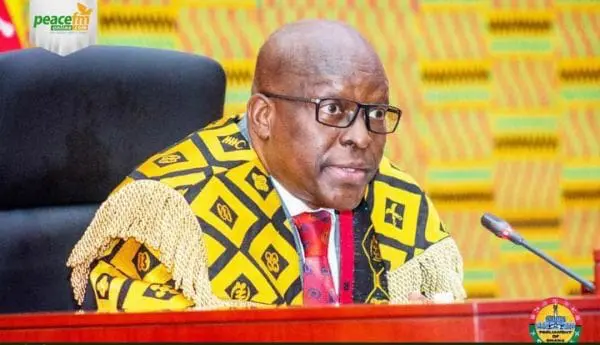

Source: Sankofaonline:com
In a startling turn of events, Ghana’s Parliament has been suspended indefinitely, raising alarming concerns about the country’s democratic stability. The suspension follows the Supreme Court’s unprecedented interference with parliamentary rules, a move that many fear could precipitate a constitutional crisis.
The recent involvement of the Supreme Court in parliamentary matters has sparked a heated debate about the separation of powers and the role of each branch of government. Traditionally, the judiciary interprets the law, while the legislature enacts it. However, the court’s decision to intervene in the Speaker of Parliament’s exercise of his rights under parliamentary rules has blurred these lines, creating a potential clash between the branches of government.
This situation is further complicated by the indefinite suspension of parliamentary proceedings. Without a functioning legislature, the ability of the government to pass laws and carry out its duties is severely hampered. This paralysis could have far-reaching implications for governance and the rule of law in Ghana.
Critics argue that the Supreme Court’s actions are setting a dangerous precedent. By overstepping its boundaries and interfering with parliamentary decisions, the court risks undermining the very foundation of Ghana’s democracy. The separation of powers is a cornerstone of democratic governance, and any encroachment by one branch into the domain of another threatens this delicate balance.
The indefinite suspension of Parliament exacerbates the situation, leaving the country in a state of limbo. Important legislative work is stalled, and the ability of elected representatives to serve their constituents is compromised. This suspension not only disrupts the normal functioning of government but also erodes public trust in democratic institutions.
As Ghana navigates this complex and volatile period, it is crucial for all branches of government to respect their constitutional boundaries. The judiciary must exercise restraint and uphold its role as an impartial arbiter of the law, while the legislature should be allowed to perform its duties without undue interference.
The current situation calls for a measured and thoughtful response to avoid a full-blown constitutional crisis. The government, political leaders, and civil society must engage in constructive dialogue to resolve this impasse and restore confidence in Ghana’s democratic institutions.
In conclusion, the suspension of Parliament and the Supreme Court’s interference in parliamentary matters pose significant challenges to Ghana’s democracy. It is imperative that all stakeholders work together to uphold the principles of separation of powers and ensure that the democratic process is respected. Only through collaboration and adherence to constitutional norms can Ghana navigate this crisis and emerge stronger.
