Sankofaonline.com News Desk – Contributing Professor Anthony Sallar
Ghana is drowning , literally and figuratively. As torrential rains batter Accra once again, homes are submerged, livelihoods destroyed, and families displaced. The perennial flooding that has haunted the capital for decades has returned with a vengeance. Yet, in the middle of this devastation, one question echoes louder than the thunder overhead: Where is the Anti‑Flood Taskforce President Mahama appointed in March 2025? And what exactly have they done in the last 15 months?
Ghanaians deserve answers , not slogans, not excuses, not photo‑ops. Real answers.
Between 2013 and 2024, Ghana received over US$655 million in World Bank financing specifically targeted at flood mitigation, drainage improvement, sanitation expansion, and solid waste management in the Greater Accra Metropolitan Area (GAMA) and the Odaw Basin. These funds were not for conferences, speeches, or political branding. They were meant to deliver concrete, measurable improvements that would prevent exactly the kind of devastation we are witnessing today.
The funding trail is clear. In 2013, Ghana received $150 million for the GAMA Water and Sanitation Project. In 2019, another $200 million arrived for the Greater Accra Resilient and Integrated Development (GARID) Project. In 2020, an additional $125 million was approved to scale up GAMA interventions. In 2023, GARID received another $150 million. And in 2024, a final $30 million was added to cover cost overruns and project delays. In total, more than 9 billion Ghana cedis have been pumped into Accra’s flood and sanitation infrastructure.
What were these funds supposed to achieve? According to the World Bank’s own implementation reports, they were meant to improve flood risk management in the Odaw Basin, expand solid waste management capacity, upgrade drainage systems, dredge the Odaw Channel, and construct detention ponds to reduce peak flood levels. Yet as of late 2024, only 36.3% of GARID funds had been disbursed. Major flood‑control infrastructure remained delayed. Dredging was partial and incomplete. Detention ponds were stuck in bureaucratic limbo. And the World Bank rated progress as “Moderately Satisfactory,” diplomatic language for slow, behind schedule, and underperforming.
Billions spent. Flooding still here. Accra still drowning.
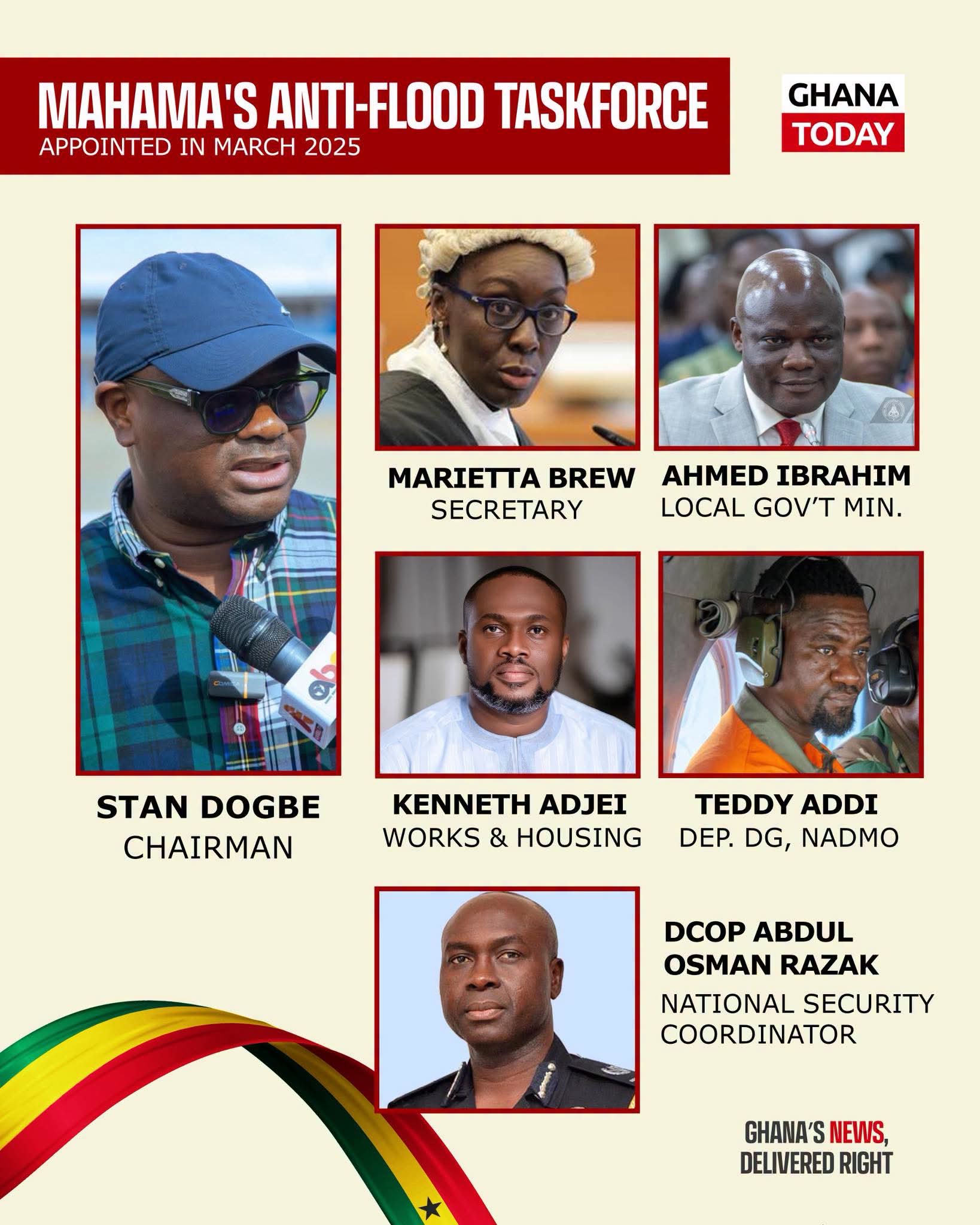
It was against this backdrop that President Mahama announced the Anti‑Flood Taskforce in March 2025. The team included Stan Dogbe as Chairman, Marietta Brew as Secretary, Ahmed Ibrahim at Local Government, Kenneth Adjei at Works and Housing, Teddy Addi from NADMO, and DCOP Abdul Osman Razak from National Security. On paper, it looked like a powerful mix of political appointees, civil servants, and security officials. But 15 months later, the public is asking: Where is the report? Where is the progress? Where is the accountability?
No publicly available record shows how many meetings the taskforce has held, what decisions were taken, what timelines were set, or what deliverables were achieved. This opacity is unacceptable for a national emergency body. Ghanaians also deserve to know how much has been paid in sitting allowances, how much has been spent on logistics, travel, and administrative support, and what the cost‑benefit ratio of this taskforce is. Without transparency, suspicion grows and trust evaporates.
There are also legitimate questions about the suitability of the leadership. The chairman, a Deputy Chief of Staff, already carries enormous administrative responsibilities. Is it prudent to saddle an already overwhelmed official with chairing a national flood‑response body? Flooding is not a PR issue. It is not a communications challenge. It is not a political messaging assignment. It is engineering, hydrology, urban planning, sanitation, waste management, and disaster preparedness. Where are the hydrologists? Where are the drainage engineers? Where are the urban resilience experts?
What tangible results can Ghanaians point to? Odaw dredging remains partial and incomplete. Detention ponds are delayed. Drainage upgrades in Nima, Akweteman, and Agbogbloshie are far from completion. Solid waste management has seen marginal improvements but not enough to stop drains from clogging. And today, as rains pound the capital, Accra is still flooding, homes are still submerged, lives are still disrupted, and businesses are still collapsing. If this is “progress,” then Ghana deserves better definitions.
President Mahama cannot personally dredge the Odaw. He cannot personally inspect every drain. He cannot personally supervise every contractor. That is why he appointed a taskforce. But those appointed must be answerable. They must report to the public. They must justify their existence. They must demonstrate results. Fifteen months is long enough to show direction, if not completion.
Ghanaians demand a full public report. The taskforce must present meetings held, decisions taken, budgets used, allowances paid, contractors engaged, timelines set, milestones achieved, challenges faced, and corrective actions planned. The government must also conduct a technical re‑evaluation of the taskforce’s composition.
Flooding is a scientific problem, and the team must include hydrologists, civil engineers, urban planners, GIS specialists, waste management experts, and climate resilience analysts. A public dashboard should be created to provide monthly updates on dredging progress, drainage construction, waste management metrics, flood‑risk mapping, and community upgrades.
Ghana must shift from political appointments to technical leadership. We cannot solve a hydrological crisis with political operatives.
Accra’s flooding is not an act of God. It is an act of governance , or the failure of it. The World Bank has poured in hundreds of millions. Ghana has created taskforces, committees, and agencies. Yet the rains still turn our capital into a disaster zone. Fifteen months after the Anti‑Flood Taskforce was appointed, Ghanaians deserve more than silence. They deserve answers. They deserve accountability. They deserve results.
And Sankofaonline will continue to ask the questions until those answers come.