

Sankofaonline Editorial June 17,2026
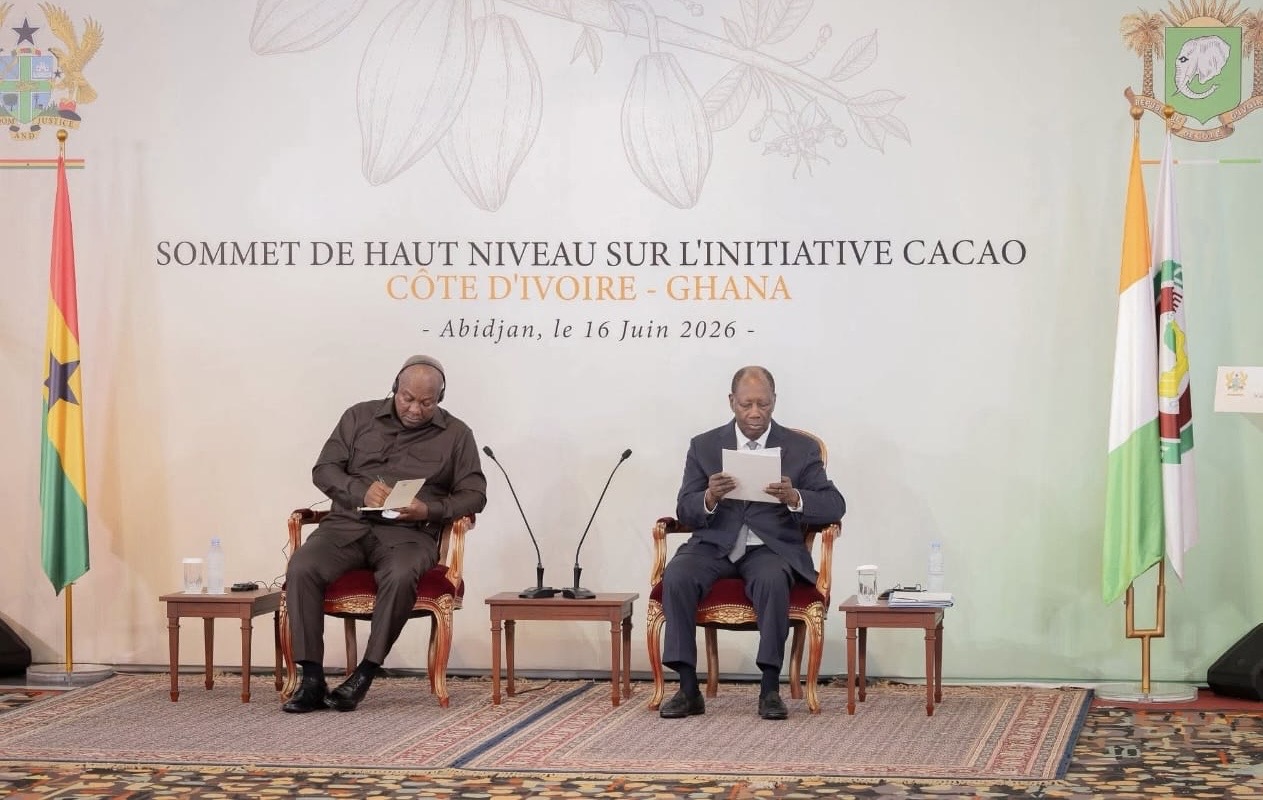
Côte d’Ivoire and Ghana have once again reminded the world that the global cocoa economy cannot function without African farmers , and this time, they’ve put it in writing with a firmness that borders on overdue defiance. Their Joint Declaration, signed in Abidjan on June 16, 2026, is more than diplomatic ceremony; it is a pointed message to an industry that has long profited from African labor while returning only crumbs to the people who grow the beans.

The two presidents, Alassane Ouattara and John Dramani Mahama, did not mince words. They anchored their renewed cooperation in the Abidjan Declaration of 2018 and reminded the world of a simple, inconvenient truth: Côte d’Ivoire and Ghana produce about 60% of the world’s cocoa. That line from the declaration is not a statistic , it is leverage.
A Sector Built on African Labor, Yet Africa Gets Pennies
The declaration bluntly acknowledges what farmers have known for decades: Africa produces nearly 80% of the world’s cocoa but captures only a sliver of the value. The presidents list the usual culprits , price volatility, illegal mining, climate change, cocoa substitutes, and suffocating sustainability regulations , but the underlying message is sharper. The system is structured to keep African producers at the bottom of the value chain.
And the two countries are clearly tired of it.
A Coordinated Pushback
The commitments outlined in the declaration are not mere aspirations; they are strategic pressure points:
- Harmonizing farm‑gate prices — a direct challenge to buyers who exploit price gaps between the two countries.
- Fair and decent remuneration for farmers — a moral stance, yes, but also an economic one.
- Strengthened scientific cooperation — especially on Cocoa Swollen Shoot Virus Disease, which has quietly devastated farms while receiving far less global attention than it deserves.
- Increased local processing — the clearest threat yet to the dominance of foreign chocolate multinationals.
- Expansion of the CIGCI — a move that could transform two‑country coordination into a continental cocoa bloc.
This is not just policy. It is positioning.
A Subtle but Powerful Shift
The tone of the declaration signals a shift from pleading for fairness to asserting it. When the document states that “fair remuneration for farmers is a pillar of the sector’s sustainability and a requirement for economic justice,” it reads less like a plea and more like a warning: the era of cheap cocoa at the expense of African farmers is ending.
The World Should Pay Attention
The Abidjan summit may not have produced fireworks, but it produced something more important , alignment. And when the two countries that feed the world’s chocolate industry align, the rest of the supply chain has no choice but to listen.