
“The greatest threat to a nation is not disagreement, but the moment every institution begins to serve power instead of principle.”
— Barima Nana Ntiamoah
Ghana, once celebrated as the beacon of democracy in Africa, now stands at a dangerous crossroads. The just‑ended elections did not merely produce winners and losers; they exposed something deeper, darker, and more troubling beneath the surface of our democracy.
For years, many Ghanaians placed hope in the neutrality of our national institutions. We believed there were still spaces in our Republic that stood above political influence. We believed there were voices that spoke truth without fear or favor. Today, many of those beliefs are collapsing before our very eyes.
Civil Society Organizations — once regarded as the conscience of the nation — are increasingly viewed through partisan lenses. Some individuals who loudly criticized governments in opposition suddenly become silent when appointed into power. Issues once described as national emergencies are now defended, ignored, or cleverly repackaged. This cycle has deepened public distrust and widened cynicism among ordinary citizens.
The media, expected to serve as the fourth estate of the realm, has become heavily polarized. Many media houses are either directly owned by politicians or indirectly controlled through political and financial influence. News is no longer simply reported; it is curated, shaped, weaponized, and delivered according to partisan interests. Talk shows have become battlegrounds of propaganda rather than platforms for truth and national dialogue. Journalism, once a tool for holding power accountable, now often appears to compete for political loyalty.
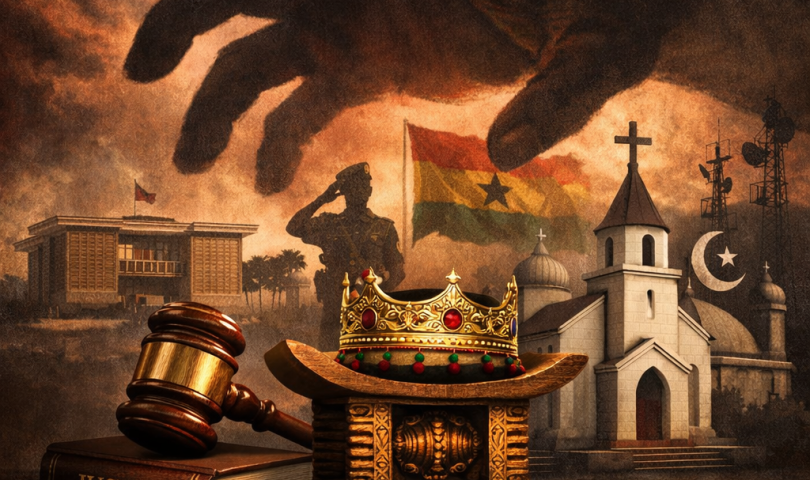
Even the revered chieftaincy institution — one of the oldest symbols of Ghanaian identity and unity — is being dragged into partisan politics. Chiefs who traditionally united communities above political divisions are now openly associated with political camps. Some publicly endorse parties, while others speak in ways that deepen political tensions. When traditional authority loses neutrality, society loses a pillar of moral balance.
The Judiciary, entrusted with protecting justice without fear or favor, has not escaped public scrutiny. Many judicial decisions are increasingly interpreted through political lenses rather than purely legal reasoning. Whether these perceptions are accurate or not, the growing mistrust is dangerous. Justice must not only be done; it must be seen to be done.
State institutions — including the Police Service, Military, Immigration Service, Fire Service, Prison Service, and other public agencies — are frequently accused of aligning themselves with the political interests of the government of the day. Promotions, transfers, investigations, and institutional conduct are often viewed suspiciously through partisan interpretations. When institutions begin to serve governments instead of the Constitution, democracy weakens from within.
Perhaps the most frightening development is the politicization of religion. Ghana remains one of the most religious nations in Africa. The church and mosque have long served as places of refuge, morality, healing, and hope. But today, some pulpits are turning into political platforms. Some so‑called men of God openly campaign for political parties, attack opponents from altars, and use divine language to manipulate political emotions. Congregations are subtly transformed into political audiences. When politics enters the sanctuary, society loses one of its last sacred spaces.
The tragedy is that all this is slowly rewriting the soul of Ghana. Our national history, identity, and values are being reshaped by extreme partisanship. Citizens no longer see each other first as Ghanaians. Political affiliation increasingly determines friendships, opportunities, public perception, and even truth itself. Loyalty to party is replacing loyalty to nation.
Beneath all this lies an even greater danger: the seeds of ethnic tension and social fragmentation. Political narratives are increasingly wrapped around tribal sentiments, regional emotions, and historical grievances — the very language that has destroyed nations before us.
No nation collapses overnight. History teaches that societies decline slowly, quietly, and systematically when institutions lose credibility, when truth becomes partisan, when religion becomes political, and when citizens stop seeing each other as one people.
As Osagyefo Dr. Kwame Nkrumah warned:
“The forces that unite us are intrinsic and greater than the superimposed influences that keep us apart.”
The question before us is not whether Ghana has problems — every nation does. The real question is whether we still possess the courage to place Ghana above party, truth above propaganda, and national unity above political survival.
Because when every institution becomes partisan, the ordinary citizen is left with nowhere to turn. And when citizens lose trust in everything, the foundation of the Republic begins to tremble.
Ghana does not need more noise.
Ghana needs reflection.
Ghana needs patriotism.
Ghana needs courageous neutrality.
Ghana needs citizens who can disagree politically yet protect the nation collectively.
The future of Ghana will not be destroyed by political parties alone. It will be determined by whether the conscience of the nation survives.
“The greatest threat to a nation is not disagreement, but the moment every institution begins to serve power instead of principle.”
— Barima Nana Ntiamoah