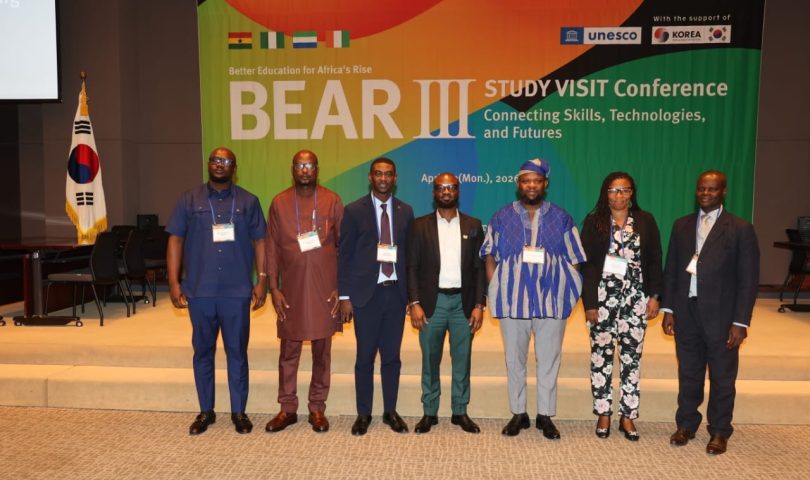

When Ghana’s delegation embarked on the BEAR III Study Visit to South Korea in April 2026, it was more than a routine mission; it was a journey into the heart of a country that has transformed its vocational education system into a powerful engine of national development. Organized under the auspices of UNESCO and KRIVET, the visit brought together delegations from Ghana, Côte d’Ivoire, Nigeria, and Sierra Leone, creating a vibrant platform for exchange and collaboration. For Ghana, the trip was both timely and strategic—an opportunity to observe how Korea integrates policy, research, and industry into a coherent TVET ecosystem, and to reflect on how such lessons could be adapted to Ghana’s own reform agenda.
A Delegation Reflecting Ghana’s Multi‑Stakeholder Approach
The Ghanaian team was carefully composed to represent the full spectrum of stakeholders driving TVET reform at home. Policy leadership came from Mr. Kwame Sewyram Anthony Zu of CTVET, Co‑Chair of the BEAR III Project Advisory Group, and Dr. Peter Boahin, Director of Standards, Curriculum Development and Enforcement, and Chair of the BEAR III Technical Working Group.
Operational expertise was provided by Mr. Jasper Dzidefo Yao Akafo, National Coordinator for Agricultural TVET under GTVETS, while Dr. Christian Sewordor Mensah, Secretary of the Agriculture Sector Skills Body, ensured that industry perspectives were firmly embedded in the dialogue.
Institutional leadership was represented by Mrs. Abigail Yvette Agbeteti, Principal of Adidome Farm Institute, and academic depth came from Prof. Emmanuel Appiah Kubi, Dean of Technical Education at USTED. The delegation was rounded out by Mr. Michael Adjei Boateng, UNESCO’s National Project Officer, who provided coordination and technical support.
Together, this team embodied Ghana’s multi‑stakeholder approach to reform—a blend of policy, academia, and industry.
A Structured Learning Journey
The structure of the study visit unfolded like a narrative in itself. It began with orientation sessions where UNESCO and KRIVET outlined Korea’s human resource development policies and the objectives of BEAR III. These sessions set the stage, introducing delegates to the country’s labor market information systems and the way they inform curriculum design and workforce planning.
From there, the programme moved into institutional visits:
- Chungbuk Regional Skills Council – where Ghana’s team witnessed how regional bodies act as bridges between research and training, conducting workforce surveys, coordinating resources, and ensuring curricula remain relevant to evolving industry needs.
- Jeonju Life Science High School – offering insight into how specialized curricula can produce graduates with deep expertise tailored to industry demands.
Agribusiness, Cooperatives, and Smart Innovation
The narrative then shifted to agribusiness and cooperative innovation:
- At Hansalim Cooperative, delegates saw how education can be embedded within community‑based enterprises that integrate production, processing, and distribution.
- The Goesan Food Support Center reinforced this lesson, demonstrating how local food systems can serve as both economic engines and training grounds.
- The Smart Agriculture Innovation Center added a futuristic dimension, showcasing digital technologies reshaping farming and underscoring the need to embed digital literacy and smart agriculture practices into vocational curricula.
Each visit built upon the last, weaving together a story of policy, practice, and innovation.
Key Outcomes for Ghana
By the time the programme concluded with plenary discussions and reflection sessions, Ghana’s delegation had distilled several key outcomes:
- The urgent need to accelerate development of Ghana’s Labor Market Information System (LMIS) to ensure policy decisions are grounded in reliable data.
- The potential of establishing regional skills councils to coordinate workforce planning at the local level.
- The relevance of cooperative agribusiness models that link training directly to livelihoods.
- The necessity of embedding digital innovation into modern curricula.
- The strengthening of partnerships with UNESCO and KRIVET, and deeper collaboration with fellow African delegations.
These insights reaffirmed that TVET reform is both a national and continental endeavor.
A Roadmap for Transformation
The lessons from Korea were clear:
policy coherence matters, regionalization strengthens relevance, cooperatives drive sustainability, digital innovation is non‑negotiable, and partnerships multiply impact.
For Ghana, the challenge now is to translate these lessons into action. Establishing regional skills councils, embedding cooperative models into agricultural training, integrating digital technologies into curricula, and accelerating LMIS development are all tangible steps toward building a future‑ready workforce.
The study visit was not simply an academic exercise; it was a strategic mission that provided Ghana with a roadmap for transforming its TVET system into a driver of employment, innovation, and sustainable development.
By: Dr. Christian Sewordor Mensah
(Secretary, ASSB)