
Sankofaonline News Desk : April 1,2026

There comes a point in every republic when the line between mere misjudgment and outright contempt for the public must be drawn, boldly, unmistakably, and without fear. Ghana is at that point.
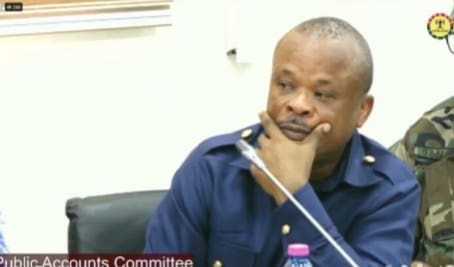
The GHS4.8 million vehicle procurement fiasco at the Ministry of Defence, and the subsequent quiet redeployment of the then Procurement Director , Frank Oliver Kpodo , to the Ministry of Lands and Natural Resources as Director of Finance, is not just another “case” in our long, depressing catalogue of procurement scandals. It is a test of whether this country is serious about accountability, or whether we have finally surrendered to a culture where public office is a risk-free venture for the well-connected.
This is why the call by Hon. Rockson-Nelson Dafeamekpor for the immediate interdiction of the former Procurement Director is not only justified, it is the bare minimum any self-respecting democracy should demand.
The parliamentary revelations we cannot ignore
From the parliamentary hearings, a disturbing picture has emerged.
The Defence and Interior Committee, probing the procurement of vehicles valued at about GHS4.8 million, was confronted with a pattern that has become all too familiar:
- Questionable procurement processes:
Evidence suggested that procurement rules were bent, if not outright broken. Competitive tendering, our primary safeguard against inflated prices and sweetheart deals, appeared to have been treated as optional rather than mandatory. - Inflated costs and poor value for money:
The vehicles in question, by all reasonable market comparisons, did not justify the amounts paid. The committee heard of pricing that raised red flags, yet the process marched on, as though public funds were an inexhaustible resource. - Weak documentation and opaque decision-making:
Key documents were either incomplete, poorly justified, or conveniently unavailable. Approvals that should have been backed by rigorous due diligence appeared to rest on little more than signatures and silence. - A system that protects officials, not the public:
Perhaps most galling was the revelation that the official at the centre of this procurement mess was not sanctioned, not sidelined, not even publicly reprimanded,but rather quietly moved and elevated to a sensitive financial role at another ministry.
In any serious jurisdiction, such findings from a parliamentary inquiry would trigger immediate administrative action. Interdiction would not be a matter of debate; it would be automatic.
Interdiction is not persecution—it is protection
Let us be clear: interdiction is not a conviction. It is not even a presumption of guilt. It is a protective measure, for the integrity of the investigation, for the credibility of the institution, and for the public interest.
When an official who supervised or significantly influenced a tainted procurement process is allowed to remain in a powerful financial position in another ministry, we send a dangerous message:
- That accountability is negotiable.
- That public outrage is manageable.
- That parliamentary findings are mere theatre.
Elsewhere, there would be no need for an MP to publicly demand prosecution at this stage. Prosecution, if warranted, would naturally follow from the findings of a thorough, independent investigation. The sequence is simple: suspend, investigate, establish facts, then prosecute where necessary.
What Dafeamekpor is demanding is not a shortcut to prosecution, but a basic first step,interdiction, so that investigations can proceed without interference, intimidation, or the quiet sanitisation of records.
The insult of redeployment
What has happened instead is an insult to the intelligence of Ghanaians.
A senior official whose actions are under serious scrutiny in a GHS4.8 million procurement scandal at the Defence Ministry is now sitting comfortably as Director of Finance at the Lands Ministry, another sector historically plagued by allegations of corruption, land grabbing, and opaque deals.
This is not just tone-deaf; it is reckless.
You do not move a person under a cloud of procurement suspicion into another role where they control or influence financial decisions, and then ask the public to “trust the process.” That is not governance, that is impunity dressed up as administrative discretion.
If the state cannot even pause such an official while Parliament and relevant investigative bodies complete their work, what confidence should citizens have that the outcome will be anything more than a whitewash?
The deeper rot: when systems protect the powerful
This case is not just about one official. It is about a system that bends over backwards to shield those in the inner circle while lecturing ordinary citizens about patriotism and sacrifice.
- When junior officers misplace petty cash, they are surcharged, queried, and sometimes dismissed.
- When senior officials preside over multi-million cedi procurement scandals, they are “reassigned.”
This double standard is tearing at the moral fabric of the state.
We cannot continue to preach integrity in classrooms, churches, and mosques while normalising impunity in boardrooms and cabinet meetings. Young people are watching. Public servants are watching. The message they are receiving is simple: the higher you climb, the less accountable you become.
Why this case must set a precedent
The GHS4.8 million vehicle procurement scandal must not become just another headline that fades into the background noise of our national frustration. It must set a precedent.
First, for Parliament:
If parliamentary committees can unearth such troubling details and yet the executive arm of government feels no urgency to act, then our checks and balances are a façade. Parliament must insist that its findings carry consequences, not just column inches.
Second, for the civil service:
The public service must understand that promotions and redeployments are not shields against scrutiny. If anything, higher office should come with higher exposure to accountability, not immunity from it.
Third, for the justice system:
No one is asking for a lynch mob. What is being demanded is a credible process. Interdict the official. Conduct a thorough, transparent investigation. If the evidence supports it, prosecute. If it does not, clear his name publicly. That is how justice works in a serious country.
This is not personal—it is about the Republic
Some will try to spin this as a witch-hunt or a political vendetta. That is the oldest trick in the book of impunity.
But this is not about personalities. It is about principles.
- Can a senior official implicated in a major procurement scandal remain in a sensitive financial role while under investigation?
- Do parliamentary findings matter, or are they mere political theatre?
- Is the Ghanaian taxpayer entitled to see real consequences when their money is mishandled?
If we answer these questions honestly, the path forward becomes obvious.
A call to act—before cynicism becomes permanent
Every time a scandal like this is brushed aside, something dies in the national psyche. People stop believing that voting matters. They stop believing that laws matter. They stop believing that truth matters.
We cannot afford that.
The Ministry of Defence, the Ministry of Lands and Natural Resources, the Office of the President, and the relevant oversight bodies must act, not with press statements, but with decisions.
- Interdict the former Procurement Director immediately pending the conclusion of all investigations related to the GHS4.8 million vehicle procurement.
- Launch a full, independent audit of the procurement process, including pricing, supplier selection, and internal approvals.
- Publish a clear, time-bound roadmap for the investigation and any subsequent actions, including potential prosecutions where evidence supports it.
- Review the practice of quietly reassigning officials under suspicion to other sensitive roles. This must end.
Elsewhere, there would be no need for anyone to stand on the floor of Parliament and demand prosecution. Prosecution would be the natural, inevitable consequence of credible findings. That is what a functioning system does, it moves from evidence to action without fear or favour.
Ghana deserves such a system.
Until then, the least we can demand, with one voice and without apology, is this:
Interdict him now.