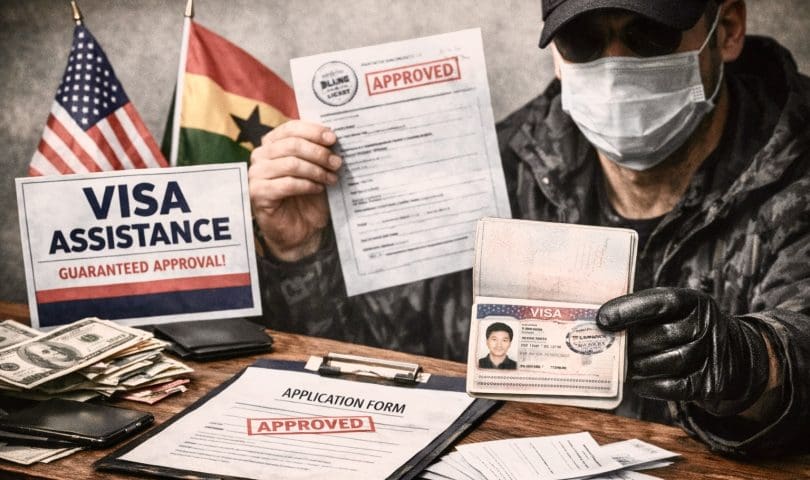

A troubling case from Ho has exposed how an alleged fraudster, identified as a police CID,used the respected name of the Council of Ewe Associations of North America (CEANA) to deceive and financially exploit an unsuspecting single mother. The incident highlights a growing pattern of visa‑related scams and underscores the urgent need for the public to exercise caution, verify information, and avoid relying solely on personal assurances when dealing with travel or visa opportunities.
The victim, who has chosen to remain anonymous, shared her ordeal after months of frustration and financial loss. A hardworking single mother from Battor; she sells thrift clothing in Ho to support herself and her child. She recounted how a former university course mate, Ladzekpo, now a police CID stationed at the Ho Police Headquarters, approached her in 2024 with what appeared to be a legitimate opportunity.
According to her, he informed her about an upcoming CEANA convention in North Carolina and claimed he could facilitate her visa processing for a fee of GH₵ 18,000. Although she could not afford the amount at the time, the idea of participating in a reputable diaspora convention appealed to her.
When she later expressed interest in attending the 2025 CEANA convention , which he claimed would be held in Colorado, Texas, the CID allegedly assured her that she could pay in installments. He directed her to send the money to a mobile money account registered under the name Emmanuel Dumor, whom he falsely described as the CEANA President.
Trusting her former colleague and believing she was dealing with a legitimate CEANA visa acquisition process, she began making payments. By her account, she eventually sent GH₵ 14,000.
Her situation worsened when she lost her father in 2025. Needing funds for the funeral, she requested a refund. It was then she discovered that the mobile money number belonged not to any CEANA official, but to a resident of Ho, Lokoe. The owner of the Momo number admitted that people frequently sent money to that number, after which the CID would come to collect it.
Months of appeals yielded only partial repayment. GH₵ 5,000 remains outstanding, and the alleged fraudster has reportedly avoided further communication.
Her plea, “Please help me get a refund of my money”,is a painful reminder of how easily trust can be exploited.
This case is not only distressing; it is a powerful warning.
A Simple Online Search Could Have Prevented the Scam
One of the most striking aspects of this incident is how easily it could have been avoided. A basic online search for “CEANA President” would have revealed the organization’s legitimate leadership, official website, and verified contact information. CEANA maintains a strong digital presence, and its officers are publicly listed.
No genuine CEANA official receives visa fees through personal mobile money accounts.
No legitimate CEANA process is conducted through private intermediaries.
No CEANA representative asks applicants to send funds to unverified numbers.
This case underscores a critical truth: fraudsters thrive when victims do not verify information.
A Growing Trend of Visa‑Related Fraud
Across Ghana, scammers increasingly exploit the aspirations of citizens seeking travel, conferences, or international exposure. They often invoke the names of respected organizations,CEANA, churches, NGOs or universities to appear credible. Some impersonate officials; others fabricate titles or claim insider access.
What makes this case particularly alarming is the alleged involvement of a law enforcement officer, someone entrusted with protecting the public.
Public Urged to Exercise Extreme Caution
As visa scams become more sophisticated, the public must adopt stronger protective habits:
- Always verify the identity of individuals claiming to represent organizations.
- Check official websites and social media pages for leadership names and contact details.
- Avoid sending money to personal mobile money accounts for institutional processes.
- Seek guidance from trusted community leaders or verified organizational contacts.
- Be wary of individuals who pressure you to pay quickly or secretly.
The victim’s courage in sharing her story may prevent others from falling prey to similar schemes.
A Call for Accountability and Awareness
This case raises broader questions about oversight, public awareness, and the vulnerability of ordinary citizens. How many others have been defrauded in similar ways but remain silent out of fear or embarrassment? How many fraudsters continue to operate by exploiting institutional names and public trust?
Visa fraud is not merely a financial crime, it is a betrayal that destroys confidence, exploits vulnerability, and tarnishes the reputation of legitimate organizations.
Read Also: Gabriel Tanko Kwamigah‑Atokple Declared Wanted
This story should serve as a wake‑up call. A reminder that due diligence is essential, not optional.
And a warning that even those who appear genuine, colleagues, acquaintances, or officials, must be verified before money changes hands.
Sankofaonline